


By Alpha SEO Tools Team | Updated May 2025
You publish a page, submit it to Search Console, and wait. Six months later it sits on page four. Rankings look reasonable. Backlinks look fine. Content is solid. Then someone runs the URL through a website metadata analyzer and finds a title tag at 78 characters, a meta description duplicated from a different page, and a canonical tag pointing nowhere. Three fixable issues. Three months of wasted ranking potential.
That is not an edge case scenario. It is the norm for websites that have never run a proper metadata audit. A good website metadata analyzer surfaces these problems and shows you exactly what fixing them would mean for your organic visibility.
The Numbers That Should Make You Run an Audit Today
| 70% of pages have missing or broken metadata, per Ahrefs | 5.8x higher CTR on pages with optimised meta descriptions |
These figures reflect real crawl data across millions of indexed pages. A website metadata analyzer that catches metadata issues before they cost you click-through rate and ranking position is not optional for any serious SEO operation.
What a Website Metadata Analyzer Actually Checks
Before going into how to use one, here is the full picture of what a thorough website metadata analyzer should evaluate on every URL:
| Metadata Element | Ideal Spec | Common Mistake | SEO Impact |
| Title Tag | 50 to 60 chars, keyword near front | Too long or keyword missing | Critical |
| Meta Description | 150 to 160 chars, clear CTA | Duplicated across pages | High |
| OG Title | Matches title, under 60 chars | Blank, pulls wrong text | Medium |
| OG Description | Under 200 chars, benefit focused | Auto-pulled, often irrelevant | Medium |
| OG Image | 1200x630px, under 1MB | Missing entirely | High |
| Canonical Tag | Self-referencing, every page | Absent or wrong URL target | Critical |
| Robots Meta | Index follow on all live pages | Accidental noindex left in | Critical |
| Twitter Card Tags | Summary or large image defined | Completely absent | Low to Medium |
Several of those impact ratings are Critical. These are not nice-to-have optimisations. A page with an accidental noindex tag is invisible to Google. A canonical pointing to the wrong URL splits authority with a ghost. Every credible website metadata analyzer flags these as the highest priority fixes.
Quick Answers Before We Go Deeper
Does metadata directly affect rankings?
Title tags are a confirmed direct ranking signal. Canonicals control which page Google indexes. Robots meta tags control whether a page is indexed at all. These are hard instructions Google follows, which makes a website metadata analyzer one of the highest return tools in your SEO setup.
How often should I audit?
Every time you publish new content, migrate a site, or a developer pushes a template change. Any of those events can introduce metadata regressions silently. Building a website metadata analyzer run into your post-publish checklist is the professional standard.
Looking For Some Premium And Classy Captions For Your Insta Posts; Well!! We Got You
What Alpha SEO Tools Delivers
The website metadata analyzer at Alpha SEO Tools was built to do the job properly, for free, every time. Here is what that means in practice:
- Instant analysis of title tags, meta descriptions, canonical tags, Open Graph data, and Twitter Card tags for any URL
- Social preview rendering showing exactly how your page appears when shared on LinkedIn, Facebook, and Twitter
- Character limit comparison against SEO standards, clearly flagged so you see what is in spec and what is not
- Zero account creation required at any stage
- Works on staging environments, so metadata mistakes are caught before indexation
The social preview rendering is worth highlighting because most website metadata analyzer tools skip it entirely. Knowing your OG tags are technically present is useful. Actually seeing the card that appears when someone shares your link on LinkedIn, and noticing the thumbnail is cropped or the description cuts off mid-sentence, is what turns an audit into an action.
And because this website metadata analyzer sits inside a full SEO platform, every fix has a corresponding tool right there. No switching services mid-workflow.
The Professional Metadata Audit Sequence
Here is how experienced SEOs use a website metadata analyzer as part of a structured review rather than a one-off check:
- Baseline audit. Run your most important pages. Screenshot what you find. This is your previous state.
- Prioritise by impact. Fix critical issues first: noindex tags on ranking pages, missing canonicals, truncated title tags.
- Fix metadata quality. Rewrite duplicated or generic titles and descriptions with the target keyword in place.
- Audit OG and Twitter tags. These are the most consistently neglected metadata elements and the fastest to fix.
- Re-run and document. Confirm fixes registered. Record the after state for client reports or internal review.
This sequence works whether you are auditing one landing page or thousands. The website metadata analyzer at Alpha SEO Tools handles both without requiring an upgrade.
The Metadata Mistakes That Cost Rankings Every Day
The Duplicate Meta Description Problem
CMS platforms often auto-populate meta descriptions from body content. With the same template across all pages, you end up with dozens of identical descriptions. Google ignores duplicates and writes its own, which is almost never better than what you would write deliberately.
The Orphaned Canonical Tag
A canonical pointing to a URL that returns a 404 is worse than no canonical at all. This is invisible unless you use a website metadata analyzer that validates the destination URL, not just the presence of the tag.
The Missing OG Image
Around 40 percent of shared pages have no OG image defined. The platform shows a blank card or pulls a random image. Both outcomes reduce click-through. A thirty second CMS fix recovers all of that lost engagement.
Tools That Work Alongside the Analyzer
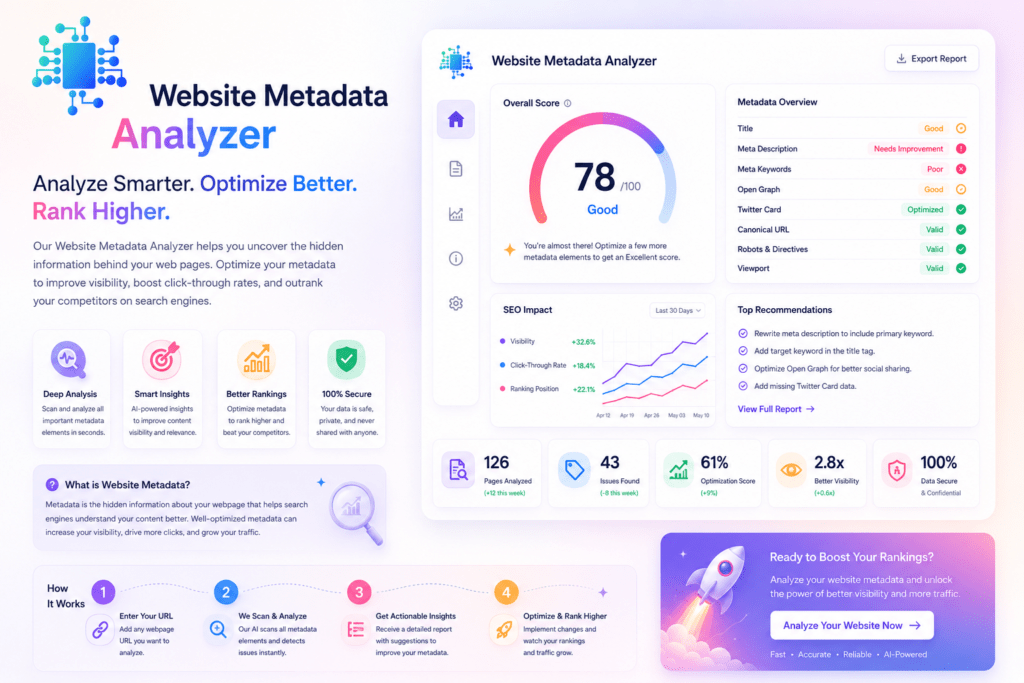
Once the website metadata analyzer has surfaced your issues, these tools handle the fixes:
- Free Google SERP Preview Tool for rewriting title tags and meta descriptions with live character count and Google preview
- SEO Keywords Finder Tool for finding keyword variants that should appear in your metadata but currently do not
- Keyword Density Analyzer for confirming keywords in metadata match their usage in body content
- Domain WHOIS Expiry Tracker for checking domain health alongside your metadata audit
Alpha SEO Tools is designed so every website metadata analyzer finding has a clear next action on the same platform. No step in the audit and fix workflow requires leaving the ecosystem.
External Resources
- Google: Control Your Title Links in Search Results for the official Google guidance on how title tags are interpreted and rewritten
- Open Graph Protocol for the complete technical specification for OG tags across social platforms
- Moz: Meta Description Tag Guide for research-backed guidance on writing meta descriptions that improve click-through rate
Two More Things Worth Knowing
Can I audit staging pages before they go live?
Yes. The website metadata analyzer at Alpha SEO Tools works on any publicly accessible URL including staging environments. Many dev teams run it before every production deployment as a quality gate. Two minutes to catch issues that are embarrassing to fix after indexation.
What if my CMS rewrites metadata automatically?
A website metadata analyzer shows you the actual rendered output, which is often different from what your CMS backend displays. What you see in the admin panel and what Google reads can be two very different things. The tool shows you the truth.
Check Our Captions Sitye For Your Insta Posts: You Will Find Aesthetic And Classy Captions Here
Your Metadata Is Talking to Google Right Now
Every page on your website sends Google signals through its metadata whether you intended those signals or not. A missing canonical is a signal. A duplicate title tag is a signal. A blank OG description is a signal. The question is not whether your metadata is communicating with search engines. It is whether it is saying the right things. A website metadata analyzer tells you the answer in under sixty seconds.
The website metadata analyzer at Alpha SEO Tools is free, instant, and requires nothing except a URL. Run your most important page right now. Most teams are surprised by what they find. The fix is usually faster than the discovery.
Head to alphaseotools.com and run your first audit with the website metadata analyzer today. No sign up. No subscription. Just answers.
Published by Alpha SEO Tools | alphaseotools.com | Free tools, zero sign up, always.