


The Complete Guide for Content Creators
By Alpha SEO Tools | Admin Alpha SEO Tools
You spend hours writing. You research, structure, rewrite, and polish. Then you hit publish — and the bounce rate climbs. Readers leave before they finish. Comments are thin. Shares are quiet. The problem is almost never the writing quality. Most of the time it comes down to one thing: content length mismatched to audience and platform.
The Reading Time & Engagement Estimator tool on Alpha SEO Tools was built to close that gap. Before you publish anything, you can see exactly how many minutes it takes a slow reader, an average reader, and a fast reader to get through your content. That single number changes how you write, how you format, and which platform you choose to publish on.
This guide covers how reading time works, what the data says about engagement across Google, Instagram, X, LinkedIn, and other platforms, and how to use the Reading Time & Engagement Estimator tool to make smarter content decisions every time you write.
What Is the Reading Time & Engagement Estimator Tool
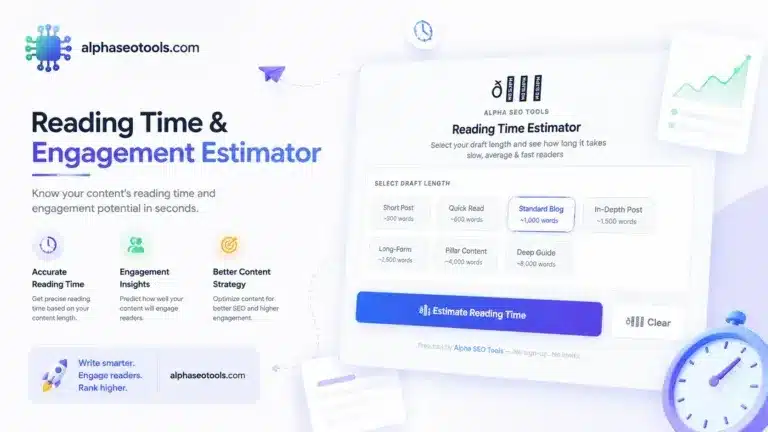
The Reading Time & Engagement Estimator tool is a free, browser-based utility that calculates estimated reading time for any piece of content based on draft word count. It uses the three most widely cited reading speed benchmarks in academic and UX research:
- Slow reader: 143 words per minute (lower cognitive bandwidth, high-friction topics)
- Average reader: 238 words per minute (the standard adult silent reading speed per Trauzettel-Klosinski and Dietz, 2012)
- Fast reader: 369 words per minute (active skimming, familiar topics, good visual formatting)
The tool does not ask you to paste your full article. You select a draft length from seven preset options, click estimate, and instantly see reading time for all three reader types alongside estimated sentence count, paragraph count, character count, and a content-specific engagement recommendation.
It is available free at Alpha SEO Tools with no account, no login, and no usage limits.
Why Reading Time Matters More Than Word Count
Word count is a proxy. Reading time is the reality. When Google, content teams, and social platforms measure user engagement, the metric that actually moves ranking signals and algorithmic distribution is dwell time — how long a user spends on a page or piece of content before navigating away.
Google Search Console surfaces average engagement time as a quality signal for Discover and organic search. A 1,500-word article that takes six minutes to read and retains readers for five of those minutes sends a stronger behavioral signal than a 3,000-word article that most readers abandon after two.
The Reading Time & Engagement Estimator tool gives you the reading time upfront so you can calibrate content length to realistic reader behavior before you publish, not after you check analytics and wonder what went wrong.
Reading Time Benchmarks by Content Format
The table below maps common content formats to word count, estimated average reading time, best-fit publishing platform, and SEO potential. All reading times are calculated at 238 wpm (standard adult silent reading speed).
| Content Format | Word Count | Avg Read Time | Best Platform | SEO Potential |
| Short Post | 300 words | 1 min 15 sec | X (Twitter), Instagram | Low |
| Quick Read | 600 words | 2 min 31 sec | Facebook, LinkedIn | Moderate |
| Standard Blog | 1,000 words | 4 min 12 sec | Google, Medium | Good |
| In-Depth Post | 1,500 words | 6 min 18 sec | Google, Email newsletters | Strong |
| Long-Form | 2,500 words | 10 min 30 sec | Google, LinkedIn Articles | Very Strong |
| Pillar Content | 4,000 words | 16 min 48 sec | Google, SlideShare, Reddit | Excellent |
| Deep Guide | 8,000 words | 33 min 36 sec | Google, Niche communities | Dominant |
Use the Reading Time & Engagement Estimator tool to run these numbers for your specific draft length and see how slow, average, and fast readers experience your content differently.
Platform by Platform: What Reading Time Data Tells You
Google Search and Organic Content
Backlinko’s analysis of 1 million Google search results found that the average word count of a first-page result is approximately 1,447 words. At 238 wpm, that is a six-minute read for an average reader. HubSpot’s internal data shows that content between 2,100 and 2,400 words generates the most organic traffic, while content averaging 2,569 words generates the most leads.
For competitive informational keywords, Google rewards content that comprehensively addresses search intent. A Reading Time & Engagement Estimator tool check before publishing helps you confirm your content hits the depth threshold that correlates with first-page performance — without going so long that the majority of readers bounce before finishing.
LinkedIn is the highest-engagement organic platform in 2025 and 2026 by a significant margin. Buffer’s analysis of over 52 million posts placed LinkedIn median engagement at approximately 6.1 percent per post. LinkedIn carousel posts specifically recorded a 21.77 percent median engagement rate, which is roughly three times LinkedIn video performance.
LinkedIn native articles perform best between 1,500 and 2,000 words, a reading time of six to eight minutes. Long-form posts in the feed (those above 700 words) consistently outperform short posts in reach when they include strong hooks and clear subheadings. Before drafting a LinkedIn article, run your target word count through the Reading Time & Engagement Estimator tool to confirm the length matches what a professional audience will actually complete during a lunch break or commute.
Instagram is a visual-first platform, but caption length still drives meaningful engagement differences. Captions between 138 and 150 characters perform well for reach. Longer captions between 400 and 500 words (used on carousel educational posts) show higher save rates and share rates, which Instagram’s algorithm weights heavily in 2025 and 2026 distribution. Adobe’s 2025 benchmark report puts Instagram engagement between 0.45 and 0.6 percent per post for most accounts.
Reading time on Instagram is functionally a caption-level concern. The Reading Time & Engagement Estimator tool is most relevant for Instagram when used to evaluate long-form blog content that you plan to repurpose into carousel slides, where the total written content informs how many slides your carousel needs.
X (Twitter)
X operates on the shortest reading time threshold of any major text platform. Posts under 280 characters dominate feed engagement, which after X’s post-character-limit expansion moved toward threads. Buffer’s 2026 state of social engagement report places X median engagement at approximately 2.5 percent, recovered from its 2024 low but still well below LinkedIn and Threads.
Long-form content on X exists as threads, where each tweet functions as a micro-paragraph. A 1,000-word thread (roughly 15 to 20 tweets at 250 to 300 characters each) performs well when the first tweet hooks and the remaining tweets deliver on that hook without padding. Use the Reading Time & Engagement Estimator tool on the estimated thread word count to confirm the depth is appropriate for the topic before you draft.
Google Discover and AI Overviews
Google Discover prioritizes content with strong behavioral signals, clear E-E-A-T (Experience, Expertise, Authoritativeness, Trustworthiness) signals, and titles that create genuine curiosity without being misleading. Ideal Discover content runs between 900 and 1,800 words, a reading time of approximately four to eight minutes for average readers.
Google’s AI Overviews in search results increasingly pull from structured, clearly written content that answers specific questions directly. Content that uses subheadings, bullet points, and numbered steps is cited more frequently in AI Overviews than dense paragraph-only content of the same length. The Reading Time & Engagement Estimator tool helps you ensure your content is long enough to demonstrate depth without being so dense that skimmability suffers.
How to Use the Reading Time & Engagement Estimator Tool Step by Step
- Open the tool at alphaseotools.com. No account creation, no pop-up forms.
- Select your draft length from the seven preset options: Short Post (300 words), Quick Read (600 words), Standard Blog (1,000 words), In-Depth Post (1,500 words), Long-Form (2,500 words), Pillar Content (4,000 words), or Deep Guide (8,000 words).
- Click Estimate Reading Time. Results appear instantly without a page reload.
- Review your three reading time estimates: slow reader, average reader, and fast reader.
- Check the content stats block: estimated sentences, paragraphs, and character count for structural awareness.
- Read the engagement recommendation. The Reading Time & Engagement Estimator tool provides a data-backed recommendation specific to your content length, covering bounce risk, shareability, and SEO positioning.
Adjust your target word count if the reading time does not fit your platform, audience, or publication goal, then re-run the estimate.
Reading Time and SEO: What the Research Actually Shows
Three consistent findings appear across Backlinko, HubSpot, BuzzSumo, and OrbitMedia research:
- Content above 3,000 words earns 77.2 percent more backlinks on average than content under 1,000 words (Backlinko and BuzzSumo analysis of 912 million blog posts)
- HubSpot blog content between 2,100 and 2,400 words generates the highest organic traffic volume among all length categories they tested
- Content with more than 7,000 words earns more than three times the average number of social shares compared to short-form content (MarketingCharts)
- The average engagement time of readers on well-structured blog content is approximately six minutes, equating to roughly 1,200 words consumed (Microsoft Clarity data via Stan Ventures)
These findings do not mean longer is always better. They mean that depth matched to search intent outperforms thin content. A 500-word answer to a simple query beats a bloated 3,000-word page that paddles around the same point. The Reading Time & Engagement Estimator tool helps you determine whether your planned word count reflects genuine depth or unnecessary padding.
Engagement Signals the Tool Predicts
Based on published research benchmarks and content performance data, the Reading Time & Engagement Estimator tool provides directional predictions on four engagement dimensions:
- Bounce risk: Content under two minutes of reading time carries the highest bounce risk because it often fails to satisfy the full depth of a search query. Content in the seven to twelve minute range shows the lowest documented bounce risk in long-form content studies.
- Scroll depth: Readers complete more of a shorter piece but invest more behavioral signal value in a longer piece they choose to complete. The tool calibrates scroll depth prediction to the known relationship between word count and average page completion rates.
- Social share potential: Content between 1,000 and 2,000 words shows the highest social share rates per BuzzSumo analysis. Very short content and very long content both underperform the mid-range for shares.
- SEO potential: The tool’s SEO potential score reflects the relationship between word count, topic coverage depth, and internal linking opportunity based on patterns from Backlinko and Semrush long-form content research.
Related Free Tools on Alpha SEO Tools
The Reading Time & Engagement Estimator tool fits into a broader content workflow. These tools at Alpha SEO Tools work alongside it:
- Keyword Density Analyzer to check that your focus keyword appears at the right frequency within your word count
- Free Word Counter to get an exact word count from your draft before running an estimate
- Free Google SERP Preview Tool to confirm your title and meta description display correctly after optimizing for the estimated content length
- SEO ROI Calculator to measure whether the time invested in long-form content is generating proportional organic revenue
- SEO Metadata Tracker Tool to audit titles and meta descriptions for click-through rate optimization on published content
- Text Transformation Tools to quickly format and restructure content once you know the reading time target
Frequently Asked Questions (FAQ’s)
What reading speed does the Reading Time & Engagement Estimator tool use?
The Reading Time & Engagement Estimator tool uses three scientifically documented reading speeds: 143 wpm for slow readers, 238 wpm for average readers (the standard adult silent reading speed from Trauzettel-Klosinski and Dietz, 2012), and 369 wpm for fast readers. These cover the realistic range of your actual audience rather than a single average that misrepresents how diverse reader behavior actually is.
Does reading time directly affect Google rankings?
Reading time is not a direct Google ranking factor, but it influences several signals that are. Dwell time (how long a user stays on a page after clicking from search results), scroll depth, and return visit rate are all behavioral signals that Google’s systems use to evaluate content quality. Content that is too short to satisfy search intent generates high bounce rates and low dwell time. The Reading Time & Engagement Estimator tool helps you plan content length that matches what users realistically read, which keeps those behavioral signals healthy.
How is reading time different from time on page in Google Analytics?
Reading time is a pre-publication estimate of how long a piece takes to consume. Time on page in Google Analytics 4 is a post-publication measurement of how long visitors actually spent on a page. Estimated reading time gives you a target and a benchmark. Actual time on page tells you whether readers hit that benchmark. If your average engagement time is significantly lower than the tool’s estimated reading time, it usually signals a structural issue: the hook is weak, formatting is poor, or the content does not match what the title promised.
Which content length generates the most social shares?
BuzzSumo’s analysis of 912 million articles found that long-form content above 3,000 words earns the most backlinks, while content between 1,000 and 2,000 words generates the highest share rates on most social platforms. For X, short and punchy content under 500 words wins for immediate shares. For LinkedIn, content between 1,500 and 2,000 words performs best for organic reach and saves. Use the Reading Time & Engagement Estimator tool to find the reading time range that fits your distribution platform before you commit to a draft length.
Stop Publishing Blind: Use the Reading Time & Engagement Estimator Tool
Every piece of content you publish is a bet. You are betting that readers will stay long enough to absorb the value you put in. The Reading Time & Engagement Estimator tool gives you the data to make that bet informed. You know the reading time before you finalize the draft. You know which platform that reading time suits. You know whether the length signals enough depth for Google to consider it a quality result.
It takes ten seconds to use. The clarity it gives you lasts through the entire content creation process.
Try the Reading Time & Engagement Estimator tool at Alpha SEO Tools — free, no sign-up, no word limits.
Published by Alpha SEO Tools | alphaseotools.com | Free tools. No sign-up. No limits.


