
Published on AlphaSEOTools.com | Admin Alpha SEO Tools
Publishing duplicate content is one of those SEO problems that tends to compound quietly. You might not see an immediate penalty, but over time the signal accumulates, confusing search engines about which version of your content to rank, splitting authority between pages that should be consolidated, and in some cases telling Google that your site is not producing genuinely original work. A duplicate content checker gives you the answer to the most pressing pre-publish question: how similar is this text to something that already exists?
This article explains what duplicate content actually is at a technical level, what types of duplication carry real SEO risk versus which ones Google largely ignores, and how Alpha SEO Tools built a free text comparison tool that surfaces similarity issues in seconds, right in the browser, with no data ever sent to a server.
What Duplicate Content Actually Means in SEO
The term gets used loosely, but it has a specific technical meaning. Duplicate content refers to substantial blocks of text that appear at multiple URLs, either on the same site or across different sites, without a clear signal to search engines about which version is canonical. According to Google Search Central’s documentation on duplicate content, the core problem is that when identical or near-identical content exists at multiple locations, search engines have to make a judgment call about which version to show in results, and they may not choose the one you intend.
The consequences come in two forms. The first is diluted ranking signals. Backlinks, engagement data, and indexing equity that should be concentrated on one strong page get spread across two or more weaker ones. The second is potential filtering from results, where Google simply picks one version to show and suppresses the rest, meaning you get none of the traffic even though the content is technically indexed.
Neither of these outcomes is inevitable, and not every form of text similarity is treated the same way. Using a duplicate content checker before publishing lets you identify where your content overlaps with existing material so you can make an informed decision about what to rewrite, consolidate, or leave as is.
Not All Duplication Carries the Same Risk
One of the most common mistakes content teams make is treating all text similarity as equally damaging. It is not. The SEO risk varies significantly depending on the type of duplication, the volume of overlapping text, and whether proper technical signals are in place.
| Duplication Type | What It Looks Like | SEO Risk | Recommended Action |
| Accidental self-duplication | Two pages on same site covering identical topic | Moderate | Merge or canonicalise the weaker page |
| Scraped or copied content | Your content republished word-for-word elsewhere | High | DMCA takedown or canonical request |
| Syndicated content | Intentional republishing with rel=canonical set | Low | Ensure canonical points back to original |
| Boilerplate duplication | Repeated footer, disclaimer, or template text | Low | Google typically ignores short repeated blocks |
| Spun or paraphrased content | Lightly reworded copy of an original source | High | Rewrite from scratch with original insight |
The table makes the distinction clear. Scraped content and spun rewrites are the situations where a duplicate content problem genuinely damages your rankings. Boilerplate text, syndicated content with proper canonicalisation, and minor phrasing overlap between pages covering related topics are not the same category of problem and do not require the same level of intervention.
How the Text Comparison Actually Works
Alpha’s duplicate content checker uses a technique called shingling combined with Jaccard similarity to measure how much two texts overlap. This is a real text comparison method used in academic plagiarism detection and large-scale near-duplicate detection systems, not a basic word-count comparison.
What Shingling Does
Shingling breaks each text into overlapping sequences of words called shingles, each six words long. So the sentence ‘this is a free content comparison tool’ produces shingles like ‘this is a free content comparison’ and ‘is a free content comparison tool’ and so on across the full text. Every unique shingle from both texts goes into a set, and the tool calculates what percentage of shingles appear in both sets versus the total combined set.
What the Similarity Score Means
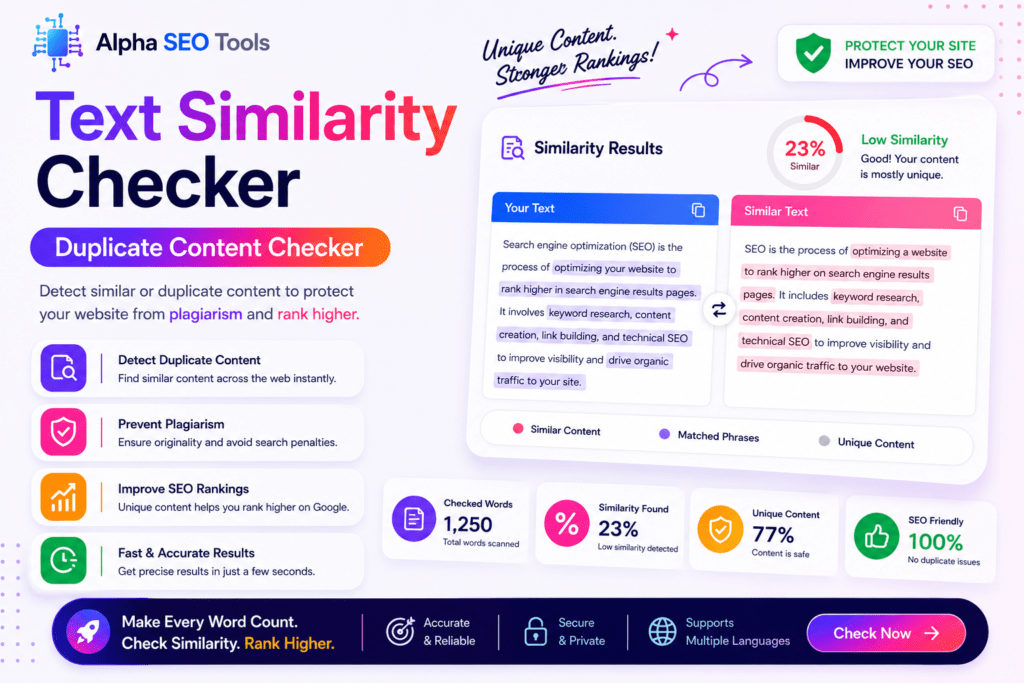
The result is a Jaccard similarity percentage. A score below 15 percent means the texts have minimal shared phrasing and your content can be considered original relative to the comparison text. A score between 15 and 40 percent flags moderate overlap worth reviewing. A score above 40 percent indicates significant duplication that would likely be detectable by search engines. The tool highlights exactly which sentences in each text are contributing to the overlap, so you can see not just a number but precisely where the similarity is coming from.
This approach is significantly more sophisticated than simple word frequency comparison because it detects phrase-level matches rather than just vocabulary overlap. Two texts that use the same common words but in completely different sentence structures will score low. Two texts that share specific multi-word phrases will score high, which is the accurate signal of real content duplication. It is the same underlying logic that enterprise-grade duplicate content checker systems use, available here for free.
What Alpha SEO Tools Built Into This Tool
| WHAT YOU GET WITH THE DUPLICATE CONTENT CHECKER |
| Side-by-side input panels for Text A (your content) and Text B (comparison source) |
| Live word count for both texts updated as you type |
| Jaccard shingle-based similarity score displayed as a clear percentage |
| Colour-coded progress bar showing overlap level at a glance |
| Verdict label: low overlap, moderate overlap, or high overlap with colour coding |
| Sentence-level highlighting in both panels showing exactly which parts match |
| Matched sentence count and word counts for both texts in the stats row |
| Runs entirely client-side, meaning your text never leaves your browser |
The client-side processing is worth emphasising specifically. When you paste content into a duplicate content checker that sends data to a server, you are sharing potentially unpublished, proprietary text with a third-party system. Alpha’s tool runs the entire comparison in your browser using JavaScript. Nothing is transmitted, logged, or stored anywhere. For content teams working under NDA or handling sensitive drafts before publication, this is a meaningful distinction.
Where This Tool Fits in a Real Content Workflow
Before Publishing Any Article
The most obvious use case is the pre-publish check. Before any piece of content goes live, paste it alongside the top-ranking page for your target keyword and run the comparison. If the similarity score is high, it tells you that your content is too close to what already ranks to offer search engines a compelling reason to prefer your version. This is not just a plagiarism concern. It is a differentiation concern. The duplicate content checker makes this check take about ninety seconds instead of reading through both texts manually.
Checking Freelancer or Agency Deliverables
If you commission content from writers or agencies, running the delivered draft through a text comparison against the brief, against existing site content, and against a major competitor page is a standard quality gate. A high similarity score against your own existing content flags a potential self-duplication problem before it goes live. A high score against a competitor page flags a writer who lifted phrasing instead of producing original work.
Auditing Existing Content for Cannibalisation
Content cannibalisation happens when two pages on the same site compete for the same keyword with sufficiently similar content that search engines cannot clearly differentiate them. Running pairs of existing pages through a duplicate content checker helps identify which pairs have enough overlap to warrant a merge, redirect, or consolidation decision. This is one of the most underused applications of text comparison tools and one of the highest-impact technical SEO audits you can run on an established site.
Three Things to Do When the Score Comes Back High
A high similarity score is a signal, not a verdict. Here is what to actually do with it:
- Identify the specific sentences flagged in the highlighted view, then rewrite only those sections with original analysis, examples, or framing. Rewriting around the matching phrases rather than replacing unrelated sections is more efficient and preserves the parts of your draft that are already original.
- Check whether the overlap is in boilerplate areas, such as introductory definitions or standard procedural descriptions, versus in the core argument of your content. Shared definitions of common terms are low risk. Shared conclusions, recommendations, or unique examples are high risk.
- If the comparison text is your own existing content, consider consolidating rather than rewriting. Two pages with 40 percent or more similarity on the same topic are often better served by merging into one stronger, more comprehensive page with a 301 redirect from the weaker URL.
What People Ask About Duplicate Content (FAQ)
Does duplicate content cause a Google penalty?
Not automatically, and not in the sense of a manual action. According to Google’s documentation, duplicate content rarely results in a manual penalty unless the intent is clearly to manipulate search results. The more common consequence is that Google filters one version from results or consolidates signals in a way that does not favour your preferred URL. Using a duplicate content checker before publishing prevents this from happening rather than requiring you to fix it afterward.
Is this the same as a plagiarism checker?
Functionally similar but contextually different. A plagiarism checker typically scans your text against a large index of web pages or academic documents to find matches across the internet. This duplicate content checker compares two specific texts you provide directly, which makes it faster, more precise, and private since nothing leaves your browser. The right tool to use depends on the question you are asking: ‘does this appear somewhere online’ requires an internet-wide scan, while ‘how similar are these two specific texts’ is exactly what this tool is built for.
How much similarity is too much?
There is no universal threshold defined by Google, but the tool’s built-in verdict levels give you a practical working guide. Below 15 percent is generally safe for original content. Between 15 and 40 percent warrants a review of the flagged sentences to decide which ones need rewriting. Above 40 percent means a substantial portion of the text is shared and the content needs meaningful differentiation before it is ready to publish. These are judgment calls, not hard rules, and context always matters.
What if I want to check against a live web page?
Copy the text content of the page you want to compare against and paste it into Text B. Most browsers let you select all visible text on a page with Ctrl+A and copy it, which you can then paste and trim to the relevant sections. This is more precise than an automated web scan because you are comparing exactly the content you care about rather than relying on a crawler to identify the right sections. Pair this tool with Alpha’s live HTML viewer to inspect the raw markup of a competitor page alongside the rendered text comparison.
Other Alpha Tools That Belong in the Same Workflow
If you are using a duplicate content checker as part of your content publishing process, several other Alpha utilities connect naturally at different stages. The keyword density analyzer checks that your primary keyword appears at the right frequency without over-optimisation. The Google SERP preview tool shows how your title and meta description appear in search results before you publish. The URL slug generator ensures every new page goes live with a clean, keyword-optimised URL. And the SEO metadata tracker gives you a full view of how any published page presents across search and social in one audit. Each tool in the chain handles a different pre-publish checkpoint, and all of them are free.
Originality Is Not Optional Anymore
Content that reads like everything else on the internet does not rank like it is different from everything else on the internet. That is not an algorithm quirk. It is the logic of how search engines decide what is worth surfacing. A duplicate content checker is how you verify, before anything goes live, that your content genuinely earns its place in results rather than competing with its own source material or sitting too close to what already ranks.
Alpha SEO Tools built this tool to run entirely in your browser, with no server, no account, and no data leaving your machine. Paste your content, paste the comparison text, and get a scored, highlighted result in seconds. It is the fastest step in a content quality workflow and the one most people skip until a ranking problem forces them to look back.
Publish something that is actually yours. The score will show you whether it is.
Where the Technical Standards Come From
The duplicate content guidance referenced in this article is drawn from two sources. Google Search Central’s documentation on duplicate content describes how Google identifies, handles, and filters duplicate pages and what site owners can do to provide clear canonical signals. The Jaccard similarity and shingling technique used in the tool itself is a standard method in information retrieval, documented extensively in academic literature on near-duplicate detection and widely used in content fingerprinting systems across the industry.
alphaseotools.com | Article: Duplicate Content Checker | Sources: Google Search Central, W3C, Academic IR Literature