


Table of Contents
The Internet of Things is used in the field of agriculture. It helps collect, transmit, and analyze data. It helps monitor soil conditions, crop health, and weather patterns. It also helps monitor irrigation systems, livestock, and farm equipment. It is used in smart irrigation, which uses soil moisture sensors and weather forecasts to determine watering schedules. This helps conserve water. It also helps ensure that crops receive the right amount of hydration. Further, IoT in Agriculture also helps with livestock monitoring. Animals are attached with sensors on some part of the body. These sensors help track vital signs. This allows farmers to detect early signs of illness.
IoT also plays an important role in enhancing supply chain efficiency. Farmers can monitor storage and transport conditions of crops through sensors. This helps ensure food safety. In addition, it helps provide real-time data which can help forecast yields.
Innovations driving connected agriculture
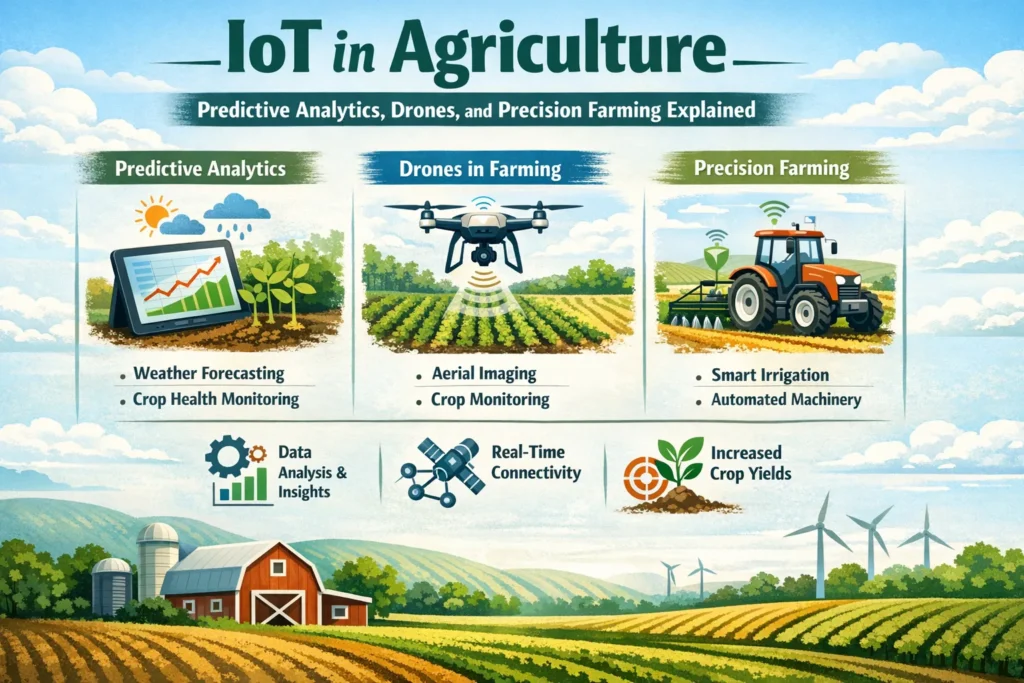
Usage of AI-powered predictive analytics that can help forecast weather, detect pest infestations, and optimize planting schedules is the latest trend in the IoT in agriculture sector. IoT sensors help provide real-time insights into large-scale farms through drones. Further, usage of IoT to minimize water usage also fosters the growth of the sector.
Impact of AI
Artificial intelligence helps analyze data collected by IoT sensors. Moreover, it helps optimize resource allocation. It determines the amount of water required for each crop as well. It helps analyze soil nutrient data to recommend fertilization. This helps reduce cost and improve crop yield.
In livestock management, artificial intelligence helps monitor animal behavior in real time. It helps detect anomalies. Thus, early detection allows timely intervention. This helps reduce mortality rates and increase productivity.
Understanding the growth factors of IoT in farming
There is an increase in need for enhanced efficiency and productivity. Also, IoT in agriculture helps provide real-time data on soil health and crop growth. This helps farmers make decisions to improve yields and reduce wastage. This fuels the growth of the sector. There is a rise in need for sustainable farming practices. IoT solutions allow farmers to use resources efficiently. This helps reduce environmental impact and maintain soil fertility for a longer duration. This boosts the growth of the sector.
However, high cost associated with IoT infrastructure limits the growth of the sector. Also, lack of technical expertise is another concern that deters the growth of the market. In addition, connectivity issues in remote or rural regions further hinder the deployment of IoT devices. This reduces their efficiency and reliability. This deters the growth of the IoT in agriculture sector. Despite these restraints, the integration of IoT with artificial intelligence presents a significant growth opportunity to the sector. Farmers can use AI insights to forecast weather and optimize crop cycles. This helps increase productivity as well as reduce loss. Further, government initiatives make way for growth opportunities for the IoT in agriculture sector.
Technology-enabled practices for modern agriculture
Smart irrigation is one of the major applications of IoT in agriculture. This approach ensures that crops receive adequate hydration. Usage of IoT in agriculture also helps decrease the overall cost. Farmers can monitor crop health and nutrient levels using GPS-enabled sensors and drones. This data helps plan for harvesting schedules for the farmers. IoT also helps with automation in machinery. Farmers can use tractors and harvesters equipped with sensors. This helps reduce human intervention in the field of agriculture.
IoT in agriculture is also used to monitor the health of livestock. Animals are provided with wearable sensors which helps detect early signs of disease.
Regional trends and opportunities in connected farming
North America holds the major share of the IoT in agriculture sector. This is attributed to surge in investments in precision farming and advancements in sensor technologies. The region focuses to invest in research and development which further fuels the growth of the sector. Also, government initiatives supporting sustainable farming promotes IoT adoption in the field of agriculture in North America. Europe witnesses growth due to adoption of IoT to meet stringent environmental regulations. Government policies and subsidies for sustainable farming practices and increase in awareness among farmers, accelerate the integration of IoT solutions across the region. h
e Asia-Pacific region is expected to experience growth. This is due to presence of large agricultural base, surge in population, and rise in food demand. In addition, adoption of smart irrigation, drone monitoring, and greenhouse automation also drive the Asia-Pacific IoT in agriculture sector. The LAMEA region is anticipated to witness growth at a moderate rate. Brazil and Argentina focus on precision farming and livestock monitoring to increase productivity. Countries in Africa focus on adopting IoT solutions that are available at lesser cost. This helps improve water management and crop yields. These factors drive the growth across LAMEA.
Key Takeaways
The adoption of IoT in agriculture is driven by the need to increase efficiency and reduce costs. IoT solutions help provide precision, automation, and predictive analytics. Also, the integration of IoT with other advanced technologies helps enhance decision-making and operational efficiency. Therefore, the IoT in agriculture sector is poised to experience growth owing to advancements in technology.