


Table of Contents
A 3d game development company plays a crucial role in shaping modern gaming experiences in 2026. The present-day games have expanded their purpose beyond entertainment. They have become powerful tools for storytelling, social interaction, learning, and digital engagement. Players expect their games to provide realistic visual elements and seamless gameplay, together with significant interactions across various platforms. The industry requires studios to implement sophisticated engine systems together with real-time rendering technology and development methods that can expand to meet their needs. The decision-makers at present need to understand the current game development trends because it helps them create better plans, make smart investments, and maintain their connection with the future development of the gaming industry.
How Game Development Is Changing in 2026
The industry is developing player-centered experiences that can be expanded to meet growing demands. Recent insights from global developer conferences show that studios now prioritize long-term engagement over one-time releases. The development of games works through continuous improvements, which include community-requested features and scheduled updates. The 3D game development services now begin with performance testing, analytical studies, and capacity expansion planning as their primary focus. Developers now design systems that grow with player demand instead of static experiences.
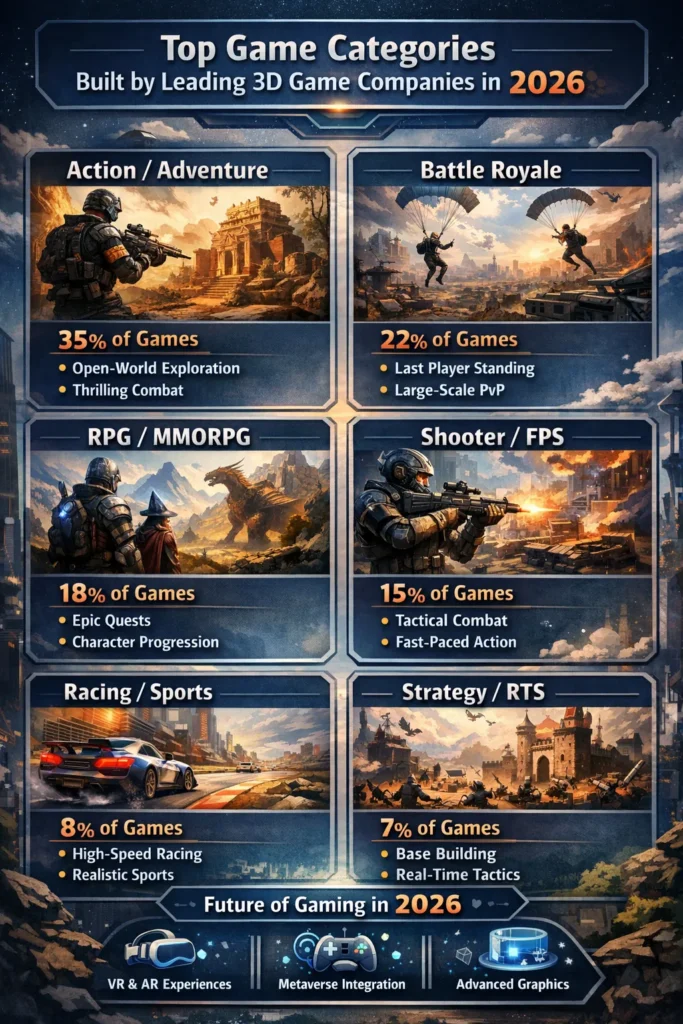
Types of 3D Games Developed:
Modern studios work across multiple game categories.
Action Games
The game requires players to move quickly while using present-day control systems. The action game genre requires players to master three core elements, which include combat, movement, and instant decision-making abilities. Developers create their games with three main priorities, which include smooth animation performance, immediate control response, and authentic physics behavior. The games require complete optimization work to achieve steady frame rates throughout all devices while providing users with a uniform gameplay experience.
Role-Playing Games (RPGs)
The video game experience combines storytelling elements with character progression development. RPGs let players discover complete game worlds which get developed through story events and player choice actions. The current 3D video game development service enables the creation of vast virtual worlds, which include interactive questlines and character development. The game’s progression systems reward players who explore the game world and make different choices, which enhances their enjoyment and game replayability.
Multiplayer Online Games
Games that combine social elements with competitive elements create their gameplay experience. The multiplayer games establish real-time player connections as their primary gameplay system. The 3d game development company creates these games through its development of secure server systems, matchmaking systems, and synchronization technology. Players now enjoy cross-platform compatibility, which enables them to connect with others from different devices without any difficulties.
Simulation Games
Digital systems create authentic virtual copies of actual physical systems. Simulation games create virtual environments that match actual human behavior and natural world conditions. Advanced 3d game development services enables developers to build realistic physics systems and interactive virtual spaces. These games serve multiple purposes because they function as training tools, educational resources, professional simulation platforms, and entertainment media.
Strategy Games
The gameplay requires players to use logical reasoning skills to develop their plans. The strategy games require players to handle resources while they select their combat methods. The combination of deep gameplay elements with visible game mechanics has become possible through modern 3D video game development. The artificial intelligence systems adjust their difficulty level according to how players interact with them while maintaining game equilibrium.
AR and VR Games
The experience provides players with complete immersion that goes beyond standard screen-based interactions. Players of AR and VR games experience interactive environments that function as virtual spaces. The 3D game development company designs its games to provide users with spatial awareness, simple controls, and comfort-based game mechanics. The games have found increasing use across various domains, which include gaming, training, and educational settings.
Metaverse-Based Games
The persistent virtual worlds support social interaction between users. The shared digital spaces of metaverse games develop through their continuous evolution. Developers build systems for avatar creation and social interaction and virtual economy development through their structured 3D game development company. The category exists because community members participate in activities, and the system supports multiple users.
Mobile 3D Games
The mobile platform delivers high-quality games that developers created as their best work. Mobile devices now provide support for advanced graphical content and complex gameplay functions. Modern 3D game development helps studios create games that run smoothly while conserving battery power and supporting all devices. The development team considers touch-based controls and accessibility options as their main focus areas.
Casual 3D Games
The game provides easy-to-understand mechanics that anyone can play. The developers of casual games create their games to allow players to experience their content through brief and effortless gameplay. Studios use effective 3D video game development techniques to create games that display attractive visuals through their basic gameplay systems. The games reach a major player base because they allow quick access, and players can master them in a short time.
Industries Adopting 3D Game Experiences
Different industries use 3D games to improve engagement and learning.
- Education and Training
3D games create interactive learning environments where students and trainees practice skills through simulated scenarios, which help them better understand the material. - Real Estate and Architecture
Virtual walkthroughs and design simulations enable buyers to explore properties while they visualize layouts and make informed decisions about construction and purchase. - Healthcare
3D games provide medical training and rehabilitation programs and patient education with safe interactive environments that enable realistic practice. - Retail and Marketing
3D game experiences enable brands to showcase their products and demonstrate product functions while customers engage with interactive storytelling. - Corporate Training and Onboarding
Enterprises use simulation-based games to train employees while increasing productivity and decreasing training expenses and dangers. - Manufacturing and Industrial Training
The 3D games enable workers to practice their training through machine operation simulations and safety procedure demonstrations, which create a safe learning environment for complex process training. - Entertainment and Media
Studios create interactive experiences that combine gaming elements with storytelling and digital events to develop new entertainment experiences that go beyond traditional entertainment.
Also check out: 5 SEO Tools for Unity Game Development Company to Boost Local SEO
Key Features of Professional 3D Game Development
These features define how high-quality games are built and maintained in 2026.
- Structured Project Planning: Every successful game starts with a clear plan. The development process starts with specific roadmaps and designated milestones,s and the evaluation of potential risks. This structured approach decreases uncertainty while stopping scope creep and maintaining project progress toward business objectives.
- High-Quality Visual Design: The use of powerful visual elements creates a more immersive experience for players. The developers create their environments through building detailed spaces that include realistic light systems and animated elements that move without interruption. The use of advanced rendering techniques enables visual content to maintain high quality while delivering performance across different systems.
- Optimized Game Performance: Player retention depends on a smooth gameplay experience. The process of performance optimization results in reliable frame rate performance, reduced loading times, and better memory management. The testing process for games includes assessment on various devices to create uniform player experiences.
- Scalable Game Architecture: Games require technical advancements for their future growth. The system creates a scalable framework that permits the addition of new levels and features and multiplayer modes without requiring core system redevelopment. This enables continuous system updates together with expansion possibilities.
- Cross-Platform Compatibility: Players expect to access their game content without any interruptions between different devices. The developers create their games to function effectively on mobile devices, personal computers, gaming consoles, and virtual reality systems. This approach expands reach and ensures consistent gameplay.
- Advanced AI and Game Logic: The smart systems provide players with advanced gameplay options. The AI system controls non-playable characters together with enemy combat strategies and game difficulty that adjusts to player performance. The designers developed their game systems to create balanced experiences that players can control through their actions.
- Security and Data Protection: Trust needs secure systems to establish itself between users. Security measures protect games from cheating exploits and unauthorized access to their systems. This situation becomes crucial for multiplayer games and online gaming environments.
- Post-Launch Support and Updates: Game development continues after release. The ongoing support provides various development tasks, which include bug fixes, performance improvements, content updates, and compatibility enhancements. The regular updates of a game system help to extend its playable period.
- Player Engagement and Retention Focus: Engagement drives long-term success. Developers create systems that provide rewards while their players progress through the game and receive ongoing feedback. Analytics tools help refine gameplay over time.
- Future-Ready Development Approach: Games need to adapt to technological advancements. Modern tools and frameworks enable developers to create games that can be updated in the future. This system guarantees that new devices and engines, and current industry developments, will remain compatible with existing content.
Which Game Types Are Most Popular in 2026?
The level of player engagement determines the popularity of a game. The demand for multiplayer, RPG, and simulation games remains strong through time. A 3d game development company focuses on live-service models that support updates and community interaction. The structured 3d game development services enable studios to maintain their creative work while preserving their ability to operate in the future.
How Technology Influences Modern 3D Games
The player experience receives its development through innovative methods. 3D game development teams use engine and hardware advancements to create new visual and interactive possibilities. The combination of real-time lighting, AI-driven systems, and physics simulations creates a more immersive experience. Modern 3D video game development removes technical limitations to provide developers with greater creative possibilities.
Check out How Artificial Intelligence in Gaming is Shaping its Future
Conclusion
The role of a 3d game development company in 2026 extends far beyond building playable content. Developers now create scalable systems designed for long-term engagement, performance, and adaptability. From action and RPGs to immersive virtual worlds, each game type demands technical precision and creative clarity. Businesses that invest in professional development gain access to optimized workflows, better performance, and future-ready design. As gaming technology continues to evolve, studios that prioritize quality, innovation, and player experience will stay competitive. Understanding these game categories helps stakeholders make informed decisions and align with the future of interactive entertainment.