


RankerX vs Money Robot By Admin Alpha SEO Tools | Research Based on Live Data, Community Forums, and Real Practitioner Experience
Two tools. Two very different personalities. One very important question that the SEO community keeps asking: do RankerX vs Money Robot still move the needle in 2026?
The short answer is yes, but that answer comes loaded with conditions, context, and caveats that any serious practitioner needs to understand before spending a single dollar on either platform. Google has rolled out three confirmed updates in 2026 alone, including the fastest spam update in the company’s history and a core update that displaced nearly 25 percent of top-10 ranking pages. The landscape these tools operate in has shifted significantly since either of them first gained popularity.
This article is a ground-level look at both tools as they stand today. Where they fit in a modern link-building workflow, where they fall short, what the practitioner community is saying about them right now, and what kind of potential they realistically offer in the current environment.
The SEO Landscape Right Now: Numbers That Set the Context
| 48%of Google queries now show AI Overviews | 3Google updates already in 2026 (as of July) | 25%of top-10 pages lost rankings after March 2026 update | Top 3Backlinks still among Google’s top 3 ranking signals |
These numbers matter because the environment in which both RankerX and Money Robot operate has fundamentally changed. Understanding the current landscape is the only way to evaluate the realistic potential of any automated link-building tool in 2026.
What Is RankerX and How Does It Work
RankerX is a cloud-based automated link-building software that was built to help SEO professionals create backlinks at scale across a curated network of real, high-authority websites. Unlike many tools in this space that rely on privately hosted blog farms or scraped spam sites, RankerX focuses on posting content to legitimate platforms that include social networks, Web 2.0 properties, wikis, PDF-sharing sites, press release directories, forum profiles, and more.
The cloud-based architecture is one of its most defining characteristics. Because it runs in the browser rather than on a desktop machine, users do not need to set up a VPS to run campaigns. This is a meaningful advantage for smaller teams and individual practitioners who want to keep infrastructure costs low.
Core Features of RankerX
• Turbo Wizard: A guided campaign-building interface that lets beginners create structured link-building campaigns in minutes without needing to understand the technical details of tier architecture.
• Visual Campaign Diagram Designer: Advanced users can build custom multi-tier link strategies using a drag-and-drop visual editor. Some users have reported building campaigns with as many as seven tiers without the software losing stability.
• Premium Site Filter: Users can choose to build links exclusively from high-DA platforms, which the tool labels as Premium sites. This is useful for Tier 1 campaigns where link quality matters most.
• Drip Feed Scheduling: Links can be released on a controlled schedule over days, weeks, or months. This creates a more natural velocity profile and reduces the footprint risk that bulk, instant link-building creates.
• Third-Party Integrations: RankerX connects with popular captcha-solving services, article spinners, indexing tools, and proxy providers. The ecosystem around the tool is well-developed.
• API Access: The tool offers an API for users who want to integrate it into broader automation workflows or agency-level dashboards.
Pricing runs at approximately $49.99 per month, with a lifetime license available. A seven-day free trial is offered with full access to all features. Users should factor in additional costs for proxies, captcha services, and any content spinning tools they choose to use alongside it.
Check The Alpha SEO Tools Extension For Quick SEO: Extension Alpha SEO Tools
What Is Money Robot and How Does It Work
Money Robot Submitter is a Windows-based desktop application that automates the process of building tiered backlink networks. It has been one of the most widely recognised tools in the automated link-building space for years, largely because of how accessible it is. The learning curve is genuinely low compared to most tools in this category. A beginner can have a campaign running within minutes of installation.
The core mechanism is the creation of what the tool calls backlinking diagrams, visual maps of how link equity should flow through the tiers of the campaign. Money Robot submits content and links to its own network of sites, which functions as an internal web of platforms it controls. It is important to understand that most of the links created are not on the well-known public platforms like Tumblr or WordPress.com. They exist on Money Robot’s own privately managed web properties, which makes them functionally closer to a managed PBN than a typical Web 2.0 submission service.
Core Features of Money Robot
• Built-In Captcha Solver: One of the standout practical advantages. Money Robot includes automated captcha solving at no extra cost, which removes one of the main recurring expenses that tools like RankerX require practitioners to manage separately.
• Backlinking Diagram Templates: Pre-built campaign diagrams let users launch structured campaigns immediately, without needing to design their own link architecture. Templates can also be purchased from other users.
• AI-Assisted Content Creation: Money Robot includes an article-building module that generates niche-related content automatically for submission. This speeds up campaign setup but produces content of varying quality.
• Live Link Checker: Real-time monitoring of live backlinks with status tracking, anchor text management, and domain-level data.
• Keyword Research Module: A basic built-in keyword research tool that helps users identify terms to target within their campaigns.
• Unlimited Website Support: The tool supports running simultaneous campaigns across an unlimited number of websites under a single liscence.
Money Robot requires a Windows machine or VPS to run, which adds infrastructure cost for Mac users or those without an existing Windows server. Pricing is available as a monthly subscription or a lifetime purchase option, making it appealing for long-term practitioners.
RankerX vs Money Robot: Feature Comparison at a Glance
| Feature | RankerX | Money Robot |
| Platform Type | Cloud / Browser | Desktop (Windows) |
| Ease of Use | Moderate | Beginner Friendly |
| Best Use Case | Tier 1 / Tier 2 Links | Tier 2 / Tier 3 Links |
| Pricing (Monthly) | ~$49.99/mo | ~$67/mo or Lifetime |
| Free Trial | 7 Days | 7 Day Money Back |
| Captcha Solving | Third Party Integration | Built In (Free) |
| Proxy Required | Yes | Yes |
| VPS Required | No (Cloud Based) | Yes (Desktop App) |
| Drip Feed Scheduling | Yes | Limited |
| Custom Campaign Diagrams | Yes (Visual Editor) | Yes (Templates) |
| Indexing Support | Third Party Required | Third Party Required |
| Tiered Link Building | Up to 7 Tiers | Up to 4 Tiers |
| API Integration | Yes | Limited |
| Support Quality | Good (Skype / Email) | Phone + Email (Long Wait) |
| Works in 2026 Effectively | Yes (Controlled Use) | Yes (Secondary Role Only) |
The table above reflects how both tools position themselves in the current market. Neither tool operates identically, and the best choice between them often depends on where in the link-building tier stack a practitioner needs support.
What Google Has Been Doing in 2025 and 2026
This section matters more than any feature comparison. The environment in which both tools operate has been shaped aggressively by Google’s spam detection systems over the past eighteen months.
The August 2025 Spam Update
This was one of the longest spam updates Google has ever run, taking nearly 27 days to complete its rollout from August 26 through September 21, 2025. It specifically targeted large-scale automated content, thin programmatic pages, and manipulative affiliate tactics. Google’s SpamBrain system received significant upgrades during this period, making it considerably smarter at detecting link patterns that deviate from natural acquisition behaviour.
For users of automated link-building tools, this update had real consequences. Sites that had previously benefited from automated link campaigns saw indexing rates drop, with many previously healthy links either being ignored or actively devalued by Google’s systems.
The November 2025 Core Update
Described by SEO analysts as the most significant ranking shift since the March 2024 site reputation update, the November 2025 core update ran for 24 days and was characterised by large ranking changes across virtually every content category. PBN-style links that had survived previous updates lost their equity boosts. Sites relying on link schemes that had been flying under the radar faced genuine demotion.
The March and April 2026 Updates
2026 began with two updates arriving almost simultaneously. A spam update rolled out on March 24, completing in under 20 hours, which made it the fastest spam update in Google’s recorded history. Three days later, the March 2026 core update began rolling out, completing on April 8. The overlap between these two updates meant that sites relying on spammy backlinks to prop up thin content were effectively hit twice. Nearly 25 percent of top-10 pages lost their ranking positions during this period.
A second core update for 2026 then rolled out from May 21 through June 2, targeting content relevance and user satisfaction signals globally across all languages.
See More SEO tools in the Alpha SEO Tools
Do They Still Work in 2026? The Honest Assessment

The practitioner community is clear on this: both tools still work, but the way they need to be used has changed materially. The days of blasting ten thousand links at a money site and watching rankings climb within weeks are genuinely over. Google’s detection systems are too sophisticated for that approach to survive contact with an algorithm update.
What the Community Is Actually Saying about RankerX vs Money Robot
Active discussions in specialist SEO communities as recently as February 2026 show practitioners using both tools with results, but with significantly more caution than in previous years. The most successful approach described repeatedly across forum threads is a tiered strategy where RankerX is used for Tier 1 links pointing to a money site, Money Robot is used for Tier 2 amplification pointing at those Tier 1 links, and GSA Search Engine Ranker handles Tier 3 volume. This cascade approach keeps automated links away from the money site while still building overall authority through the tier structure.
The critical insight from experienced practitioners is that link indexing has become the most significant pain point with both tools. Links that do not get indexed by Google contribute nothing to rankings. Both RankerX and Money Robot generate links that are difficult to get indexed without a separate paid indexing service layered into the workflow. Users who have budget for a quality indexing service report results. Users who do not are often disappointed.
One widely cited strategy from an experienced practitioner in a February 2026 forum discussion describes achieving DR50 and DA50 metrics across money sites through a combination of RankerX for Tier 1, Money Robot for Tier 2, and GSA for lower tiers, combined with ZenNo automation to manage campaign construction. This is a sophisticated, high-investment approach that delivers results, but it is very different from the plug-and-play promise that both tools sometimes market themselves on.
RankerX: Where It Still Holds Up
RankerX is the stronger performer of the two for Tier 1 link placement in 2026. The key differentiator is that it submits to real websites with genuine traffic rather than to privately hosted networks. A backlink sitting on a real WordPress.com site, a legitimate wiki platform, or a high-DA social profile carries more credibility than one sitting on a server farm of privately managed domains. That distinction has grown more important as Google’s detection systems have become better at identifying link-pattern footprints.
The drip feed scheduling feature is genuinely valuable in the current environment. Spreading link acquisition over 30, 60, or 90 days produces a velocity profile that looks far more natural than bulk submissions. This reduces the algorithmic footprint and gives links a better chance of surviving Google’s ongoing spam assessment cycles.
The cloud-based architecture also means the tool continues to receive updates and platform list refreshes without requiring the user to manage software on a VPS. The developer team has maintained regular updates, which matters for a tool that depends on being able to successfully submit to hundreds of different web platforms.
Money Robot: Where It Still Earns Its Place
Money Robot’s reputation has been more mixed in recent years, and some community voices are openly critical of its effectiveness as a standalone tool. The most honest practitioners describe it as a useful secondary or tertiary instrument rather than a primary ranking driver. One practitioner’s January 2026 review, drawing on years of testing, put it clearly: Money Robot still has a place in SEO, but only as a secondary or tertiary tool. Used too aggressively as a direct ranking driver, it creates more risk than reward.
Where Money Robot genuinely earns its keep is in amplifying links that already exist. When used to send Tier 2 links at Tier 1 placements that were built with a higher-quality tool like RankerX, it can help push those Tier 1 links to get indexed and pass more authority downstream. The built-in captcha solver reduces operational costs compared to RankerX when running at volume, and the lifetime pricing option makes it an attractive long-term infrastructure investment for practitioners who plan to run ongoing campaigns.
What Is the Real Potential of These Tools in 2026: (The RankerX vs Money Robot)
Honest potential assessment requires separating what these tools can do technically from what they can realistically achieve in the current algorithmic environment.
Both tools can still generate meaningful ranking improvements, particularly in low to medium competition niches where the bar for link authority is not set by sites with large editorial backlink profiles. In these niches, a well-structured tiered campaign using RankerX at Tier 1 combined with Money Robot amplification at Tier 2 can produce measurable movements in organic rankings within 30 to 60 days, provided links get indexed properly.
In high-competition niches, particularly anything touching finance, health, legal, or established e-commerce sectors, the potential of these tools as standalone strategies is genuinely limited. Google has raised the quality bar in these categories significantly through multiple updates, and automated link networks simply do not produce the kind of contextual, editorial authority signals that top-ranking pages in these verticals accumulate.
The practitioner community that reports the best results in 2026 consistently describes using these tools as amplifiers for legitimate manual link-building rather than as replacements for it. A site that has earned 15 quality editorial placements through guest posting, outreach, and digital PR will see those Tier 1 links become more powerful when RankerX or Money Robot are used to send controlled Tier 2 signals at them. Used this way, both tools extend the value of legitimate link-building work rather than trying to substitute for it.
Risks Every User Should Understand Before Starting
These tools operate in a grey area. That is not sensationalism, it is an accurate description of where automated link-building sits relative to Google’s guidelines. Both tools automate a process that Google’s spam policies explicitly target. Users need to understand these risks before committing budget to either platform.
• Indexing is not guaranteed. Most links created by both tools require a separate indexing service to have any chance of being found and evaluated by Google. Without indexing, links from either tool pass no value.
• Google’s detection has improved significantly. The August 2025 spam update and the March 2026 updates demonstrated that Google’s SpamBrain system is actively getting better at identifying automated link patterns. What worked two years ago is no longer guaranteed to work today.
• Money Robot’s network is effectively a managed PBN. The links it creates do not sit on publicly accessible Web 2.0 platforms. They exist on privately managed servers, which creates a different risk profile than tools like RankerX that post to real external sites.
• Never link directly to a money site with either tool at scale. The practitioner consensus on this point is essentially unanimous in 2026. Both tools should be pointed at intermediary properties, not directly at the main site being ranked.
• Velocity patterns matter more than volume. Building 5,000 links in three days creates an obvious, detectable footprint. Spreading the same volume over 90 days through drip feed settings produces a profile that is far harder for algorithmic systems to flag as manipulative.
Which Tool Is Right for You: A Practical Decision Guide
| RankerX: Recommended For | Money Robot: Recommended For |
| Tier 1 and Tier 2 quality link campaignsSEOs who need cloud access without a VPSAgencies managing multiple client websitesAdvanced users who want custom campaign diagramsThose prioritising high DA site placements | Tier 2 and Tier 3 link amplification campaignsBeginners who want fast setup without complexityUsers who prefer a one time payment structureSEOs powering up web 2.0 properties or PBNsThose who want a built in captcha solver |
The decision between the two tools is not really an either-or question for most serious practitioners. The most effective documented strategies in 2026 use both tools in combination, with RankerX handling Tier 1 quality and Money Robot handling Tier 2 volume and amplification.
Practical Tips for Using These Tools Effectively in 2026
1. Invest in a quality indexing service first. Without indexing, neither tool produces results. Budget for this before anything else.
2. Use private proxies, not shared ones. Both tools benefit significantly from dedicated private proxies. Shared proxies increase detection risk and reduce submission success rates.
3. Enable drip feed on every campaign. A link velocity of 20 to 50 links per day spread over 60 to 90 days is far safer than blasting the same total volume in a week.
4. Never point automated links directly at money sites. Always use intermediary properties such as web 2.0s, niche-relevant sites, or guest post placements as the buffer layer.
5. Spin content properly. Submitting identical content across multiple platforms creates a footprint. Use a quality spinning tool or write multiple content variations to reduce duplication signals.
6. Monitor with Ahrefs or a comparable tool. Track which links are actually getting indexed and which are surviving over time. Links that disappear within 30 days are contributing nothing and should inform how you adjust campaign settings.
7. Combine with legitimate link-building. The highest-performing practitioners in 2026 use these tools to amplify editorial links, not replace them. A hybrid strategy is both safer and more effective than automation alone.
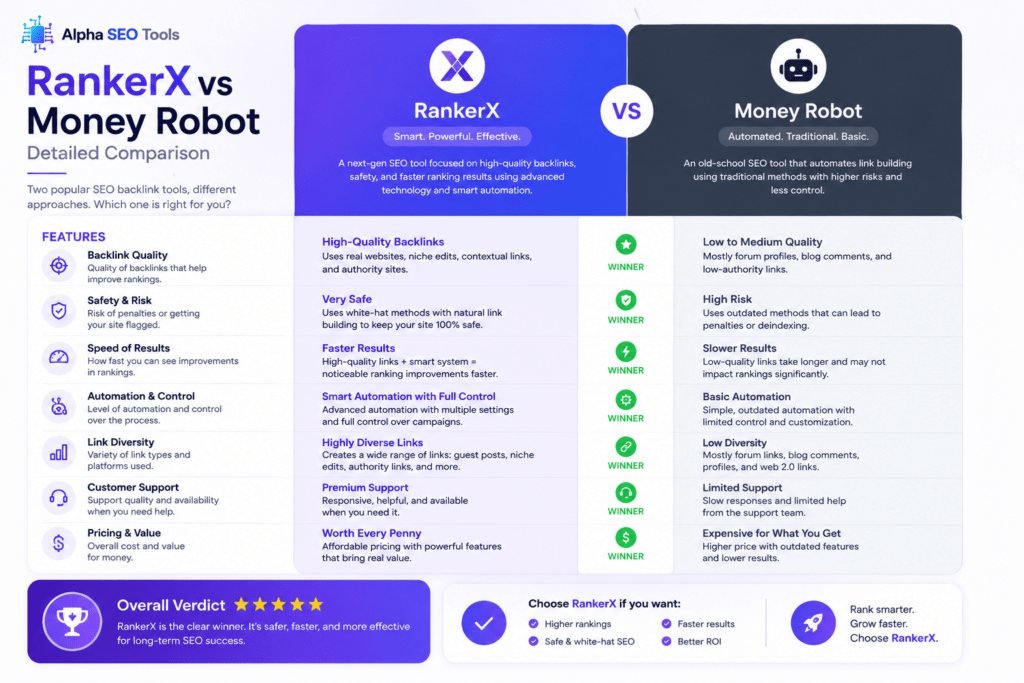
Final Verdict about RankerX vs Money Robot
RankerX vs Money Robot are not findable. They are not the ranking shortcuts they may once have appeared to be, but in the hands of a practitioner who understands how to use them with discipline and restraint, they still represent a real tool with real potential in 2026.
RankerX remains the stronger option for quality-focused Tier 1 link building. Its cloud architecture, real-site network, premium filtering, and drip feed capabilities make it the more defensible choice in a post-2025-spam-update environment. If you are building links that will point toward anything you care about, this is the tool to start with.
Money Robot earns its place as a Tier 2 and Tier 3 amplification tool when used with the appropriate restraint. Do not use it as a direct ranking driver. Do not point it at your money site. Do not run it without a working indexing service. But within those guardrails, it can add real value to a layered link strategy at a cost that is hard to beat.
The meta-lesson from 2026 is straightforward: Google’s tolerance for automated link manipulation has shrunk considerably, and the tools that survive in this environment are the ones used intelligently rather than aggressively. Both RankerX and Money Robot can be part of a smart, disciplined workflow. Neither one is a substitute for one.
Disclaimer: This article is written for informational purposes only and reflects community research and publicly available practitioner data as of July 2026. Automated link-building may violate Google’s Webmaster Guidelines. Use these tools at your own risk and always evaluate the compliance implications for your specific situation.
RankerX vs Money Robo By Alpha SEO Tools | All Rights Reserved