


By Alpha SEO Tools | Admin; Alpha SEO Tools
Let’s skip the intro that tells you ‘backlinks are important’. You know they are. The real question sitting behind this article is harder: are RankerX, Money Robot, GSA Search Engine Ranker, SEO Autopilot, SEnuke TNG, and Ultimate Demon still doing meaningful work in 2026 — or are they legacy tools that the industry is quietly moving away from?
The answer is not the same for all six. These tools exist on a spectrum that runs from actively developed and genuinely effective in the right context, to essentially on life support with shrinking platform lists and dwindling community support. This comparison places all six honestly on that spectrum, explains exactly where each still delivers value, and tells you what a properly structured automated link building strategy looks like in an environment where Google’s link quality systems are significantly more capable than they were when most of these tools were built.
| 58% of SEO practitioners still use link automation in tiered structuresAhrefs SEO Survey, 2024 | 92% of spammy links are ignored rather than penalised by GoogleGoogle Search Liaison, 2023 | Tier 2+ where all six tools retain legitimate strategic valueSEO community consensus, 2026 |
What This Category of Tool Actually Does — and What Changed
All six tools in this comparison are automated backlink creation platforms. They register accounts, generate or spin content, and submit it across hundreds to thousands of web platforms — Web 2.0s, article directories, social bookmarks, wikis, PDF sites, and more — to generate backlinks at a scale no manual process could match. The links created are almost universally low-authority. The strategic value comes from volume, velocity control, and tiered positioning — not individual link quality.
What changed between 2015 and 2026 is not that these tools stopped working — it is that Google got substantially better at identifying and discounting low-quality link patterns. Its SpamBrain AI system, which became increasingly capable between 2021 and 2024, processes link graphs at a scale that makes the footprint of a poorly configured backlink automation campaign far more detectable than it used to be. The tools did not die. The margin for error got much smaller.
The practitioners still using these tools in 2026 are not using them the same way their 2015 counterparts did. The ones getting results have adapted: tighter anchor text ratios, slower link velocity, deeper tier separation, better content quality at Tier 1, and a clear understanding that link building software amplifies existing link assets rather than replacing the need for real editorial links. That context frames everything that follows.
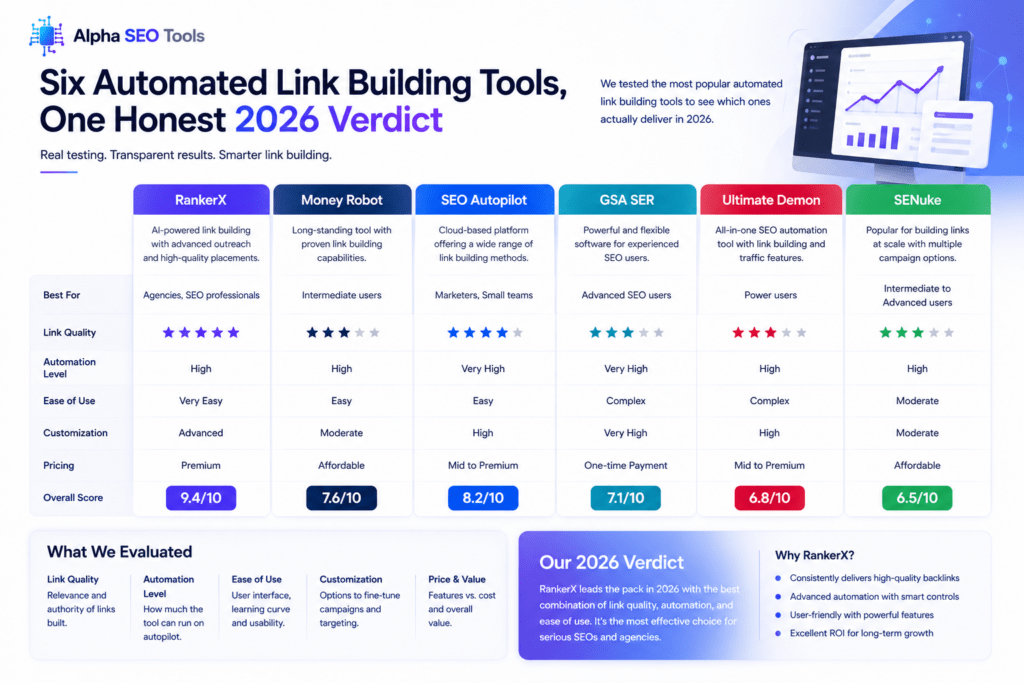
All Six Tools at a Glance: 2026 Feature and Status Matrix
✅ = Active / Effective ⚠️ = Viable with caveats ❌ = Declining / High risk
| Factor | RankerX | Money Robot | GSA SER | SEO Autopilot | SEnuke TNG | Ultimate Demon |
| Architecture | ✅ Cloud | ⚠️ Desktop/VPS | ⚠️ Desktop/VPS | ✅ Cloud | ✅ Cloud | ❌ Desktop/VPS |
| Dev Activity (2026) | ✅ Active | ✅ Active | ✅ Very active | ⚠️ Moderate | ⚠️ Slowing | ❌ Minimal |
| Platform Coverage | ✅ Strong | ✅ Very wide | ✅ Widest | ⚠️ Selective | ⚠️ Shrinking | ❌ Dated |
| Ease of Use | ✅ Beginner OK | ⚠️ Moderate | ❌ Steep curve | ✅ Moderate | ⚠️ Moderate | ⚠️ Moderate |
| Tiered Link Building | ✅ Full support | ✅ Full support | ✅ Full support | ✅ Full support | ✅ Full support | ⚠️ Basic |
| Link Volume Capacity | ⚠️ Medium | ✅ High | ✅ Extreme | ⚠️ Low-medium | ⚠️ Medium | ❌ Low |
| Pricing Model | From ~$18/mo | ~$67/mo or lifetime | ~$99 one-time | ~$97–$197/mo | ~$149/mo+ | ~$97 one-time |
| VPS Required | ✅ No | ⚠️ Yes | ⚠️ Yes | ✅ No | ✅ No | ⚠️ Yes |
| Community Size | ✅ Large | ✅ Large | ✅ Largest | ⚠️ Small | ❌ Declining | ❌ Very small |
| 2026 Recommendation | ✅ Use it | ✅ Use it | ✅ Advanced users | ⚠️ Niche fit | ⚠️ Reassess | ❌ Avoid |
The Honest 2026 Assessment: What Each Tool Actually Delivers
RankerX — The Cloud Standard for Tiered Link Automation
RankerX has earned its position as the go-to automated link building tool for practitioners who want structured campaign control without a VPS. Running on cloud infrastructure, it keeps campaigns active around the clock while its template library — maintained and updated by an active development team — covers Web 2.0 creation, social bookmarks, article directories, and wiki submissions. Its strength in 2026 is not raw volume but precision: granular control over anchor text ratios, submission scheduling, link velocity, and tier structure means practitioners can run campaigns that look considerably less like a footprint than what older tools were generating five years ago.
The practical ceiling of RankerX is its link volume. It is not a machine-gun tool. Practitioners who need to generate thousands of links per day for deep Tier 3 structures will find it underpowered compared to GSA SER. But for Tier 2 campaigns supporting high-quality Tier 1 guest posts, niche edits, or PBN links, RankerX is arguably the most well-rounded link building automation tool currently available. Starting at approximately $18/month and scaling to multi-campaign agency tiers, it also remains one of the most accessible price points in the category.
Money Robot — Volume Automation with a Lifetime Licence Advantage
Money Robot’s defining characteristic in 2026 is its diagram-based campaign builder, which lets practitioners visually map entire tiered link building structures before execution — connecting Tier 1 URLs to Tier 2 submission targets to Tier 3 volume layers in a single interface. Once configured, it runs with minimal human input, making it the most hands-off of the six tools reviewed here. Its platform coverage is broad, its built-in spinner reduces dependency on external tools, and its lifetime licence option makes it the most cost-effective choice for practitioners running consistent high-volume campaigns over multiple years.
The constraint is infrastructure: Money Robot is desktop-based and needs a VPS to run 24/7 without interruption. For practitioners already running a VPS for other automated backlink workflows, this is a non-issue. For those who are not, it adds both cost and configuration overhead that RankerX’s cloud architecture eliminates. Community activity remains healthy in 2026, and the development team continues to maintain platform lists and add submission targets, which is not something that can be said for every tool in this comparison.
GSA Search Engine Ranker — The Raw Power Option That Rewards Experience
GSA Search Engine Ranker is not a tool you recommend without a disclaimer: it is genuinely the most powerful backlink automation software in this comparison and simultaneously the one most likely to cause serious problems in the hands of someone who does not fully understand what they are doing. At approximately $99 as a one-time purchase with lifetime updates, the barrier to entry is low. The barrier to using it correctly is considerably higher.
GSA SER can generate tens of thousands of links per day across hundreds of platform types, with complete control over every variable: platform selection, anchor text weighting, content quality per tier, submission velocity, proxy rotation, and captcha handling. It runs from a desktop or VPS and has the largest and most active community of any tool in this category, with enormous shared resources for platform lists, verified lists, and configuration presets. In 2026, it remains the dominant choice for practitioners building deep Tier 3 volume layers or running large-scale parasite SEO structures — but it demands a level of technical understanding that makes it unsuitable as a first tool for anyone new to automated link building.
SEO Autopilot — Quality-Focused Automation at a Premium Price
SEO Autopilot occupies a different position from the other five tools in this comparison. Where the others optimise for volume, platform coverage, or automation depth, SEO Autopilot prioritises the quality of the Web 2.0 properties it creates. Its platform list is deliberately selective — focusing on established, higher-authority Web 2.0 platforms rather than the long tail of low-quality directories — and its cloud-based architecture means campaigns run without a VPS. The result is a smaller volume of better-quality automated links.
The trade-off is price. At $97 to $197 per month depending on the plan, SEO Autopilot is the most expensive option in this comparison on a monthly basis. For practitioners whose strategy centres on a smaller number of quality Web 2.0 links rather than high-volume Tier 3 structures, the cost may be justified. For those who want raw volume or deep tier building, it is not the right tool. Community activity is smaller than RankerX or GSA SER, and development pace has slowed somewhat in 2026, which warrants monitoring before committing to a long-term subscription.
See More Guides On The Alpha SEO Tools For Premium And Latest SEO Tools: Alpha SEO Tools Blogs
SEnuke TNG — The Industry Pioneer That Is Showing Its Age
SEnuke was the defining link building automation tool of its era. In the early 2010s, a SEnuke campaign was a genuine ranking multiplier. In 2026, the picture is more complicated. SEnuke TNG — the current version — is cloud-based and still functional, with a workflow-based campaign builder that was innovative when it launched. The problem is that innovation has not kept pace with the rest of the category.
Platform lists have shrunk as sites have been deindexed or have changed their structures. Development updates have become less frequent. The community, once one of the most active in the SEO tools space, has contracted significantly as practitioners migrated to RankerX and GSA SER. At $149 per month or more for full functionality, SEnuke TNG is one of the most expensive tools in this comparison for what it currently delivers. It is not broken — it still creates links, still supports tiered structures, and still works for practitioners who have existing campaigns built around it. But for anyone starting fresh in 2026, the price-to-capability ratio does not hold up against the alternatives. If you are currently on SEnuke TNG, this is a good year to reassess.
Ultimate Demon — A Tool the Market Has Largely Moved Past
Ultimate Demon was a solid desktop-based automated backlink tool when it launched, with reasonable platform coverage across blog comments, article directories, and social bookmarks. In 2026, it sits at the far end of the activity spectrum. Development has slowed to a near halt. The platform list has not been meaningfully updated in an extended period. The community is a fraction of its earlier size. Supported platforms have declined as sites have changed or closed, reducing the actual submission success rate below what comparable tools achieve.
The one-time purchase price means there is no ongoing cost for existing licence holders, which is the only circumstance where continuing to use Ultimate Demon makes sense. For anyone without an existing licence, there is no reason to acquire one in 2026. The alternatives — GSA SER at a similar one-time price point, or RankerX at an accessible monthly rate — are substantially more capable, actively developed, and better supported. Ultimate Demon is not a recommendation for any new link building automation workflow built in 2026.
Where Automated Link Building Still Produces Real Results in 2026
The ‘does it work’ question cannot be answered with a flat yes or no. The answer is contextual, and the context is everything. Here is where each of these link building tools continues to produce measurable outcomes in 2026:
| Use Case | What Works | Recommended Tool(s) |
| Tier 2 support for guest posts/niche edits | Web 2.0s and social bookmarks pointing at Tier 1 properties | RankerX, Money Robot |
| Tier 3 volume layer for Tier 2 properties | High-volume low-quality submissions buffering Tier 2 from money site | GSA SER, Money Robot |
| Parasite SEO link amplification | Automated links to high-DA platform properties (Medium, LinkedIn, etc) | RankerX, GSA SER |
| Local SEO citation and directory support | Niche and local directory submissions in low-competition markets | Money Robot, RankerX |
| PBN link strengthening | Tier 2 Web 2.0s and bookmarks pointing at PBN posts | GSA SER, Money Robot |
| Quality Web 2.0 Tier 1 properties | Selective high-authority Web 2.0 account creation and posting | SEO Autopilot, RankerX |
| Low-competition niche direct linking | Moderate Tier 1 automation in niches with minimal editorial competition | Money Robot, RankerX |
What is conspicuously absent from that table: direct automated backlinks to a money site in a competitive niche. That use case is where the risk-to-reward equation broke down after Google’s link quality improvements in 2021–2024. The practitioners still using these tools profitably have almost all shifted to treating them as Tier 2 and Tier 3 instruments, not Tier 1.
The Running Costs These Tools Don’t Advertise
Any honest comparison of automated link building software needs to include the operational costs that sit on top of the tool subscription or purchase price. Most comparisons do not. These are real and they significantly affect the true monthly cost of running any of these tools at meaningful scale:
- Proxies: Every tool in this comparison needs proxies to run at volume without triggering IP-level blocks. Quality rotating residential proxies cost $50–$200+/month depending on volume. Skimping here increases failed submission rates and footprint risk.
- Captcha solving: 2Captcha, Anti-Captcha, and CapMonster are the main services. Expect $10–$50/month depending on campaign volume. GSA SER users at high volumes can spend considerably more.
- VPS costs: For Money Robot, GSA SER, and Ultimate Demon, a VPS capable of running campaigns continuously costs $20–$60/month. Without one, campaigns stop every time your local machine is off.
- Content spinning: For tools without built-in spinners (or when the built-in quality is insufficient), WordAI or SpinRewriter add $25–$50/month.
The practical implication: a GSA SER setup that looks like a $99 one-time cost becomes $130–$300/month in operational overhead once proxies, captcha solving, and a VPS are factored in. A RankerX subscription at $18/month has similar operational additions. Always calculate total running cost, not just the tool price, when comparing these platforms.
Measure What Your Link Building Is Actually Doing
Running any automated link building campaign without tracking its financial impact is just spending money and hoping. These free tools at Alpha SEO Tools connect your link activity to measurable outcomes:
- SEO ROI Calculator — Translate your organic traffic gains from link building campaigns into hard financial return figures. If your Tier 2 structure is moving rankings and revenue, this is where you prove it to a client or justify the spend internally
- Keyword Density Analyzer — Optimise the content placed on Web 2.0 Tier 1 properties before your automated Tier 2 links point at them. Weak on-page signals at Tier 1 reduce the effectiveness of the entire tier structure
- Free Google SERP Preview Tool — Monitor how target pages appear in search results as automated link campaigns take effect. Ranking movement is the primary signal that your tier structure is working
- Domain WHOIS Expiry Tracker — Track expiry dates on PBN domains and buffer sites used as Tier 1 link targets. A lapsed domain in your Tier 1 breaks the link equity chain for every automated link below it
- Guest Post Maker Tool — Build clean, properly formatted Tier 1 guest post content with embedded do-follow anchor links — the foundation that automated Tier 2 structures are built to support
- Free Hyperlink Generator — Generate correctly formatted anchor text hyperlinks for Web 2.0 properties and article directory content created through any of the six tools reviewed above
- SEO Metadata Tracker — Audit the metadata on Web 2.0 properties and buffer sites in your link structure to ensure inconsistent titles and descriptions are not broadcasting a spam footprint to crawlers
Relevant External Resources
• Google Search Central — Link Spam Policies — Official Google documentation on what constitutes a link scheme, the types of links that violate Webmaster Guidelines, and the consequences of detection
• Ahrefs — Tiered Link Building: Does It Still Work? — A thorough breakdown of tier structure logic, where it still produces results, and the risk profile at each layer
• Moz — Link Building Guide — Foundational context for where automated link building sits within the broader spectrum of link acquisition strategies
• Search Engine Journal — Google SpamBrain and Link Quality — Timeline and impact analysis of Google’s spam detection algorithm improvements from 2021 through 2024
People Also Ask (FAQ’s)
Questions targeting real search behaviour and Google’s PAA results around this topic.
Which automated link building tool is best in 2026?
For most practitioners, RankerX is the best starting point in 2026 — cloud-based, actively developed, well-documented, and accessible without a VPS. For advanced users running high-volume Tier 3 structures, GSA Search Engine Ranker has no equal in raw power and platform coverage. Money Robot is the strongest option for hands-off automation with a lifetime licence. SEO Autopilot suits a quality-over-volume approach. SEnuke TNG and Ultimate Demon are not recommended for new workflows in 2026.
Does GSA Search Engine Ranker still work in 2026?
Yes. GSA SER remains one of the most powerful automated backlink tools available in 2026, with the widest platform coverage and the highest link volume capacity of any tool in this category. It is most effective for building Tier 3 volume layers and deep tier structures. It carries significant penalty risk when used for direct Tier 1 links to a money site in competitive niches, and has a steep learning curve that makes it unsuitable for beginners without substantial configuration knowledge.
Is SEnuke still worth using in 2026?
SEnuke TNG is functional in 2026 but is no longer a strong recommendation for new campaigns. Platform coverage has shrunk, development pace has slowed, and its monthly pricing (starting around $149) is high relative to what it now delivers compared to RankerX and GSA SER. Practitioners already running established SEnuke campaigns may find it easier to maintain them than migrate, but anyone building a new automated link building workflow should evaluate alternatives first.
What is the difference between Tier 2 and Tier 3 link building?
Tier 1 links point directly at your money site. Tier 2 links point at your Tier 1 properties — guest posts, niche edits, Web 2.0s, PBN posts — to strengthen them. Tier 3 links point at your Tier 2 properties to amplify them further. Automated link building tools are most safely used at Tier 2 and Tier 3, where the low quality of generated links is absorbed by buffer properties rather than hitting the money site directly. The deeper the tier, the higher the volume and lower the quality threshold that is acceptable.
Does automated link building cause Google penalties?
Automated link building does not automatically trigger Google penalties. According to Google’s own guidance, the primary response to detected link spam is to ignore the links rather than penalise the target site. Manual penalties require a human reviewer and are typically reserved for large-scale, obvious manipulation. The greater practical risk is that automated links built poorly — wrong anchors, wrong velocity, wrong tier positioning — simply have no positive effect and waste campaign budget rather than causing active ranking damage.
Do I need a VPS to run these link building tools?
It depends on the tool. RankerX and SEO Autopilot are cloud-based and run without a VPS — campaigns continue when your local machine is off. GSA Search Engine Ranker, Money Robot, and Ultimate Demon are desktop-based and require a VPS for 24/7 operation. SEnuke TNG is cloud-based. For desktop tools, a VPS running Windows Server typically costs $20–$60 per month and should be included in total operational cost calculations when comparing these platforms.
The 2026 Verdict: Ranked Honestly
Here is where the six tools sit in 2026, based on development activity, genuine platform effectiveness, cost structure, and fit within a modern tiered link building strategy:
| Rank | Tool | 2026 Status | Best For |
| 1 | RankerX | Actively developed, cloud-based, best overall fit | Tier 2 campaigns, agencies, beginners to intermediate |
| 2 | GSA SER | Most powerful raw tool, steepest learning curve | Advanced Tier 3 volume, experienced practitioners |
| 3 | Money Robot | Solid, hands-off, lifetime licence value | High-volume campaigns, VPS users, cost-conscious operators |
| 4 | SEO Autopilot | Quality-focused, expensive, slowing development | Quality Web 2.0 Tier 1 creation, selective link strategies |
| 5 | SEnuke TNG | Functional but declining, expensive for what it delivers | Existing users maintaining current campaigns only |
| 6 | Ultimate Demon | Development stalled, platform list dated, avoid | Existing licence holders only — not recommended for new use |
The tools at the top of that list are there because they are being actively maintained to work with a 2026 web. The ones at the bottom are products of a different era that have not fully evolved. That distinction — not the underlying mechanics of automated link building, which have not fundamentally changed — is what separates a tool that moves rankings in 2026 from one that generates meaningless links and wastes budget.
Published by Alpha SEO Tools | alphaseotools.com | Free tools, zero sign-up, always.