
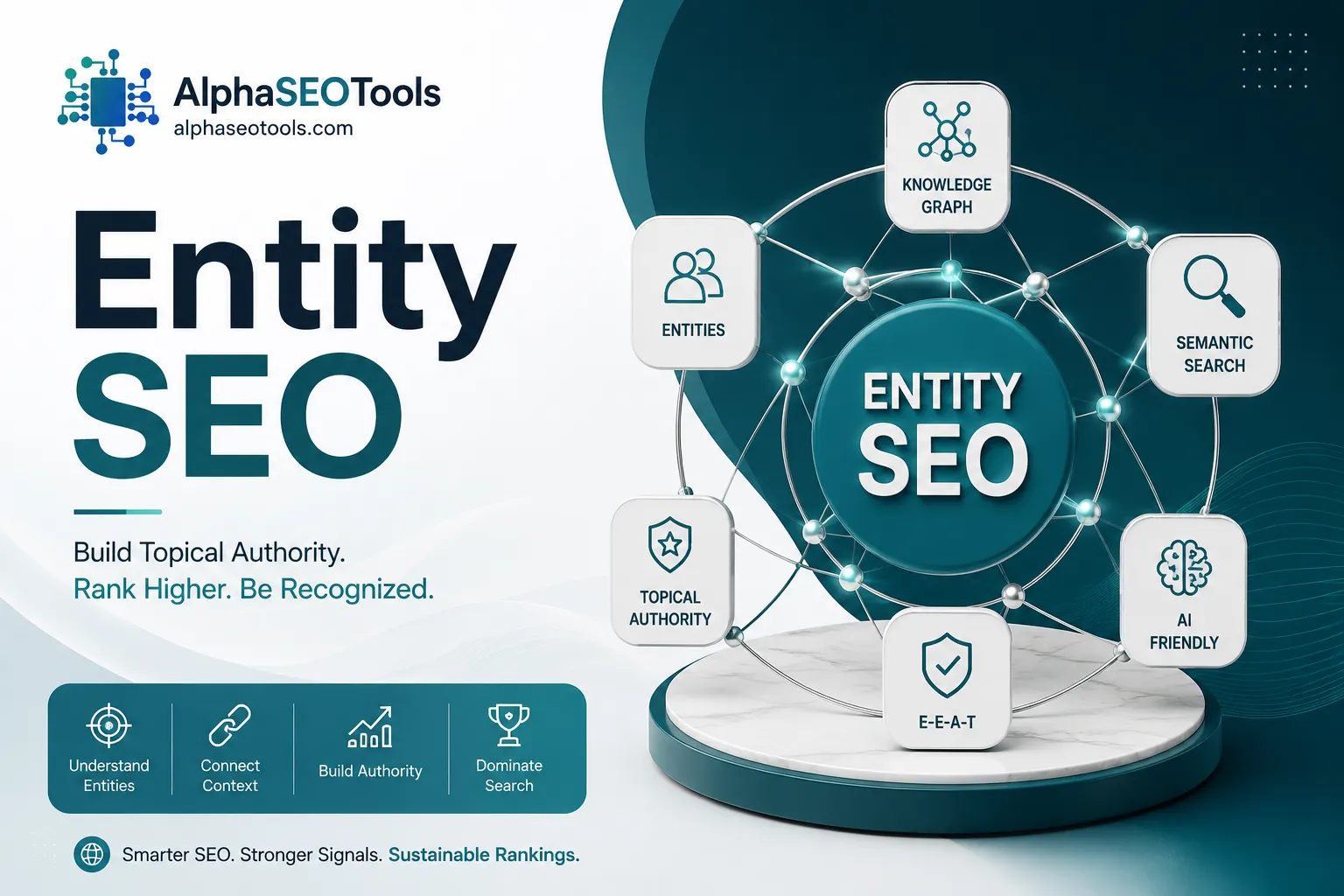
Search engines no longer see the web as a collection of strings. They see it as a universe of things, people, places, brands, products, concepts. These things are called entities. If you’ve ever searched for “Leonardo da Vinci inventions” and seen a carousel of his works pop up directly in Google, you’ve witnessed entity SEO in action. No single page dictated that result; Google’s Knowledge Graph assembled it from understanding Leonardo as an entity with attributes and relationships. Entity SEO is the discipline of optimizing your digital presence so search engines recognize you, your brand, or your content as a distinct, authoritative entity. It’s no longer optional; it’s the backbone of modern organic visibility. This guide breaks down entity SEO for beginners step by step, covering the Knowledge Graph, entity recognition, structured data, and brand entity fundamentals.
We’ll explore what entities are, how the Knowledge Graph catalogs them, the role of entity recognition algorithms, why structured data acts as a direct translator for machines, and how to build a brand entity that Google trusts. By the end, you’ll understand why entity based optimization has replaced old school keyword stuffing and how to implement these concepts starting today.
Traditional SEO vs. Entity SEO: A Quick Comparison
| Aspect | Traditional SEO | Entity SEO |
| Core Focus | Single primary keyword | Entities, topics, and relationships |
| Keyword Usage | Exact match repetition, density tracking | Contextual mentions, entity recognition, semantic relevance |
| Content Structure | Isolated pages targeting one keyword each | Entity hubs, topic clusters, and interlinked entity pages |
| Search Engine View | Pages seen as bags of words | Pages seen as collections of entities with attributes |
| Ranking Goal | Rank for one phrase | Rank for thousands of related queries and rich features |
| Technology Leveraged | Basic crawling and indexing | Knowledge Graph, entity recognition, structured data, NLP |
| Trust Signal | Backlinks primarily | EEAT, brand entity authority, Google entities recognition |
What Is an Entity in SEO?
An entity is anything that is singular, unique, well defined, and distinguishable. It doesn’t have to be a physical object. A movie, a city, a historical event, a scientific formula, a company, even a specific song each qualifies. Google’s official definition from its patents describes an entity as “a thing or concept that is singular, unique, well defined and distinguishable.” Crucially, entities have attributes and relationships. The entity “Mount Everest” has attributes like height (8,848 meters), location (Nepal/China border), and first ascent date (May 29, 1953). It relates to entities like “Tenzing Norgay,” “Himalayas,” and “Mountaineering.”
In the world of SEO, shifting from keywords to entities means you’re no longer asking “what phrase do I want to rank for?” but rather “what entities does my content represent, and how clearly are they connected?” When a user searches “capital of France,” Google doesn’t hunt for pages matching those four words. It identifies the entity “France,” understands the attribute “capital,” and returns the entity “Paris.” Simple, direct, semantic.
Entity recognition is the computational process by which search engines extract these entities from text, images, and other media. It’s a critical component of Natural Language Processing and forms the bridge between raw content and the structured world of the Knowledge Graph. For entity SEO for beginners, understanding entity recognition is essential because Google entities depend on accurate entity recognition to function properly.
Why Entity SEO Matters Now
Google’s shift from “strings to things” began in earnest with the Knowledge Graph launch in 2012. Every major algorithm update since Hummingbird, RankBrain, BERT, MUM has pushed the search engine further toward entity based understanding. The implications for SEO are profound. Pages that clearly identify and connect entities earn richer SERP features: knowledge panels, entity carousels, “People Also Ask” boxes, and featured snippets. Brand entities that Google recognizes as trustworthy gain an EEAT advantage, making all their content easier to rank. Voice search, which relies almost entirely on entity recognition and knowledge bases, demands entity clarity. If Google Assistant can’t identify your business as the entity behind a product category, it won’t recommend you. Mobile and local searches similarly pull heavily from entity databases. Entity SEO is not a tactic; it’s the strategic foundation for search visibility across every surface. Google entities recognition through structured data and entity recognition makes this possible.
The Knowledge Graph: Google’s Entity Brain
The Knowledge Graph is Google’s massive, ever evolving database of entities and the relationships between them. Think of it as a machine readable encyclopedia that connects facts. When you search “Barack Obama,” the right side panel showing his photo, birth date, spouse, education, and related people is generated from the Knowledge Graph. It’s not pulling from a single webpage; it’s synthesizing data from trusted sources like Wikipedia, Wikidata, and structured data across the web. For entity SEO for beginners, the Knowledge Graph represents the destination where your brand entity ultimately needs to reside.
How the Knowledge Graph Builds Connections
The Knowledge Graph operates on nodes and edges. Nodes are entities. Edges are the relationships linking them. For example: Node “Marie Curie” connects via edge “discovered” to Node “Radium.” Node “Radium” connects via edge “atomic number” to Node “88.” This web of triples (subject predicate object) enables Google to answer complex, multi hop questions like “What element did the scientist who won two Nobel Prizes discover?” It traverses the graph from “two Nobel Prizes” to “Marie Curie” to “Radium” and possibly “Polonium.” Your job in entity SEO is to feed accurate, well structured triples into this system through your content and markup. Every factual statement you make is a potential edge. Entity recognition algorithms parse these statements to populate Google entities within the Knowledge Graph.
Getting Your Information into the Knowledge Graph
There’s no “submit to Knowledge Graph” button. Google automatically populates it by ingesting high authority data sources. Wikipedia and Wikidata are the most influential, but they’re not alone. DBpedia, Freebase (now deprecated but legacy remains), Crunchbase for businesses, MusicBrainz for artists, and government databases all feed the graph. For beginners, the most practical paths to Knowledge Graph inclusion are:
- Create or claim a Wikidata entry for your brand or entity, which requires meeting notability guidelines and providing verifiable references. This directly seeds the Knowledge Graph.
- Secure a Wikipedia article, though extremely difficult for most businesses and requires genuine, independently sourced notability.
- Implement robust structured data across your website using Schema.org vocabulary, giving search engines explicit entity definitions.
- Build consistent citations and entity mentions across high authority platforms relevant to your niche, reinforcing entity recognition.
- Become a recognized entity in Google’s own product ecosystem through Google Business Profile, Google Merchant Center, and YouTube official channels.
Knowledge Graph inclusion is a long term authority play, not an overnight hack. Start building genuine prominence, and the graph will eventually reflect you. Structured data accelerates this process significantly for any entity SEO for beginners strategy.
Entity Recognition: How Machines Identify “Things”
Entity recognition sits at the heart of modern search. When you publish an article, NLP algorithms sweep through your text to tag people, organizations, locations, dates, quantities, products, and custom entity types. This process is called Named Entity Recognition, and it’s what transforms your unstructured blog post into structured, queryable data. For entity SEO for beginners, grasping entity recognition is foundational knowledge.
How Entity Recognition Algorithms Work
Modern entity recognition relies on deep learning models, not just dictionary lookups. Context is everything. The word “Apple” must be classified as a fruit or a company based on surrounding language. If your sentence reads “Apple announced a new chipset at WWDC,” the model sees “announced,” “chipset,” and “WWDC” and correctly tags it as the tech company. If it reads “apple slices with caramel dip,” the food entity emerges. Ambiguity is resolved through contextual embeddings like BERT’s, which read the whole sentence bidirectionally. For SEOs, this means clarity matters enormously. Don’t make algorithms guess. If you’re writing about a lesser known entity, define it explicitly. Use full names before abbreviations. Surround entities with rich, descriptive context that solidifies their identity. Good entity recognition practices directly impact how Google entities process your content.
The Role of Confidence Scores and Disambiguation
Entity recognition systems don’t just output tags; they assign confidence scores. A high confidence entity extraction means the model is certain it got the type and identity right. A low confidence extraction might happen if your text is ambiguous or the entity is obscure. Google uses these confidence thresholds to decide whether to display a knowledge panel or a featured snippet. High confidence entity recognition across your site signals topical authority. For beginners, the lesson is clear: mention entities precisely, link them to established databases where possible, and avoid vague references that dilute recognition confidence. Entity recognition accuracy determines your visibility in Google entities results.
Disambiguation pages on Wikipedia illustrate this principle perfectly. When multiple entities share a name, clear distinguishing attributes become critical. In your content, adopt the same mindset. If you mention “Michael Jordan” the statistician, make that distinction explicit early, so entity recognition doesn’t default to the basketball legend.
Building Your Brand Entity
For most businesses, the ultimate entity SEO goal is building a strong, recognized brand entity. A brand entity is your company as it exists in the Knowledge Graph and search engine understanding. When Google recognizes your brand entity, it can display a knowledge panel, correctly attribute your content, understand your area of expertise, and crucially apply your EEAT signals to every page you publish. Entity SEO for beginners must prioritize brand entity development from the start.
Step 1: Establish Entity Home and Identity
Your website is your entity’s home base. The homepage and About page must clearly state who you are, what you do, and where you operate. Use clear, declarative sentences: “Acme Analytics is a data visualization software company based in Austin, Texas, founded in 2018 by Jane Doe.” This single sentence provides entity type (company), attribute (data visualization software), location entity (Austin), date (2018), and related person entity (Jane Doe). Structure this information using Organization or Corporation Schema, which directly feeds Google’s entity database. Also claim and fully complete your Google Business Profile, which serves as a primary local entity source. Ensure your business name, address, phone number, and categories are accurate and consistent everywhere online. Structured data implementation at this stage is critical for entity recognition.
Step 2: Create Entity Corroboration Across the Web
Entity recognition systems gain confidence when multiple authoritative sources corroborate the same facts. This means your entity needs a consistent footprint. Profiles on LinkedIn, Crunchbase, industry specific directories, your local chamber of commerce, and social media platforms all serve as corroboration points. Each citation should match your official entity name exactly; variations introduce ambiguity. If your business is legally “WidgetPro, Inc.,” don’t list yourself as “Widget Pro” on one site and “WidgetPro Inc.” on another. The Knowledge Graph merges these signals, and inconsistency lowers merge confidence. Aim for a clean, unified entity identity across every platform. Google entities databases reward consistent brand entity signals.
Step 3: Earn Entity Links and Mentions
Unlinked brand mentions now carry weight in entity recognition. Google’s patents discuss “implied links” and entity association through co occurrence. When a reputable news article discusses your company without hyperlinking, the entity recognition pipeline still registers the connection. Even so, earning linked citations from authoritative domains strengthens your entity graph far faster. Guest posting, podcast interviews, speaking engagements that generate press, and active public relations all feed your entity’s web of relationships. Link to your homepage or About page using your brand entity name as anchor text. Avoid overly optimized commercial anchors; natural brand name links build entity recognition without triggering spam signals.
Step 4: Expand Your Entity with Sub Entities
Large organizations spawn sub entities: products, executives, publications, awards. Each deserves its own entity page with structured data. For instance, a SaaS company might create dedicated entity pages for each software product, complete with Product Schema. The CEO’s bio page becomes a Person entity, linked back to the Organization via Schema relationships. Awards and certifications become their own entries. This internal entity graph strengthens the parent brand and creates opportunities for knowledge panels to display rich, interconnected data. Document every significant facet of your business as a discrete entity with its own identity and attributes. Entity recognition across these sub entities reinforces your overall Google entities presence.
Structured Data: Your Direct Line to Entity SEO
Structured data, most commonly implemented through Schema.org markup, is the closest thing SEOs have to a direct data feed into Google’s entity understanding. It’s a standardized vocabulary of tags you add to HTML that explicitly defines what your content represents. Without structured data, search engines must infer entity types and attributes from raw text which they do remarkably well, but with uncertainty. Structured data removes the guesswork. For entity SEO for beginners, structured data is your most powerful tactical tool.
Key Schema Types for Entity SEO
The Schema.org vocabulary provides several essential types that directly support entity SEO. Understanding these is crucial for feeding accurate information to Google entities:
- Organization and LocalBusiness: These define your brand entity. Include name, alternateName, legalName, url, sameAs for social profiles and corroboration pages, logo, address, founder, foundingDate, and contactPoint. The sameAs property is especially powerful for entity reconciliation, telling Google exactly which external profiles represent the same entity.
- Person: For individuals associated with your brand. Connect to the Organization via worksFor or memberOf. Include jobTitle, alumniOf, knowsAbout for areas of expertise, and sameAs links to verified profiles like LinkedIn and Twitter.
- Product: Each product should be its own entity with name, description, brand linking to Organization, sku, offers, and aggregateRating. Structured data for products enhances Google entities visibility.
- Article and NewsArticle: For content entities. Include author as Person entity, publisher as Organization entity, about for the main entity discussed, mentions for secondary entities, and datePublished.
- FAQ and HowTo: These help content appear in rich snippets and connect to user intent questions, increasing visibility for entity topic associations.
- BreadcrumbList: Reinforces site structure and entity hierarchy, helping search engines understand the relationship between sections and the parent brand entity.
Using about and mentions for Semantic Richness
The about and mentions properties in Schema are often underutilized but profoundly important for entity SEO. The about field tells search engines the primary entity your page covers. If you’re writing a review of the Tesla Model 3, your Article schema should set about to the Tesla Model 3 entity. The mentions field captures secondary entities discussed. If the same review also mentions Elon Musk and the Ford Mustang Mach E, those go in mentions. This creates a clear, machine readable map of the entities on your page. Over time, this helps Google link your site to the correct Knowledge Graph nodes, especially when combined with high quality content that explains those entities in depth. Structured data with proper about and mentions tags strengthens entity recognition signals significantly.
Internal Linking for Entity Reinforcement
Internal links are not just for PageRank flow; they establish relationships between your site’s entities. If your About page (Organization entity) links to the CEO’s bio page (Person entity) with anchor text “founded by Jane Doe,” and the bio page links back with “CEO of Acme Analytics,” you’ve just created a bidirectional entity relationship that structured data can further cement. Cluster content around entity hubs. A central resource page about your flagship product should link to related case studies, tutorials, and testimonials, all reinforcing the product entity. Use descriptive anchor text that includes entity names and attributes, never generic phrases like “click here.” Internal linking supports entity recognition across your domain.
Entity Research Tools for Beginners
You don’t need an enterprise SEO budget to begin entity optimization. Several free SEO Tools and low cost tools provide immense value for entity SEO for beginners:
- Google Natural Language API demo: Paste text and see exactly which entities it extracts, including confidence scores and sentiment. This is a direct line into how Google interprets your content and tests entity recognition.
- Wikipedia and Wikidata: Look at any Wikipedia infobox; the fields there are the attributes Google entities expect for that entity type. Wikidata entries show formal property value pairs. Model your content accordingly.
- Google Knowledge Graph Search API: Query for entities by name and see their machine IDs, types, and description. Excellent for confirming whether your brand entity is recognized yet.
- Schema.org documentation: The definitive reference for which properties apply to which entity types. Bookmark it for structured data planning.
- Third party tools: SEMrush and Ahrefs now offer entity focused features in higher tier plans, showing keywords clustered by entity and topic. But for beginners, the Google NLP API and Wikipedia study deliver 80% of the value at zero cost.
Common Entity SEO Mistakes Beginners Make
Even experienced SEOs stumble on entity concepts. One frequent mistake is entity cannibalization, creating multiple pages targeting the same entity but splitting its authority. If you have three blog posts all vaguely about “project management software,” each competing for the same entity terms, consolidate them into one comprehensive entity pillar page. Another error is inconsistent NAP (Name, Address, Phone) and entity naming. A brand called “Smith & Co. Consulting” that appears as “Smith and Company Consulting” on Yelp, “Smith Co.” on LinkedIn, and “Smith & Co.” on Google Business Profile creates three fragmented entity records that fail to reconcile into one strong Knowledge Graph node. Audit all citations and correct them. Entity recognition fails when your brand entity identity is fragmented.
Neglecting entity descriptions is also costly. Every important page should include a clear definition of the primary entity in the first paragraph. “Acme Analytics is a data visualization platform that…” acts as a self contained entity declaration. Without this, algorithms must piece the entity together from scattered clues. Also, don’t ignore your alt text. Image alt text provides entity context and can associate products, logos, and people with their respective entity IDs when you use descriptive, entity rich language. Structured data alone cannot compensate for poor on page entity signals. Finally, don’t treat structured data as a “set it and forget it” task. As your entity grows with new products, new team members, new awards, your Schema must update. Outdated markup that contradicts current reality creates confusion, and search engines may lower trust in your structured data over time. Google entities profiles require ongoing maintenance.
How Entity SEO Unlocks Rich SERP Features
When your entity SEO is solid, the visible rewards are substantial. Knowledge panels appear for your brand on branded searches, giving you control over how your organization is presented. Entity carousels, those horizontal scrollable image strips, surface for entity type queries like “best sci fi movies” or “project management software tools.” If your product entity is recognized, you can appear there. “People Also Ask” boxes often draw from FAQ schema and clearly defined entity topic relationships. Featured snippets increasingly rely on entity extraction, pulling concise entity definitions directly from your opening paragraphs. Local pack results depend entirely on Local Business entities linked to verified Google Business Profiles. Voice search results come almost exclusively from structured entity data. These aren’t peripheral wins; they represent the future of click through behavior. Entity optimization gives you entry to the rich result ecosystem that plain keyword pages are increasingly excluded from. Entity recognition excellence unlocks all of these features.
Measuring Entity SEO Progress
Traditional rank tracking doesn’t fully capture entity SEO success. Complement it with these signals. Check if your brand name triggers a knowledge panel; if not, entity recognition hasn’t matured yet. Search for your brand name plus a key attribute like “founded” or “CEO”; Google should display the correct information in a featured snippet. Monitor Google Search Console for impressions on entity type queries that don’t contain your exact brand name but relate to your category. Use the Knowledge Graph Search API to verify your entity ID exists and contains accurate data. Track rich result appearances in GSC’s Performance report, filtering by “Knowledge Panel,” “FAQ,” and other entity driven result types. Over time, a successful entity SEO strategy manifests as growing brand search volume, improved EEAT signals, higher rankings across your entire topic cluster, and a Knowledge Graph presence that you no longer have to fight for. Your brand entity becomes a permanent fixture in Google entities.
People Also Ask / FAQ’s
What is entity SEO and why is it important for beginners?
Entity SEO optimizes your content so search engines recognize it as a distinct entity with clear attributes and relationships. It’s important because Google’s Knowledge Graph and entity recognition power modern search, helping you earn knowledge panels, rich snippets, and better trust signals for all your pages.
How does the Knowledge Graph use entities to improve search results?
The Knowledge Graph stores entities and their relationships, then uses them to answer queries directly instead of just matching keywords. This allows Google to display knowledge panels, carousels, and factual snippets, giving users instant answers while giving your recognized brand entity more visibility.
What is the role of entity recognition in modern search?
Entity recognition scans content to identify and categorize people, products, locations, and concepts, assigning confidence scores. High-confidence entity recognition feeds Google entities and the Knowledge Graph, determining whether your content qualifies for rich results and featured snippets.
How does structured data help with entity SEO?
Structured data uses Schema.org markup to explicitly declare what your content represents, removing guesswork for search engines. It accelerates entity recognition and increases the chance your information feeds into Google entities, appearing in knowledge panels and rich results.
What is a brand entity and how do you build one?
A brand entity is your business as a unique, identifiable thing in the Knowledge Graph with attributes like name, logo, and location. Build it by implementing Organization structured data, claiming your Google Business Profile, keeping NAP consistent everywhere, and earning authoritative mentions and links.
What are the most common mistakes beginners make with entity SEO?
Common mistakes include entity cannibalization across multiple pages, inconsistent NAP details that fragment your brand entity, neglecting clear entity descriptions in content, treating structured data as a one-time task, and relying on markup without building genuine authority through quality backlinks and citations.
The Future of Entity SEO
Entity search is still accelerating. Google’s MUM model operates fundamentally on entities, not keywords, and its multimodal capabilities mean images, audio, and video all feed into entity recognition pipelines. Visual entity recognition, where Google identifies products and landmarks from photos without any text, is already live in Google Lens. Augmented reality queries will overlay entity data on the real world. The brands that invest in entity clarity now through structured data, consistent identity, and deep topical content will own that future landscape. Entity recognition technology will only grow more sophisticated.
Entity SEO for beginners doesn’t require advanced technical skills. It requires a mindset shift: stop thinking about pages and start thinking about things. Define your entities clearly. Connect them richly. Mark them up precisely. Corroborate them consistently. The Knowledge Graph is hungry for accurate, structured information, and Google entities built on solid entity recognition foundations will dominate search for the next decade. This is your starting line.
Conclusion
You’ve now walked through the complete beginner’s blueprint for entity SEO. From understanding what entities are and how the Knowledge Graph organizes them, to implementing structured data and building a recognizable brand entity, every piece connects. Entity recognition algorithms are getting smarter every quarter, but they still rely on clear signals from your content and markup. The brands and creators who adopt entity first thinking today are building a moat that keyword centric competitors can’t cross.
Start small: audit your homepage for entity clarity, implement Organization Schema with sameAs links, claim your Wikidata entry, and ensure every piece of content you publish names and defines the entities it discusses. Build out from there. Entity SEO is a compounding investment. The earlier you begin, the more entrenched your presence becomes in the Knowledge Graph that increasingly powers all search. Now go make your entity known.