
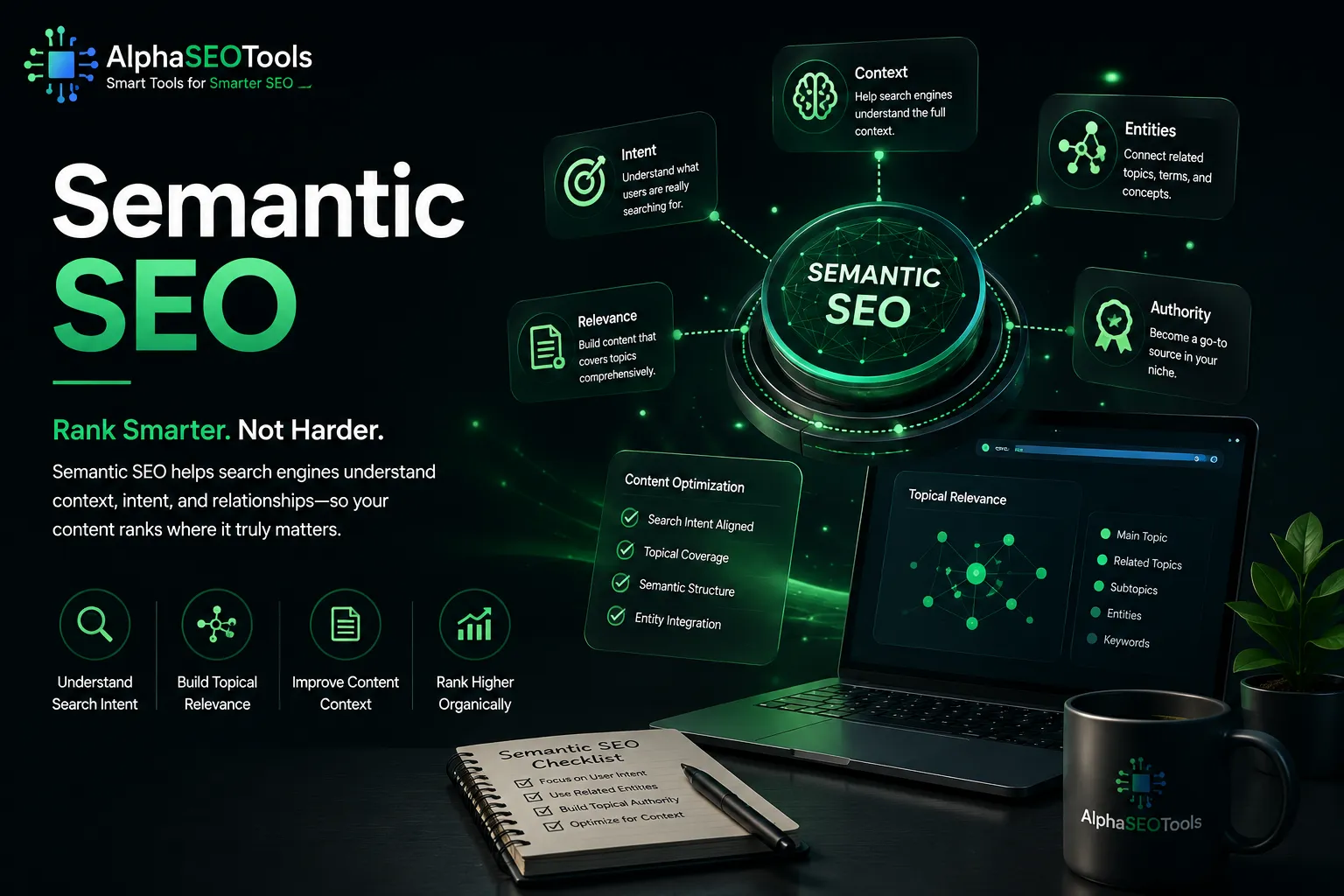
Imagine typing a question into Google like “best way to fix a squeaky wooden floor without removing carpet” and getting exactly the step-by-step guide you need—even though you never used the word “repair” or “hardwood.” This magic isn’t keyword luck; it’s semantic search at work. Semantic SEO is the art and science of aligning your content with how search engines truly understand meaning, not just match character strings. Gone are the days when stuffing a page with “cheap running shoes” guaranteed a ranking. Today, Google, Bing and other engines use advanced Natural Language Processing (NLP), entity recognition and intent analysis to connect users with answers that feel human. If you want your website to thrive in this meaning-based search landscape, you need to grasp semantic SEO from the inside out.
This article breaks down semantic SEO in the simplest possible way. You’ll learn what NLP in SEO really does, how contextual keywords replace exact‑match phrases, why meaning-based search has rewritten the rules of content strategy, and most importantly, how to optimize your pages so they resonate with both readers and modern search algorithms. No jargon without explanation. No fluff. Just a clear, actionable walkthrough that will transform the way you think about creating content.
So take a deep breath. In the next few minutes, you’ll discover how to make your website not just visible, but truly understood.
What Is Semantic SEO?
Semantic SEO is the practice of optimizing content around topics, entities and user intent rather than focusing on a single keyword. It treats a web page as a comprehensive answer to a question, enriched with context, related concepts and factual depth. The word “semantics” comes from linguistics and refers to meaning. Applied to search, it means building content that search engines can interpret the way a human would—by grasping connections, nuances and the “why” behind a query.
Traditional SEO often zeroed in on one target phrase: “best vegan protein powder.” A page would repeat that phrase multiple times, get some backlinks with that anchor text, and hope for the best. Semantic SEO flips this model on its head. Instead of obsessing over “best vegan protein powder,” you build a resource that covers protein types (pea, rice, hemp), digestibility, taste, certifications, how to use them in smoothies, and answers related questions like “Is vegan protein complete?”. Google recognizes that this page is deeply relevant to the concept of vegan protein, not just the exact phrase. As a result, the page can rank for thousands of long-tail variations—without any of them being the primary “keyword.”
This evolution was driven by the search engines’ mission to organize the world’s information and make it universally accessible. When a user asks “who played the Joker in The Dark Knight,” Google knows it’s an entity search (the actor Heath Ledger) and can pull that fact straight from the Knowledge Graph. It doesn’t just locate pages containing the words “played,” “Joker,” and “Dark Knight”; it understands the relationship. Semantic SEO aligns your content with this way of thinking. You become the source of structured, connected knowledge, not a bag of words.
Table 1: Traditional SEO vs. Semantic SEO – A Quick Comparison
| Aspect | Traditional SEO | Semantic SEO |
| Core Focus | Single primary keyword | Topic clusters, entities, and user intent |
| Keyword Usage | Exact-match repetition, density tracking | Contextual keywords, synonyms, and related concepts used naturally |
| Content Structure | Isolated pages targeting one keyword each | Pillar pages and topic clusters interlinked for comprehensive coverage |
| Search Engine View | Pages seen as bags of words | Pages seen as interconnected knowledge graphs of entities and facts |
| Ranking Goal | Rank for one or a handful of specific phrases | Rank for hundreds or thousands of long-tail queries and rich results |
| User Experience | Often stiff, repetitive copy | Natural, informative, and truly helpful content |
| Technology Leveraged | Basic crawling and indexing | NLP, machine learning, Knowledge Graph, MUM |
The Foundation: How Search Engines Understand Meaning
To master semantic SEO, you have to see the world from a search engine’s perspective. Over the last decade, Google in particular has moved from a lexical matching engine to a semantic reasoning engine. Here’s how that journey unfolded.
From Strings to Things – The Knowledge Graph
In 2012, Google introduced the Knowledge Graph, a massive database of entities (people, places, things, concepts) and the relationships between them. An entity is anything that is distinct, well-defined and can be referenced: a movie, a city, a scientific theory, a brand. The Knowledge Graph stores facts like “Albert Einstein – born in – Ulm” or “E=mc² – proposed by – Albert Einstein.” When you search for “Einstein birthplace,” Google doesn’t need to crawl a new page; it already knows the answer. For SEOs, this was a seismic shift. Your content could now be a source of entities and connections, not just keywords. By clearly mentioning related entities (“special relativity,” “Nobel Prize in Physics 1921,” “German-born theoretical physicist”) and linking them with clear context, you help the Knowledge Graph enrich its understanding of your page’s topic.
Entities, Attributes, and Relationships
Semantic search thinks in triples: subject–predicate–object. “Mount Everest (subject) – has height (predicate) – 8,848 meters (object).” Your content should do the same. If you’re writing about the iPhone 15, don’t just say “the new iPhone is great.” Describe it as an entity with attributes (A17 Pro chip, 48MP camera, USB‑C port) and relationships (successor to iPhone 14, competes with Samsung Galaxy S23). Structured data like Schema markup explicitly labels these triples for search engines, making it easier to surface rich results. But even without Schema, natural language can signal entities: “The Eiffel Tower, which stands on the Champ de Mars in Paris, was completed in 1889.” The engine extracts the entity “Eiffel Tower,” its location entity, and the completion date, building a semantic map.
The Role of Natural Language Processing (NLP)
NLP is the technology that allows machines to read, decipher and make sense of human language. It’s the engine under the hood of semantic search. When you type a query, NLP algorithms break it down into components, resolve ambiguity (“apple” the fruit vs. “Apple” the company), and match it against the billions of documents in the index that carry related meaning. Without NLP, semantic SEO wouldn’t exist. That’s why the next section dives deep into NLP in SEO—it’s the key to unlocking why your content ranks or doesn’t.
NLP in SEO: The Engine Behind Semantic Understanding
If you take only one thing from this guide, let it be this: NLP is not a buzzword; it’s the foundation of modern search. Understanding its role will completely change how you write for the web.
What Is NLP and How Does It Work?
Natural Language Processing sits at the intersection of linguistics, computer science and artificial intelligence. Its goal is to enable computers to understand, interpret and generate human language in a way that is both meaningful and useful. For search engines, NLP transforms raw text into structured data that can be analyzed for intent, entities, sentiment and much more.
Imagine the query “how to tie a tie”. An NLP pipeline starts with tokenization—splitting the sentence into words or subwords. Then part-of-speech tagging identifies “tie” as a verb and “tie” (the second one) as a noun. Named Entity Recognition (NER) might not find any proper noun, but dependency parsing reveals the grammatical structure: “how” (adverb) modifies the verb “tie,” and “a tie” is the direct object. The engine now knows this is an instructional query about a physical object, not a request about a draw in a game. All of this happens in milliseconds.
Key NLP Tasks That Directly Impact SEO
- Tokenization & Normalization: Breaking text into tokens and standardizing words (lowercasing, stemming “running” to “run”). For SEO, this means that “running shoes” and “run shoe” are connected, but modern systems go far beyond simple stemming.
- Part-of-Speech Tagging: Identifies whether a word is a noun, verb, adjective, etc. This helps distinguish between “book” as a noun (“read a book”) and a verb (“book a flight”), which affects how content matches intent.
- Named Entity Recognition (NER): Locates and classifies named entities like persons, organizations, locations, dates, and even product names. If your article mentions “Tesla,” NER determines if it’s the company, the inventor, or the band—based on context. Good content creates unambiguous entity signals.
- Dependency Parsing: Maps grammatical relationships between words, revealing subject-verb-object structures. This is crucial for understanding who did what to whom. For complex queries, dependency parsing allows engines to match long-tail questions precisely.
- Sentiment Analysis: Determines whether the text is positive, negative, or neutral. This influences review-related queries and can affect how your product page is evaluated.
- Coreference Resolution: Links pronouns to the nouns they refer to. In “Samsung released the Galaxy S24. It has a titanium frame,” NLP knows “It” refers to the Galaxy S24. When writing, clear antecedents help search engines connect the dots.
Each of these tasks feeds into the ultimate goal: understanding the meaning behind a page and a query, not just the words.
Table 2: NLP Tasks and Their Semantic SEO Importance
| NLP Task | What It Does | Why It Matters for Your Content |
| Tokenization | Splits text into meaningful units (words, subwords) | Ensures engines can process every part of your sentence, breaking nothing down incorrectly. |
| Part-of-Speech Tagging | Labels words as noun, verb, adjective, etc. | Helps resolve ambiguity; “lead” as metal vs. “lead” as verb depends on context you create. |
| Named Entity Recognition | Identifies people, places, brands, dates, products | Critical for connecting your content to the Knowledge Graph; missing entities = missed rankings. |
| Dependency Parsing | Maps grammatical relations between words | Determines the subject, object, and action in your sentences, vital for matching complex queries. |
| Sentiment Analysis | Gauges positivity, negativity, or neutrality of text | Influences how review, opinion, and product content is surfaced for comparative queries. |
| Coreference Resolution | Links pronouns (“it,” “he”) to their nouns | Prevents meaning loss when you use pronouns; clear writing means engines don’t get lost. |
BERT, SMITH, MUM – Google’s NLP Milestones
Google has publicly launched several breakthrough NLP models that revolutionized semantic search.
- BERT (Bidirectional Encoder Representations from Transformers, 2019): BERT reads text bidirectionally—it considers the full context of a word by looking at the words before and after it. This was a game-changer for conversational queries. For example, in the query “2019 brazil traveler to usa need a visa,” the old algorithm might have focused on “traveler to Brazil.” BERT understood that “to USA” is critical: the person is from Brazil traveling to the US. It affected about 10% of English queries, signaling that Google was getting serious about nuance.
- SMITH (Siamese Multi-depth Transformer-based Hierarchical, 2020): Designed to understand long documents by breaking them into blocks and comparing sentence-level meanings. SMITH can match a long article to a query even if the exact keywords appear only once in 5,000 words, because it sees the overall topic similarity.
- MUM (Multitask Unified Model, 2021): MUM is 1,000 times more powerful than BERT and is multimodal—it can understand information from text, images, and eventually video and audio. MUM can take a complex task like “I’ve hiked Mt. Adams and now want to hike Mt. Fuji next autumn, what should I do differently to prepare?” and break it down, compare the two mountains, and surface insights across languages. For SEO, MUM means content must be genuinely comprehensive and possibly enriched with visual and audio elements that engines can parse.
These models are trained on massive amounts of data to predict missing words, infer relationships and generate embeddings—dense vector representations of meaning. When you optimize for semantic SEO, you’re essentially trying to create content that yields high-quality embeddings aligned with a cluster of user intents.
How NLP Determines Search Intent
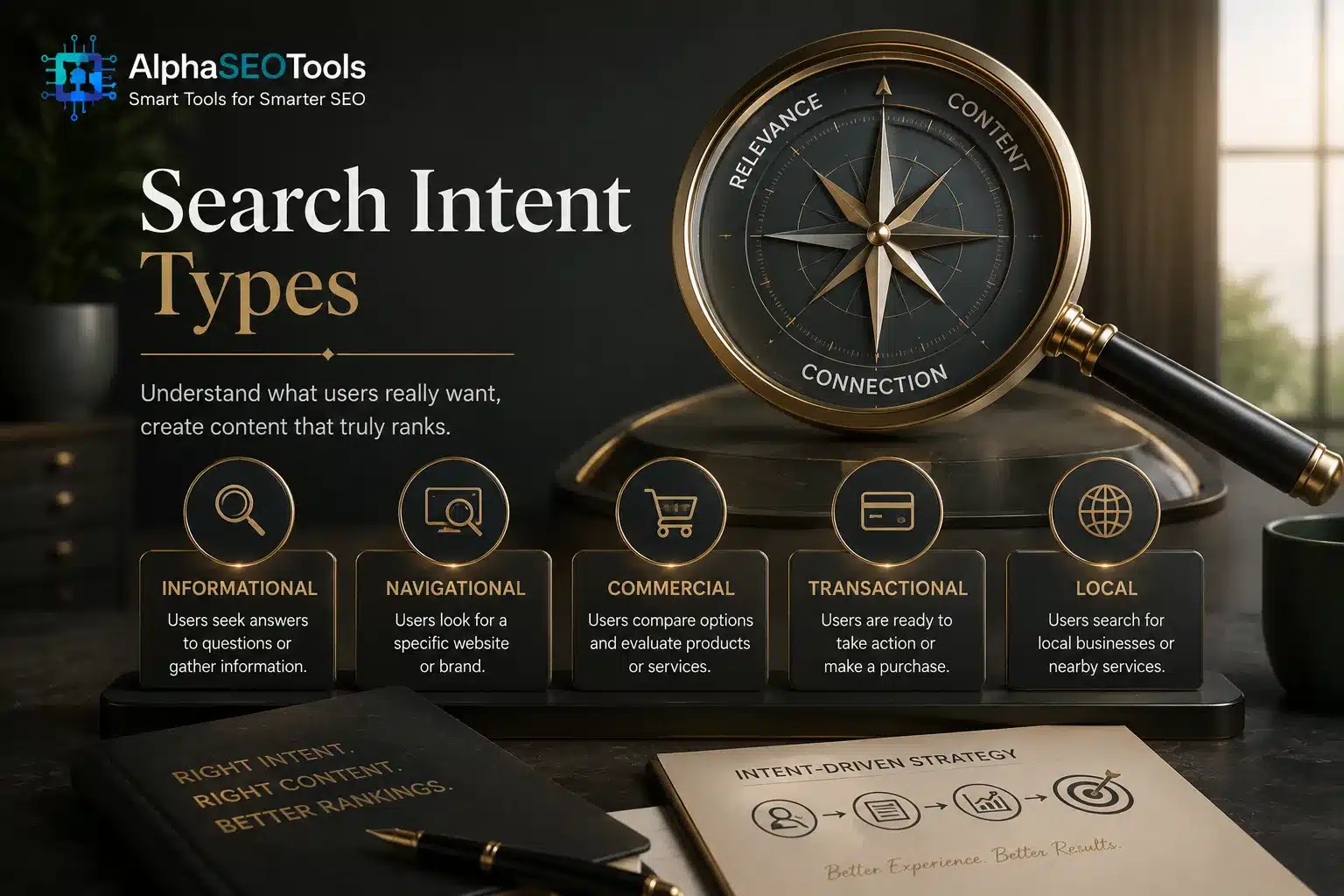
Every query has an intent. NLP classifies intent into broad categories: informational (learn about something), navigational (find a specific site), commercial (research before buying), and transactional (complete an action). But modern NLP goes deeper. It can detect micro-intents: a search for “best time to visit Italy” might have a sub-intent to avoid crowds, find cheap flights, or enjoy specific festivals. Your content that addresses these sub-intents—by discussing shoulder season, regional climate, and major events—will be deemed more relevant because the NLP model sees the topical overlap between the query’s semantic space and your page’s semantic space. In essence, NLP builds a meaning cloud, and your article needs to live in the same cloud.
Contextual Keywords: Beyond Exact Match
The phrase “contextual keywords” is often misunderstood. It doesn’t mean synonyms you sprinkle randomly. It’s about words and phrases that naturally occur when a topic is discussed comprehensively.
The Old Way: Keyword Density and Exact Match
In the early 2000s, a page about “how to potty train a puppy” would need that exact phrase in the title, header, first paragraph, and several times throughout the text. An SEO checklist might target a 2% keyword density. This led to unnatural writing like “If you want to potty train a puppy, potty training a puppy requires patience. Our puppy potty training guide covers how to potty train a puppy fast.” It was terrible for readers, but it worked. Then Google’s Hummingbird update (2013) and subsequent NLP advancements buried that approach. Search engines became capable of understanding that a page discussing “crate training,” “puppy pads,” “positive reinforcement,” and “accident cleanup” is all about puppy potty training, even if the phrase never appears.
What Are Contextual Keywords?
Contextual keywords are the terms, phrases and entities that create the semantic frame around your main topic. They are the concepts that co-occur in high-quality, expert-level content. For the topic “growing tomatoes in pots,” contextual keywords include:
- Varieties: cherry tomatoes, Roma, determinate, indeterminate
- Supplies: container size, potting mix, drainage holes, tomato cage
- Care: watering schedule, full sun, fertilizing with potassium, blossom end rot
- Related actions: hardening off, transplanting, pruning suckers
- Seasonality: last frost date, growing season, harvest time
If you write an article that naturally includes these terms, with detailed explanations and clear relationships, NLP models will embed your page into the “container tomato gardening” semantic cluster. It will then rank for a wide variety of searches, such as “what size pot for tomatoes,” “how to stop tomatoes splitting in pots,” and “best soil for potted tomatoes,” even if you never optimized for those exact strings.
How Search Engines Extract Context
Modern search engines use word embeddings and transformer-based models to capture context. Word2Vec, developed by Google in 2013, learned that words with similar meanings appear in similar contexts. It placed words like “doctor” and “surgeon” close together in vector space. But Word2Vec had a limitation: it gave each word a single static embedding. The word “bank” would always sit halfway between “river” and “money,” causing confusion.
BERT introduced contextual embeddings. The word “bank” gets a different embedding depending on whether the sentence is “I sat on the bank of the river” or “I deposited money in the bank.” This means your content must make the disambiguation crystal clear. If you’re writing about river banks, include words like “water,” “stream,” “erosion.” If you’re writing about financial banks, use “account,” “loan,” “interest rate.” That’s how the engine picks the right contextual cluster.
Crafting Content with Contextual Keywords
Creating contextually rich content is both a science and an art. Start with a topic, not a keyword. Then do the following:
- Mine related queries: Use tools like AlsoAsked.com, AnswerThePublic, or Google’s “People Also Ask” to see the questions real users have. Each question reveals a contextual concept.
- Identify entities: Use Wikipedia, Google Knowledge Graph API, or tools like TextRazor to extract the entities typically associated with your topic. Your content should mention and explain these.
- Cover subtopics comprehensively: If you’re covering “semantic SEO explained simply,” you must touch on NLP, contextual keywords, meaning-based search, entity optimization, and perhaps Google updates. An outline based on these pillars ensures semantic coverage.
- Use related terms naturally: Write as an expert would. If you truly know the subject, contextual keywords will flow into your text without artificial insertion. Editing with a “related terms checklist” can help fill gaps, but never force them.
- Leverage TF-IDF and corpus analysis: Tools like MarketMuse, SurferSEO, or Clearscope compare your content against top-ranking pages and show which relevant terms you might be missing. Use these as suggestions, not rigid requirements.
Contextual keywords are the connective tissue of semantic SEO. They signal to NLP models that your content is a genuine knowledge resource, not a thin page built around a single money keyword.
Meaning-Based Search: The User Intent Revolution
Semantic SEO and meaning-based search are two sides of the same coin. Meaning-based search is the outcome—the search experience that understands what the user actually wants. Your job as an SEO is to create content that fits that new reality.
The Shift from Lexical to Semantic Search
Lexical search matched the words in the query to the words on a page. It was brittle. If a user typed “fixing a leaky faucet” but the page used “repairing a dripping tap,” the match might fail even though they mean the same thing. Semantic search, powered by NLP, translates both the query and the documents into meaning representations. A meaning-based engine can see that “leaky faucet” and “dripping tap” are the same intent, same entity (a water tap), same problem. It also accounts for user location, search history, and real‑time context. For instance, searching “where to watch the game” on a Sunday in September in the US will likely yield NFL results; on a Saturday in May in the UK, it might mean Premier League football. Meaning-based search adapts.
Understanding Search Intent at a Granular Level
Semantic search categorizes intent but also delivers mixed-intent results. A SERP for “apple” will include the technology company, the fruit, and perhaps news about Apple Inc., because it’s an ambiguous entity. For a clearer query like “how to slice a mango,” intent is purely informational, and Google will show a featured snippet with a step-by-step guide, a video, and related questions. Meaning-based search also looks at micro-moments: “I want to know,” “I want to go,” “I want to do,” “I want to buy.” Your content needs to match these moments. A recipe blog post can address “I want to know” (ingredients, technique), “I want to do” (video demonstration), and “I want to buy” (links to tools or ingredients), all within one URL.
How Google Delivers Meaning-Based Results
Google’s ranking systems now incorporate multiple layers of meaning analysis:
- Query interpretation: Spell correction, synonym expansion, entity identification, breaking queries into meaningful chunks.
- Passage-based indexing: Even if your page is about a broad topic, a specific passage that answers a niche question can rank independently. This rewards long-form, comprehensively structured content.
- Multimodal understanding: MUM can combine text and image information. An image with alt text “ripening mango stages” next to descriptive text enriches the page’s meaning profile.
- Freshness and authority signals: Meaning-based search evaluates whether your content is current and whether the source is a recognized authority on the entity topic, often using E-E-A-T (Experience, Expertise, Authoritativeness, Trustworthiness) signals.
All these layers mean your page competes in a multidimensional semantic space, not a one-dimensional keyword arena.
Examples of Meaning-Based Queries
Consider “what’s the temperature like at the top of Kilimanjaro vs. Everest base camp in October.” This query compares two entities on an attribute (temperature) with a temporal condition. A search engine using NLP would:
- Identify entities: Mount Kilimanjaro, Everest Base Camp.
- Recognize attribute: temperature.
- Understand the temporal aspect: October.
- Find pages that contain climate data for both places, or synthesize information from multiple sources.
A page that simply lists “Kilimanjaro weather” won’t cut it. A page that includes a comparison table, month-by-month temperature averages for both locations, and practical advice will be a perfect match. Semantic SEO is about anticipating and answering these complex, real-world questions before the user even asks them.
Practical Guide to Implementing Semantic SEO
Now for the actionable part. Everything above has been building towards a clear set of strategies you can implement today.
Topic Clusters and Pillar Content
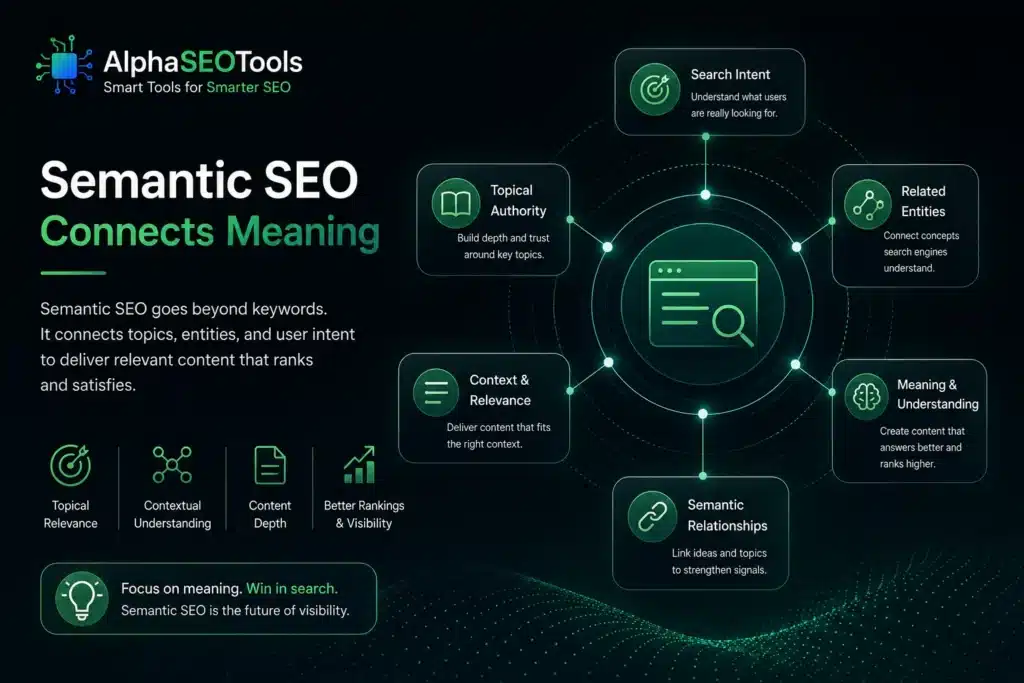
Semantic SEO thrives on structured topical authority. Instead of isolated blog posts, organize your content into clusters. Choose a broad “pillar” topic—like “Semantic SEO” for our example—and create a comprehensive pillar page that gives an overview and links out to detailed cluster pages on subtopics: “NLP in SEO,” “Contextual Keywords,” “Entity Optimization,” “Meaning-Based Search,” etc. Internal linking between pillar and cluster pages sends strong semantic signals that your site thoroughly covers the subject. Google will begin to see your domain as an authority on the semantic field. Each cluster page should itself be rich in contextual keywords and entity mentions.
Entity-Based Content Creation
Build content around entities, not just keywords. When covering a topic, list the main entities (people, products, locations, events, concepts) and ensure you define them, describe their attributes, and explain their relationships. For a post about “electric cars,” the entities could include Tesla Model 3, battery technology, lithium-ion, charging stations, range anxiety, Elon Musk, and environmental impact. Use phrases that express relations: “The Tesla Model 3 has a range of up to 358 miles,” “Lithium-ion batteries store energy through…” This feeds the Knowledge Graph and improves the chance of appearing in knowledge panels and entity-rich snippets.
Structuring Content for Semantic Understanding
- Clear heading hierarchy: Use H1 for the main title (this article’s H1 is “Semantic SEO Explained Simply…”), H2s for major sections, H3s for sub-points. Screen readers and search crawlers alike use headings to understand the outline of your content. Semantic HTML elements like <article>, <section>, <aside> also help.
- Bullet points and tables: When comparing entities or listing steps, use bulleted lists and tables. They are easy to parse and often get pulled into featured snippets.
- Schema Markup: Implement structured data such as Article, FAQ, HowTo, Product, and BreadcrumbList. Schema explicitly tells search engines what your content is about. For semantic SEO, using about and mentions properties in Schema can directly connect your page to entities. For example, a recipe schema can include recipeIngredient and nutrition entities, linking them to a unified meaning graph.
- Write descriptive alt text: Images are entities too. Describe what’s in the image using natural language that includes relevant context. “Electric car charging at a public station with city skyline in background” is far better than “car charging.”
Using Internal Linking to Build Topical Authority
Every internal link is a vote of semantic relevance. Link from contextually relevant anchor text. If a paragraph about BERT mentions query understanding, link that phrase to your pillar page on semantic search. This creates a web of meaning across your site. Avoid generic “click here” links; use anchors that describe the destination page’s topic. Also, consider adding a “Related Resources” section at the end of posts to connect sibling cluster pages.
Leveraging NLP Tools for Content Optimization
You don’t need a PhD in computational linguistics to optimize for semantic search. Several tools use NLP to give you actionable insights:
- Google NLP API: Demo available at cloud.google.com/natural-language. Paste your text and it will extract entities, analyze sentiment, and show syntax. This helps you see if your content contains the right entities.
- TF-IDF tools: Ryte, Text Tools, or even simple Python scripts can show you term frequency-inverse document frequency. This reveals terms that are unusually important in your content compared to a corpus.
- Frase.io, MarketMuse, Clearscope: These platforms use NLP to analyze top-ranking pages and suggest semantically related terms and questions to cover. They are essentially content briefing tools built on BERT-like models.
- AlsoAsked.com: Visualizes the “People Also Ask” questions from Google, showing how the semantic topic tree branches. This helps you map out a full content outline that meets meaning-based search.
Use these tools during the research and editing phases, not as a template to copy. Your goal is to understand the semantic space and write naturally within it.
Measuring Semantic SEO Success
Semantic SEO changes the KPIs you focus on. While keyword rankings still matter, you’ll see a broader impact:
- Increase in total organic keywords: A semantically optimized page often ranks for hundreds or thousands of long-tail queries. Track this in Google Search Console or Ahrefs.
- Higher average dwell time and lower bounce rate: When users find comprehensive answers, they stay longer, signaling content satisfaction.
- Featured snippet ownership: Semantic structure increases your chance of winning paragraph, list, and table snippets.
- Topical authority growth: Over time, you’ll notice that new content in the same topic cluster ranks faster because the domain has built semantic authority.
- CTR improvement: Rich results and better matching lead to higher click-through rates.
Rather than obsessing over a single “money” keyword’s position, monitor the organic traffic trend for the entire topic cluster. That’s the true testament of semantic SEO.
Common Myths and Mistakes in Semantic SEO
Clarifying these misconceptions will save you hours of misdirection.
- “LSI keywords are the secret.” LSI (Latent Semantic Indexing) is an old mathematical method patented in the 1980s. Google doesn’t use it. When people say “LSI keywords,” they usually mean contextually related terms. Use the term “contextual keywords” instead; it’s more accurate and avoids implying a magic formula.
- “You must include every related term.” No. Semantic analysis is about meaning density, not checklist tick-boxing. Forced insertion of related terms creates unnatural text. Write for humans first, then use tools to identify potential gaps.
- “Semantic SEO is just writing longer content.” Length alone doesn’t equal semantic richness. A 500-word article can be highly semantic if it directly answers a narrow query with proper entity usage and schema. A 3000-word ramble without clear structure may confuse NLP models.
- “BERT is a ranking factor you optimize for.” BERT is a query processing model, not a direct ranking factor. You can’t “optimize for BERT.” You can optimize for clarity, comprehensiveness, and natural language—which BERT understands better.
- “Structured data automagically makes a page semantic.” Schema is a helper signal; it’s not a substitute for high-quality meaning-rich text. Use both together.
The Future of Semantic Search and NLP in SEO
Semantic search is only going to deepen. Google’s MUM and future multimodal AI will transform how users find information. Imagine snapping a photo of a broken bike part and asking aloud, “How do I fix this?” The AI will identify the part through image recognition, understand the verbal query via NLP, and present a video at the exact moment the repair action is demonstrated. For content creators, this means your future articles might need to be enriched with multiple media types, each annotated with semantic metadata.
Voice search, already heavily reliant on NLP, will continue to rise, demanding even more conversational content. Passage indexing could evolve into “atomized answers” where any discrete piece of knowledge on your page becomes directly surfaced. To stay ahead, build your content as a semantic knowledge base. Treat every piece you publish as a node in a larger web of meaning, interconnected by entities, clear language, and a deep understanding of user intent.
Semantic SEO is not a trick or a fleeting trend. It’s the current state of search, and it rewards those who genuinely aim to teach, inform, and solve problems. By weaving NLP awareness, contextual keywords, and meaning-based strategies into your content process, you align yourself with the core mission of search engines: to provide the best answer, every time.
Conclusion
We’ve journeyed from the old school of exact‑match keywords to a landscape where your content is understood at a conceptual level. Semantic SEO, explained simply, is about speaking the same language as the search engines—one of entities, context, and intent. Natural Language Processing in SEO is the force that makes this possible, turning messy human language into structured meaning. Contextual keywords are your vocabulary for building topical depth without sounding robotic, and meaning-based search is the new battlefield where the most helpful, well-structured content wins.
The path forward is clear. Build topic clusters, think in entities, structure your pages with care, and never sacrifice clarity for optimization tricks. Whether you’re a seasoned SEO professional or a small business owner writing your first blog, embracing semantic principles will future‑proof your content. The engines are getting smarter, but so can you. Now it’s time to apply what you’ve learned—go create something that doesn’t just rank, but truly answers.