


By Alpha SEO Tools | June 2026
You have built the content, earned the backlinks, climbed the rankings — and then one missed renewal email wipes it all out overnight. The domain expires, the site goes dark, and Google starts deindexing your pages before you even notice. The fix is embarrassingly simple: a solid domain expiry tracker that watches your domains so you never have to lose sleep over it. This is not optional infrastructure anymore. It is the baseline.
| 360M+ active domains registered globally as of 2024 | ~$400 average recovery cost after a domain enters redemption | 68% of businesses lost traffic due to accidental domain expiry |
What a Domain Expiry Tracker Actually Does
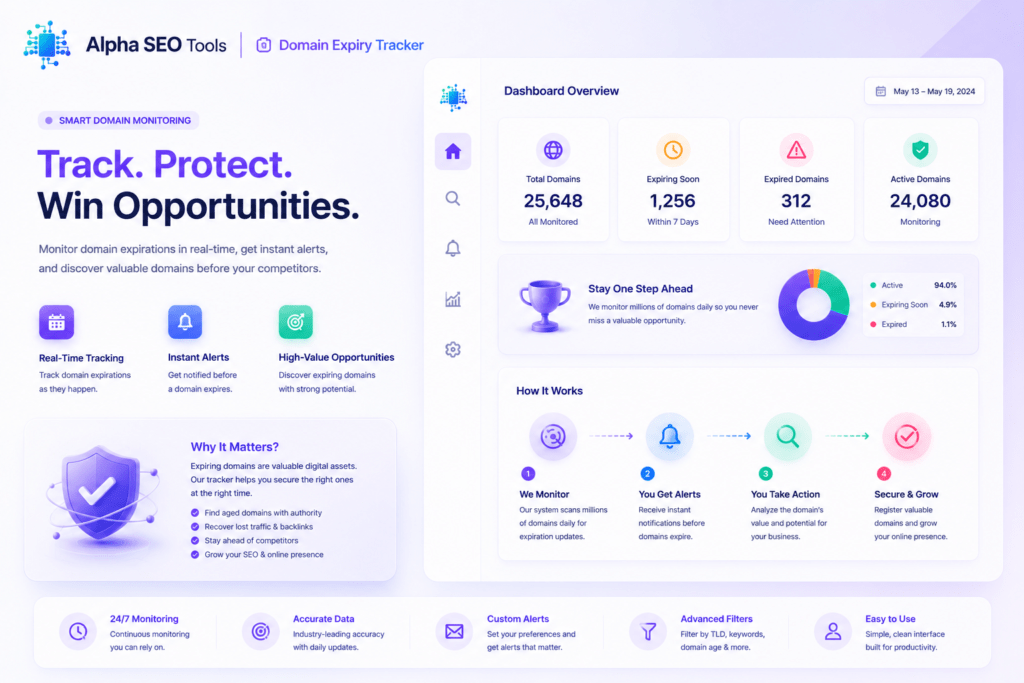
A domain expiry tracker is a tool that queries live WHOIS registries and surfaces the renewal deadline, registrar details, nameserver configuration, and domain status for any domain you point it at. The good ones — like the one at Alpha SEO Tools — do this in real time, not from a cache, and return the full registration record in one clean output.
The difference between a basic expiry reminder and a real domain expiry tracker is depth. Renewal date alone is not enough. You need registrar identity, domain age, DNS health, and contact data — all at once — because decisions about domains are almost never just about the date.
| Data Field | What It Shows | Why It Matters for SEO & Business |
| Expiry Date | When the registration lapses | Primary alert trigger — your renewal window |
| Registrar | Company holding the registration | Controls transfer authority and renewal policies |
| Registration Date | When the domain was first registered | Older domains carry stronger trust signals with Google |
| Nameservers | Active DNS provider | Flags hosting changes, hijacks, or misconfigurations |
| Domain Status | Active, locked, redemption, or deleted | Confirms whether a domain is recoverable or gone |
| Registrant Contact | Owner name or privacy proxy | Outreach route for acquisitions and link prospects |
| Last Updated | Most recent modification to the record | Signals ownership transfers or recent renewals |
Why Domain Expiry Is a Silent SEO Killer
Most SEOs spend their time on content, links, and technical audits — and completely overlook domain lifecycle management. That is a costly blind spot. A lapsed domain is not just an inconvenience. It triggers a cascade of damage that a domain expiry tracker prevents entirely, at zero cost.
What Happens the Moment a Domain Expires
The timeline moves faster than most people expect:
- Day 0: Domain expires — your website goes offline and starts returning errors
- Day 1–30: Grace period — renewal still possible at standard cost, but site is dark
- Day 31–60: Redemption period — recovery costs jump to $150–$400 depending on registrar
- Day 61–75: Pending delete — no recovery possible, domain queued for public release
- Day 76+: Domain drops — available for anyone to register, including your competitors
Every day without a functioning domain expiry tracker is a day this timeline can catch you off guard. According to ICANN’s domain lifecycle documentation, domains in the redemption phase can take up to 30 days to fully process — by which point the SEO damage is already significant.
The SEO Consequences Nobody Talks About
Google deindexes pages within days of a domain going offline — even a 48-hour lapse can trigger recrawl failures
- Backlinks pointing to a dead domain lose their equity immediately — all that link building work goes to waste
- Domain age and ownership continuity are trust signals — a lapse resets the credibility clock with search engines
- SSL certificates tied to the domain expire or become invalid — browsers flag the site as “Not Secure”
- Competitors monitoring your domain with their own domain expiry tracker can acquire your lapsed domain and redirect
- your traffic
Looking For Some Authentic Captions For Instagram For Your Profile…?? We Have Got Your Back… See Caption Haze
Three Real Workflows Where a Domain Expiry Tracker Earns Its Keep
1. Protecting Your Own Domain Portfolio
The most obvious use case — and the one people discover only after an expensive near-miss. Run your full domain list through the domain expiry tracker at Alpha SEO Tools monthly. Flag anything expiring within 90 days. Renew early, document the dates, and remove manual reminders from the equation entirely. This workflow takes under five minutes once it is set up.
2. Competitor and Opportunity Monitoring
When a competitor lets a domain lapse, the first person with a domain expiry tracker watching it wins. Set up monitoring on high-DA domains in your niche, your top competitors’ primary domains, and any expired domains with existing backlink profiles you have identified as acquisition targets. The intelligence advantage here is real and consistently underutilised.
3. Backlink Prospecting Due Diligence
Before pitching a guest post or paying for a link placement, running the target domain through a domain expiry tracker confirms the site is actively maintained, the registration is current, and it is not operating on borrowed time. Link farms and PBNs frequently run domains close to expiry. A quick WHOIS check filters them out before you invest outreach effort or budget.
How to Use the Alpha SEO Tools Domain Expiry Tracker
No login. No extension. No subscription. The domain expiry tracker at Alpha SEO Tools is built for speed — here is the full workflow:
- Open the Domain WHOIS Expiry Tracker Pro — no account setup, no permissions required
- Enter a single domain or paste a bulk list — root domains only, no http or www needed
- Hit check and wait approximately 3–5 seconds for the live WHOIS data to return
- Review the full output: expiry date, registrar, nameservers, registration date, and domain status
- For bulk work, use the Pro view — paste your full domain list and monitor expiry across every entry simultaneously
- Export results and add critical expiry dates to a shared team calendar for accountability
That is genuinely it. The domain expiry tracker was built without friction by design — the kind of tool you open, use, and get on with your day. No upsells mid-workflow, no throttled queries after ten searches, no ad interruptions. Just clean data, fast.
Domain Expiry Tracker: Free vs Manual vs Paid — Full Comparison
Here is how the domain expiry tracker at Alpha SEO Tools measures up against the alternatives:
| Feature | Manual Tracking | Alpha SEO Tools Domain Expiry Tracker | Paid SaaS Tools |
| Cost | Free (but unreliable) | 100% Free | $15–$60/month |
| Real-Time WHOIS Data | ❌ Manual only | ✅ Live, auto-pulled | ✅ Yes |
| Bulk Domain Monitoring | ❌ Not possible | ✅ Unlimited | ✅ Yes |
| Expiry Alerts | ❌ None | ✅ Built-in | ✅ Yes |
| No Login Required | N/A | ✅ Zero friction | ❌ Account required |
| Registrar + DNS Data | ❌ Separate lookup | ✅ All-in-one | ✅ Yes |
| SEO Metadata Integration | ❌ None | ✅ Native | Partial |
| Speed | Slow (manual) | ✅ Under 5 seconds | Moderate |
Where It Fits in the Alpha SEO Tools Ecosystem
The domain expiry tracker is the due diligence layer. Everything downstream in your SEO workflow is better informed because of it. Here is how it connects with the rest of the Alpha SEO Tools stack:
- SEO Metadata Tracker — audit on-page quality and social preview data of domains you are considering for outreach or acquisition
- Keyword Density Analyzer — evaluate content quality of prospect domains before committing to a link placement
- Free Domain Extractor Tool — strip root domains from raw URL lists before running bulk WHOIS queries
- SEO Hyperlink Generator — build correctly formatted links once domain health and ownership are confirmed
- Google SERP Preview Tool — check how a domain’s pages appear in search results as part of acquisition evaluation
- Bulk URL Opener — open and review all WHOIS-cleared prospect domains simultaneously
Alpha SEO Tools operates on a straightforward principle: every serious SEO task should have a free, fast, professional-grade tool behind it. The domain expiry tracker is one piece of that — but when you use it alongside the rest of the platform, the compound value becomes genuinely difficult to match with any paid alternative.
Further Reading
ICANN — Domain Name Expiration Policy — the authoritative source on redemption periods, deletion timelines, and registrant rights
ICANN WHOIS Lookup — the official global WHOIS registry for verifying raw domain registration data
Google Search Central — URL and Domain Best Practices — Google’s own documentation on how domain stability and structure affect crawling and indexing
Moz — Domain Authority Explained — context on why domain age and ownership history carry genuine SEO weight
Ahrefs — The Beginner’s Guide to Link Building — practical examples of using domain data within a link building and vetting workflow
Quick Answers ( FAQ’s )
How often should I run a domain expiry check?
At a minimum, once per month across your full domain portfolio. For high-value domains — your primary brand domain, client domains, or domains with significant link equity — set a monthly calendar reminder. The domain expiry tracker at Alpha SEO Tools makes this a five-minute task, so there is no reason to do it less frequently.
What happens if my domain enters the redemption period?
Recovery is still possible but it gets expensive fast — typically $150 to $400 depending on the registrar, on top of the standard renewal fee. Beyond the 75-day mark, the domain enters pending delete and cannot be recovered at all. A domain expiry tracker eliminates this scenario entirely by catching expiry dates 90+ days in advance.
Can I monitor competitor domains with a domain expiry tracker?
Yes — and it is one of the most underused competitive intelligence moves in SEO. Paste competitor domains into the domain expiry tracker and monitor their expiry dates alongside your own. When a competitor’s domain lapses, you have a narrow window to acquire it or redirect their existing traffic and backlink equity.
Does WHOIS privacy protection block all data?
Privacy protection masks personal registrant details — name, email, phone — but a domain expiry tracker still returns expiry date, registrar, nameservers, domain status, and registration history. That is more than enough data to make qualified decisions on any domain for SEO or acquisition purposes.
Is the Alpha SEO Tools domain expiry tracker free?
The core domain expiry tracker is completely free — no account, no usage cap, no throttling. The Pro bulk tracking version handles large domain lists for agencies and link builders managing active pipelines. All of it, free.
The One Habit That Separates Smart SEOs from Expensive Mistakes
The SEOs and site owners who consistently protect their rankings have one habit in common: they treat domain management as infrastructure, not admin. A domain expiry tracker running as part of your monthly workflow is the difference between catching a renewal deadline early and scrambling to recover a domain in redemption for four hundred dollars.
The domain expiry tracker at Alpha SEO Tools gives you everything you need — live WHOIS data, expiry monitoring, bulk domain checks, and zero friction — at no cost. There is no subscription tier it is hiding behind, no feature you have to upgrade to unlock.
Head to Alpha SEO Tools and run your first check with the domain expiry tracker right now. Your domains are either protected or they are not. The data is free. The only question is whether you look at it before it is too late.
Published by Alpha SEO Tools | alphaseotools.com | Free tools. Zero sign-up. Always.