
Let’s clear up a common confusion first.
Topical authority is not the same as Domain Authority (DA). Domain Authority is a third-party score built mostly on backlinks. It’s about how many other sites vouch for you. Topical authority, on the other hand, is about coverage: how completely and cohesively you treat a subject across your whole site.
Here’s the key difference / Summary:
| Domain Authority | Topical Authority |
| Based on backlinks | Based on content depth and coverage |
| Third-party metric (Moz) | Google’s own internal signal |
| Hard to control directly | You build it deliberately with content |
| Spreads across your whole site | Focused on specific topics |
| Takes years to build | Can show results in 60-120 days |
A finance site with just 12 clustered articles outranked a competitor with 50 scattered posts and 60% more backlinks by building topical depth rather than keyword breadth. That’s the power of topical authority.
In 2026, topical authority is now Google’s primary trust signal—not just domain authority. The 2024 Google Content Warehouse API leak confirmed two internal metrics, siteFocusScore and siteRadius, proving that niche focus is mathematically measured and rewarded by Google’s own systems.
Why Topical Authority Matters More Than Ever in 2026
1. AI Search Is Rewriting the Rules
AI Overviews now appear on more than 40% of Google searches. ChatGPT has over 800 million weekly users. When someone asks an AI engine a question, it’s not returning ten blue links—it’s composing an answer and choosing a small number of sources to cite.
To pick those sources, AI leans on what it can read from the content itself: does this site cover the subject thoroughly, do the pages connect to each other, is the information current? A site that answers the main question and the five follow-up questions in connected, well-structured pages is an easy source to trust and quote. Topical authority is what makes you quotable.
2. Most Categories Are Still Unclaimed
According to a Semrush study analyzing 1,094 U.S. categories from January to June 2026, only 15.2% of categories had a clear AI search owner by June. That means 89.3% of estimated AI search demand sits in unsettled spaces.
The opportunity is massive. Brands that focus on building topical authority now can claim ownership of their niche before competitors do.
3. Topical Authority Beats Domain Authority for Speed
Pages on high-topical authority sites gain organic traffic 57% faster and are 62% more likely to receive traffic in the first week. A study of 253,800 search results found that page-level topical authority is the largest on-page ranking factor for Google—more important than domain monthly traffic volume.
4. Zero-Click Results Are Rising
Answer engine optimization now requires fast answers, schema markup, and original data for easy citation. Brand authority plus topical authority now decide AI search outcomes. If you’re not building topical authority, you’re invisible in the AI era.
Estimate Your Free & Occupied Time Through Time & Date Duration Calculator Tool | Alpha SEO Tools
How to Build Topical Authority on WordPress: A Step-by-Step Strategy
Step 1: Pick Your Core Topic (The Pillar)
Choose one topic you genuinely want to be known for—broad enough to support twenty or more posts. For AlphaSEO Tools, this could be “SEO Tools,” “AI Search Optimization,” “WordPress SEO,” or “Technical SEO.” This is your pillar topic. Everything else will orbit around it.
Step 2: Map Your Cluster Subtopics
List every subtopic and question a reader might have. Mine People Also Ask, Reddit threads, and your own support inbox for the real questions.
For “SEO Tools,” your clusters might include:
- Keyword research tools
- Rank tracking tools
- Backlink analysis tools
- Technical SEO audit tools
- AI content optimization tools
- Site speed testing tools
Step 3: Build the Pillar-Cluster Architecture
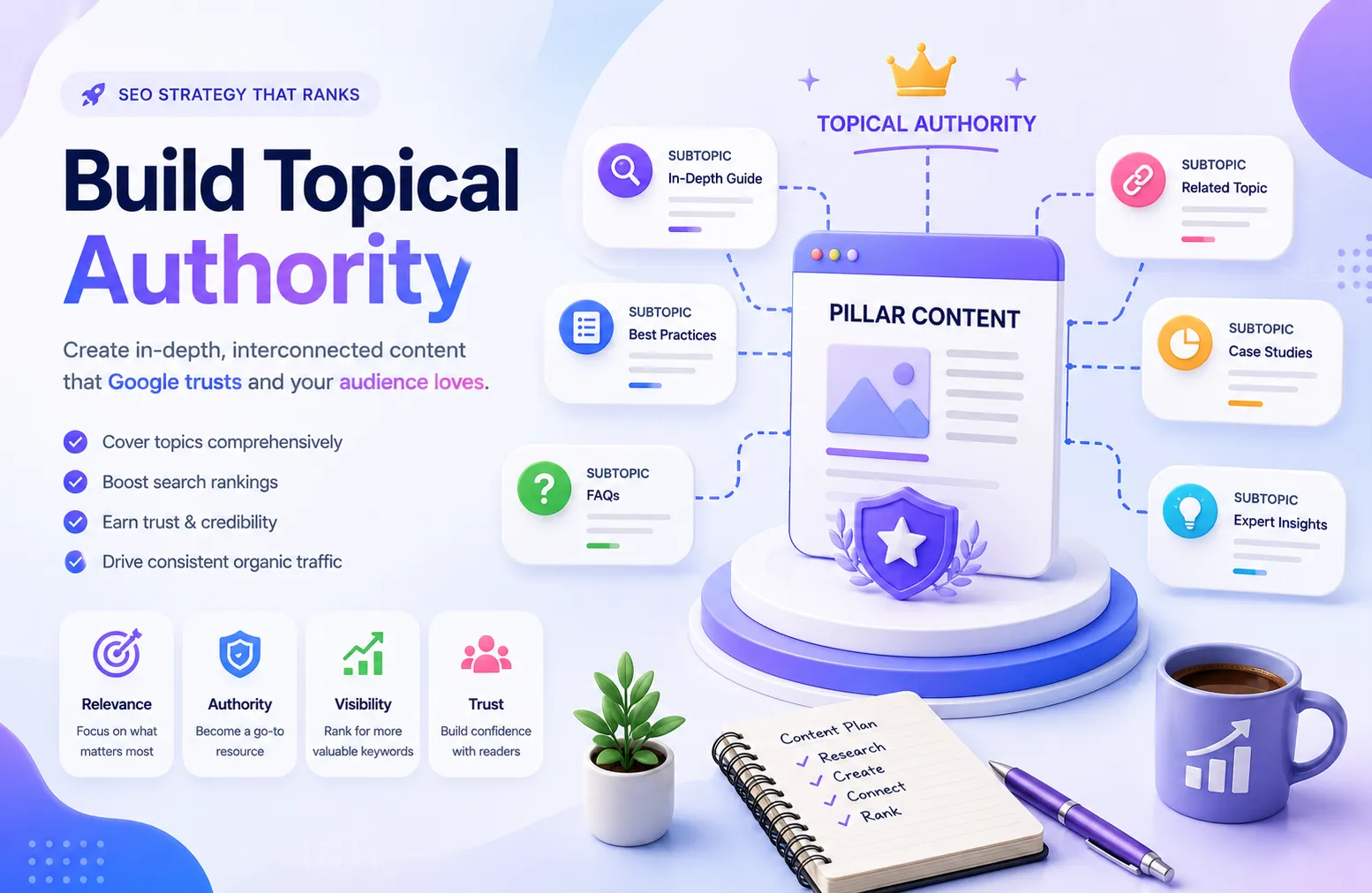
The most effective way to structure your WordPress content for topical authority is through topic clusters:
- Pillar page: The broad, definitive guide to the core topic.
- Cluster posts: Focused pieces that answer specific questions and how-tos under that topic.
- Connector posts: Comparisons, best-of lists, and troubleshooting articles that link clusters to one another.
Every cluster post links up to the pillar, the pillar links down to the clusters, and connectors stitch related clusters together. Those internal links are not decoration—they are how a search engine or AI crawler understands that these pages belong to one coherent topic.
Step 4: Master Internal Linking
This is where most WordPress sites fail. Topical authority is not achieved through content volume alone—without structured linking, topical relevance quickly breaks down. A site with hundreds of posts but weak internal linking will see topical authority stagnate across all categories.
What to do:
- Link every cluster post to the pillar page using descriptive anchor text.
- Link between related cluster posts to create a web of relevance.
- Use a WordPress internal linking plugin to automate and scale your linking strategy.
- Run regular internal link audits to identify orphan pages.
Step 5: Structure Content for AI Extraction
AI engines scan for the clearest, most direct response to a query. A page that opens with “we’re a leading provider” answers no question and gets skipped. A page that opens with the actual answer gets cited.
What to do:
- Lead with the answer: Put your main point front and center.
- Use a clean semantic heading hierarchy: One H1, descriptive H2s and H3s.
- Add FAQ sections with direct answers.
- Implement schema markup: FAQ, Article, Product, HowTo schemas.
- Use descriptive internal anchor text.
Step 6: Demonstrate E-E-A-T
Google’s quality rater guidelines emphasize Experience, Expertise, Authoritativeness, and Trustworthiness.
- Experience: Show first-hand usage of the SEO tools you review. Include screenshots, real test data, and practical walkthroughs.
- Expertise: Write with authority and accuracy. Fact-check everything.
- Authoritativeness: Earn mentions and links from other trusted sites in your niche.
- Trustworthiness: Be transparent about affiliate relationships and your testing methodology.
Step 7: Publish at Scale—But Strategically
The quickest way to increase topical authority is by publishing at least 25 authoritative articles within one tightly connected content cluster. Sites that achieve this threshold typically see a 40-70% increase in keyword rankings for their target topic within 3-6 months.
But don’t confuse volume with strategy. Twelve connected posts that own a subject will out-cite forty scattered posts that touch many subjects.
How to Measure Your Topical Authority Progress
You can’t manage what you don’t measure. Track these signals:
1. Keyword Coverage
The percentage of category keywords where you rank in the top 10. A rising percentage is a clear sign your topical authority is increasing.
2. AI Citation Share
Track how often your content is cited in AI-generated responses on queries related to your topic. Tools like Semrush’s AI Visibility Toolkit can help.
3. Branded Search Volume
An increase in branded searches for topic-related terms is a strong indicator that you are becoming a recognized authority.
4. Internal Link Health
Use a WordPress internal link audit tool to identify orphan pages and ensure your content hierarchy is intact.

2026 Topical Authority Statistics You Need to Know
- 88% of SEOs now rate topical authority as very important to their content strategy.
- Pages with high topical authority gain organic traffic 57% faster than pages with low topical authority.
- A study of 253,800 search results found page-level topical authority is the largest on-page ranking factor for Google.
- Sites with 10 or more interlinked pages on a topic cluster earn AI citations at 2 to 3 times the rate of single-page competitors.
- Only 15.2% of categories had a clear AI search owner by June 2026, leaving 89.3% of AI search demand open for the taking.
- Clear owners retained the top spot in 90.4% of month-over-month comparisons—once you earn topical authority, it sticks.
- Owners of a topic have 55.7% higher brand search volume, 48.4% more organic traffic, and 52.5% greater authority scores than runners-up.
- The most cited page types in AI search are product or service landing pages, followed by editorial content (homepages are only cited 4% of the time).
- YouTube remains the dominant source in AI search, generating 188,863 citations and growing 56.4% month-over-month.
- Wikipedia citations grew 55.2% month-over-month, reaching 83,191 citations.
Putting It All Together for Alpha SEO Tools
Building topical authority on your WordPress site is not complicated—but it requires discipline. Here’s your action plan:
- Pick one core topic you want to dominate (e.g., “SEO Tools” or “AI Search Optimization”).
- Map 20-30 subtopics that cover every angle of that topic.
- Create a pillar page that serves as the definitive guide.
- Write cluster posts for each subtopic, linking back to the pillar.
- Implement internal linking across all related posts.
- Structure content for AI extraction with clear headings and FAQs.
- Publish consistently until you reach 25+ interconnected articles.
- Track your metrics and adjust your strategy.
The window won’t stay open forever. Start building your topical authority today, and watch your WordPress site become the go-to resource in your niche.
Frequently Asked Questions (FAQ’s)
What is topical authority in SEO?
Topical authority is the degree to which a site is recognized as a comprehensive, reliable source on a specific subject. It’s built through depth of coverage, internal linking, and content interconnectedness.
How is topical authority different from domain authority?
Domain authority is a third-party score based on backlinks. Topical authority is about content coverage and cohesion. You build topical authority deliberately with content—it’s what you have the most direct control over.
How long does it take to build topical authority?
With a tight topic cluster strategy, you can see initial lifts in 60-120 days. The 25-article threshold typically delivers a 40-70% ranking increase within 3-6 months.
Why does topical authority matter for AI search?
AI engines like ChatGPT and Perplexity select sources based on how coherently a site covers a topic. Topical authority signals to AI that your site is a trustworthy source to cite.
How do I build topical authority on WordPress?
Use the pillar-cluster model: one pillar page, eight to fifteen connected cluster posts, and internal links that tie them together. Use a WordPress internal linking plugin to automate and scale your linking strategy.
This guide was updated in July 2026 with the latest data on topical authority, AI search citations, and WordPress SEO strategies. For more SEO tools and resources, explore AlphaSEO Tools.