Table of Contents
Glance at it:
Search intent types explained is the systematic analysis of the underlying goal a user holds when submitting a query to a search engine. The four fundamental categories are informational intent, navigational intent, commercial intent, and transactional intent. Mastering the identification and application of these intent types enables precise content creation, stronger organic performance, and enduring relevance across traditional, voice, and AI‑powered search environments.
Introduction
Search engines process billions of queries every day. Each one represents a person seeking an answer, a destination, a comparison, or a transaction. The text they type is merely a surface signal; beneath it lies a distinct objective. Interpreting that objective correctly is what separates content that ranks and satisfies from content that languishes unseen. This discipline has a name: search intent types explained.
The ability to accurately classify and respond to query intent has become the single most influential factor in modern search optimization. Algorithms no longer rely on isolated keywords. They evaluate entire pages against the inferred purpose of a search. When content aligns with that purpose, dwell time increases, bounce rates fall, and trust accumulates—both with users and with the ranking systems that guide them. When content misaligns, the page is discarded, often within seconds.
This guide provides an exhaustive examination of search intent types explained. It defines each primary category with precision, demonstrates how to extract intent signals from search engine results pages, and outlines a repeatable methodology for building content portfolios that match user needs at every stage of the journey. The discussion extends into mixed intent, local intent, and the implications of generative AI and voice interfaces, where satisfying intent is more consequential than ever. The goal is not merely to describe a concept but to equip practitioners with a durable strategic asset.
What Is Search Intent?
Search intent—synonymous with user intent, query intent, or searcher intent—refers to the specific goal a person aims to achieve when performing a search. It answers the question: why did this individual type these words? The answer could be a desire for knowledge, a wish to locate a particular website, an intent to research products before purchasing, or a readiness to complete a transaction immediately.
Within the framework of search intent types explained, it is critical to understand that identical keyword strings can carry entirely different purposes depending on context. A user entering “Apple” might be seeking the technology company’s homepage (navigational intent), information about the fruit (informational intent), stock performance data (commercial investigation), or a local store to purchase a device (transactional with local intent). Only by analyzing surrounding signals can one reliably determine the dominant purpose.
Modern search engines deploy deep learning models, such as Google’s BERT and MUM, to decode this purpose at scale. They process query language, historical user behavior, and the content of indexed pages to infer what a searcher truly wants. For the content professional, search intent types explained means operating on the same wavelength—producing resources that anticipate and fulfill that inferred need before the user ever needs to reformulate their query.
Why Search Intent Types Explained Is Central to SEO Performance
Ranking well in organic search is no longer a function of keyword density or even raw backlink volume alone. The fundamental question Google asks of every page is: does this result give the searcher what they came for? If the answer is no, no amount of external authority can permanently sustain the position.
When a website consistently delivers on intent, the user experience metrics speak clearly. Dwell time lengthens. Pogo-sticking—the act of clicking a result and immediately returning to the SERP—declines. Click-through rates improve because title tags and meta descriptions accurately reflect the page’s content. Over time, these signals accumulate, and the page’s ranking stabilizes. This is the practical outcome of applying search intent types explained rigorously.
Conversely, intent misalignment produces rapid user departure. A product page forced into an informational query will see visitors flee within seconds. A blog post attempting to rank for a transactional term will generate neither engagement nor conversions. The search engine observes these failure patterns and gradually demotes the page. Mastering search intent types explained is therefore not a theoretical exercise; it is the foundation upon which sustainable search visibility is built.
The Four Core Search Intent Types Explained
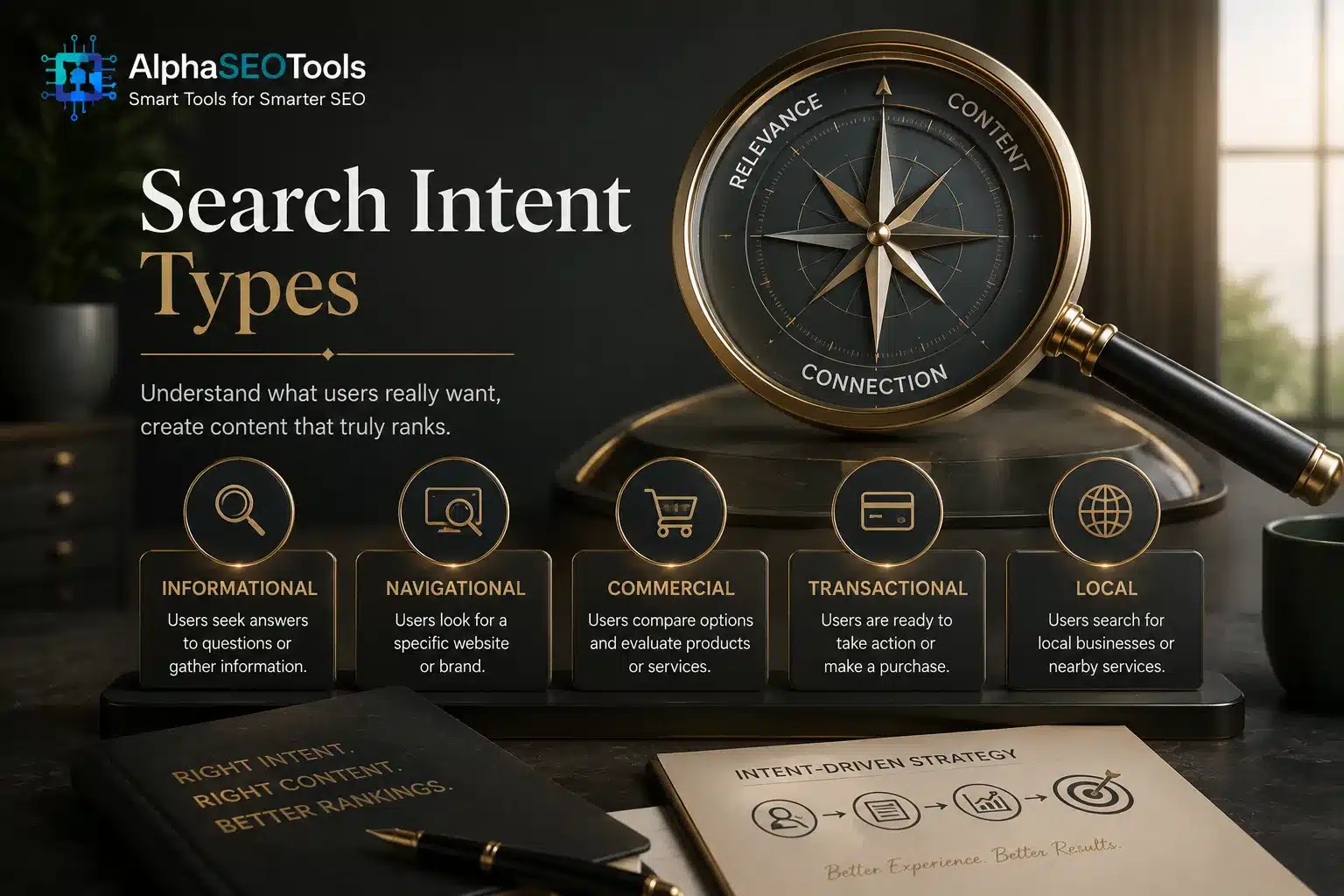
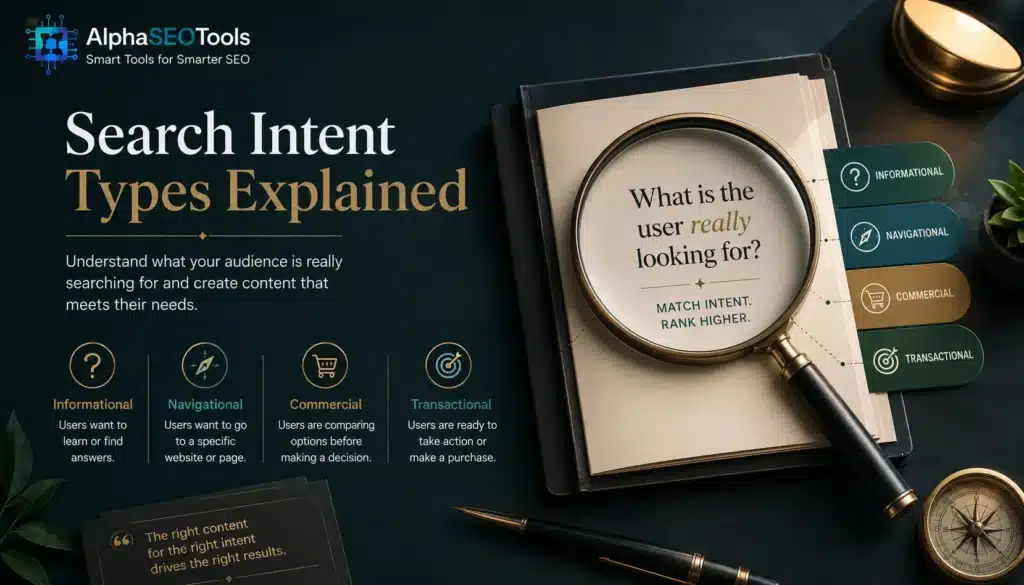
The SEO industry has broadly standardized on four primary categories of search intent. While the boundaries between them can blur, these classifications provide an essential lens for content planning and keyword research.
Informational Search Intent Types Explained
Informational intent dominates search volume. The user seeks knowledge, answers, instructions, or understanding. They are not in a purchasing mindset; their need is purely cognitive. Queries often begin with interrogatives: what, why, how, when, where, and who. Other common informational phrases include “guide,” “tutorial,” “definition,” “examples,” and “tips.”
Representative informational searches include “how to change a tire,” “what is blockchain technology,” “history of the Silk Road,” and “symptoms of seasonal allergies.” The user expects a clear, accurate, and well-structured explanation. They do not expect to be sold to.
In the context of search intent types explained, informational content should prioritize pedagogical clarity. The most effective pages present a concise answer near the top—often in a short paragraph or bulleted list—and then expand into greater depth. Rich media such as diagrams, infographics, and video embeds enhance comprehension. Structured headings and a table of contents allow users to navigate to the precise sub-topic they need. This format is also preferred by Google’s featured snippet extraction and AI overview generation.
Navigational Search Intent Types Explained
Navigational intent arises when a user already has a specific website or page in mind and uses the search engine as a conduit. They might type a brand name (“Nike”), a service portal (“Stripe login”), a social platform (“YouTube”), or a specific resource location (“Apple support manual”).
For the site owner, winning navigational queries is largely a function of technical soundness and brand authority. The official domain should be the first result for its own brand terms. This requires proper indexation, a clean canonical setup, and a logical information architecture that allows crawlers to associate the brand entity with its primary pages.
Within search intent types explained, navigational queries are unique in that the searcher’s satisfaction does not stem from discovering new information but from reaching a known destination efficiently. Any friction—slow loading, a missing login page, a competitor bidding on the brand term—degrades the user experience and can erode brand trust.
Commercial Search Intent Types Explained
Commercial intent—often called commercial investigation intent—occupies the middle of the buying funnel. The user intends to make a purchase in the future but is currently evaluating options. They compare products, read reviews, assess pricing, and seek authoritative recommendations.
Common commercial query modifiers include “best,” “top,” “reviews,” “comparison,” “vs,” “alternatives,” “affordable,” “premium,” “features,” and “worth it.” Example searches include “best project management software for small teams,” “iPhone 16 vs Samsung Galaxy S25 camera,” “Semrush pricing review,” and “top-rated standing desks.”
For content creators, commercial intent demands depth, objectivity, and transparency. Formats such as detailed comparison tables, buyer’s guides, and methodologically sound review articles perform best. The user wants to understand trade-offs. They seek guidance they can trust. In search intent types explained, commercial content that acknowledges both strengths and limitations builds the credibility necessary to shepherd users toward a confident transaction.
Transactional Search Intent Types Explained
Transactional intent signals immediate action readiness. The user has completed research and is prepared to buy, subscribe, download, book, or hire. Queries include words like “buy,” “order,” “discount,” “coupon,” “pricing,” “sign up,” “download,” “free trial,” and “get a quote.” The search “buy Sonos Era 300” or “pizza delivery downtown Austin” exemplifies transactional intent.
The appropriate response to transactional intent is a conversion-optimized page. For ecommerce, this means a product page with high-quality imagery, clear pricing, prominent “add to cart” buttons, and trust signals such as secure checkout badges and customer reviews. For services, it means a landing page with a concise value proposition, an accessible contact form or booking calendar, and social proof elements.
Search intent types explained in this stage is about removing obstacles. The user’s intent is hot; any delay or confusion introduces cognitive friction that sends them to a competitor. The page must load instantly and present a single, unmistakable path to completion.
Table 1: Search Intent Types Explained – A Comparative Overview
| Intent Type | User Goal | Common Query Modifiers | Ideal Content Format | SERP Features Often Present |
| Informational | Acquire knowledge | what, why, how, when, guide, tutorial, meaning | Blog post, guide, video, FAQ page, infographic | Featured snippet, People Also Ask, knowledge panel, AI Overview |
| Navigational | Reach a specific site or page | brand names, login, homepage, support, contact | Homepage, login portal, branded landing page | Sitelinks, knowledge panel, brand Knowledge Graph |
| Commercial | Research before purchasing | best, top, review, comparison, vs, alternatives, pricing | Comparison article, buyer’s guide, review roundup | Shopping ads, review stars, People Also Ask, product carousel |
| Transactional | Complete an action or purchase | buy, order, discount, download, sign up, book, near me | Product page, service landing page, checkout | Shopping ads, local pack, direct product listings |
This table provides a concise, actionable reference for anyone applying search intent types explained to content planning. The alignment of query modifier, content format, and SERP expectation is the core of effective intent optimization.
Mixed Intent and Intent Overlap
While the four-category model is foundational, real‑world searches frequently blend multiple intents. A query like “best running shoes for marathons” is primarily commercial, yet it contains an informational component—the user wants to understand what features make a shoe suitable for marathon distances. Another query, “buy Nike Air Max near me,” combines transactional and local intent with a specific brand preference.
Search intent types explained must therefore account for layered motivations. Google’s own SERPs often reflect this ambiguity by serving mixed‑intent results. A search for “electric cars 2026” might display a news article (informational), a comparison guide (commercial), and a local dealer inventory (transactional/local) on a single page. This indicates that the engine recognizes multiple valid intents.
For content strategists, the practical lesson is to design pages that address the primary intent while accommodating secondary needs. A commercial buyer’s guide should include clear, educational explanations of technical terms. A transactional product page can benefit from a short FAQ section that answers common pre‑purchase questions. These layered approaches satisfy more users, improve engagement metrics, and align with the nuanced nature of modern search behavior.
How to Identify Search Intent for Any Keyword
Determining intent reliably requires a blend of linguistic analysis, SERP observation, and understanding of the user journey. The following methodology, anchored in search intent types explained, provides a repeatable diagnostic process.
- First, examine the query’s linguistic construction. The presence of question words strongly suggests informational intent. Brand names point to navigational or transactional intent depending on modifiers. Terms like “best” or “review” indicate commercial investigation. Action verbs such as “buy” or “download” signal transactional readiness. While not infallible, this linguistic layer provides an immediate hypothesis.
- Second, perform a live SERP analysis. Enter the keyword into the search engine and record the format of the top‑ranking pages. Are they predominantly blog posts, product pages, category hubs, or videos? This reveals the content format the algorithm has determined satisfies the query. Additionally, note the SERP features that appear. A featured snippet at the top indicates that Google believes users want a quick, extractable answer—a hallmark of informational intent. Shopping carousels and product listing ads signal commercial or transactional intent. A local pack indicates local intent.
- Third, study the content angle of the leading pages. Observe not just the format but the framing. Are the top results tailored for beginners or experts? Do they emphasize affordability, premium quality, or speed? The dominant angle provides insight into the audience’s expectations and helps refine the approach within the search intent types explained framework.
- Fourth, consider the funnel stage. Ask whether the searcher is likely at the awareness, consideration, or decision phase. This contextual layer ensures that content not only matches the query but also the psychological readiness of the user.
By applying this four‑step diagnostic consistently, teams can move beyond guesswork and build content plans rooted in empirical evidence rather than assumption.
Content Strategy Aligned with Search Intent Types Explained
Once intent is understood for a set of target keywords, content creation becomes a precise mapping exercise. Each intent category demands a distinct content format, structural approach, and conversion posture.
- For informational intent, long‑form guides, tutorials, explainer articles, and educational videos are ideal. The content should prioritize breadth and clarity. A logical heading hierarchy, a clickable table of contents, and the strategic use of images and diagrams all enhance the user experience. Calls‑to‑action should be subtle—perhaps an invitation to join a newsletter or explore related resources—rather than aggressive sales pitches.
- For commercial investigation intent, the emphasis shifts to comparative depth. Detailed comparison tables, feature matrices, pricing breakdowns, and honest assessments of strengths and weaknesses are essential. Transparency about how recommendations were derived builds the authority needed to influence a future purchase decision. Pages optimized for commercial intent often serve as the critical bridge between initial awareness and final conversion.
- For transactional intent, the page must be designed for conversion with minimal friction. High‑resolution product images, concise yet persuasive copy, clear pricing with no hidden fees, and a streamlined checkout or contact process are non‑negotiable. Every element that distracts from the primary action should be removed.
- For navigational intent, the content team’s responsibility is primarily architectural. Ensuring that the correct pages are live, indexed, canonicalized, and easily discoverable through clear site navigation and internal links is the objective.
In all cases, the page’s title tag, meta description, and URL should reflect the intent. An informational page might use a title like “What Is Content Marketing? A Complete Guide,” while a transactional page might read “Buy Running Shoes Online – Free Shipping & Returns.” These signals help both users and search engines immediately understand the page’s purpose, reinforcing the principles of search intent types explained.
Search Intent and the Marketing Funnel
Search intent types explained maps directly onto the classic marketing funnel. Top‑of‑funnel queries are overwhelmingly informational. Users become aware of a problem or opportunity and seek understanding. Content at this stage builds brand awareness and positions the site as a helpful authority.
Middle‑of‑funnel queries align with commercial investigation. Users have identified their need and are evaluating potential solutions. Content here should compare options, highlight unique value propositions, and nurture trust. A well‑crafted comparison guide can influence preference for months before a purchase is made.
Bottom‑of‑funnel queries are transactional. Users are ready to act, and content must facilitate conversion without hesitation. The alignment between intent stage and content type ensures a seamless user journey from discovery to action.
Post‑purchase queries, often overlooked, are typically informational or navigational—how‑to guides for using a product, warranty information, support contact pages. Addressing these intents effectively boosts customer satisfaction and retention, and can generate positive engagement signals.
AI, Voice Search, and the Evolution of Intent Understanding
The emergence of AI‑powered search experiences, including Google’s AI Overviews, large language models, and voice assistants, has added a new dimension to search intent types explained. While the underlying human goals remain constant, the manner in which answers are surfaced and consumed is shifting rapidly.
Voice queries are typically longer, more conversational, and heavily question‑based. A spoken query like “What’s the best Italian restaurant that’s open late near me?” blends commercial, local, and transactional intent into a single natural language string. Optimizing for voice search requires anticipating such conversational phrasing and providing concise, direct answers that a voice assistant can read aloud. FAQ sections marked up with FAQ schema are particularly effective for capturing voice results.
AI overviews synthesize answers from multiple authoritative sources and display them directly on the SERP, often above the traditional blue links. For informational intent, being cited in an AI overview is now a primary visibility objective. This demands content that is not only accurate and comprehensive but also machine‑readable. Clear entity definitions, logical information hierarchy, and the use of structured data enable AI systems to extract and cite content with confidence.
In the search intent types explained framework, generative engine optimization (GEO) extends traditional practices by emphasizing entity richness, factual precision, and semantic depth. The page that can serve both the human reader and the machine parser is the page that will maintain visibility across all search surfaces.
Common Mistakes When Applying Search Intent Types Explained
Despite the conceptual simplicity, intent misalignment remains one of the most frequent causes of SEO underperformance.
- One pervasive error is optimizing for a keyword’s surface meaning without verifying intent via the SERP. A term like “project management” may appear informational but often yields commercial SERPs dominated by software listings. Creating an educational guide for such a term without recognizing the commercial reality dooms the page to obscurity.
- Another mistake is format rigidity. Producing blog posts for every keyword in a list, regardless of whether the SERP shows videos, product pages, or local results, ignores the clear signals the search engine provides. Format flexibility is a competitive advantage.
- Keyword cannibalization—multiple pages targeting the same query with the same intent—also undermines performance. A periodic content audit, informed by search intent types explained, can identify these redundancies and guide consolidation into a single, authoritative resource.
- Finally, treating intent as static leads to gradual decay. User expectations evolve, and the dominant intent for a keyword can shift over time. Regular SERP monitoring and content refreshes ensure continued alignment.
Frequently Asked Questions
How do I identify the intent of a keyword?
Analyze the query language for modifiers, observe the format of top-ranking pages on the SERP, note the SERP features present, and consider where the user is in the marketing funnel.
Why is matching search intent important for SEO?
Pages that satisfy the user’s true intent earn better engagement signals—longer dwell time, lower bounce rates—and are rewarded with higher, more stable rankings.
Can a single query have multiple intents?
Yes. Mixed intent is common, especially for queries like “best laptops,” which combine commercial investigation with informational elements. SERP analysis reveals the dominant intent.
How does AI affect search intent optimization?
AI‑generated search answers and voice assistants demand content that is not only helpful but also machine‑readable, with clear entity definitions, structured data, and conversational phrasing.
Conclusion
Search intent types explained is far more than a conceptual sorting exercise. It is the strategic framework that connects keyword research, content creation, technical optimization, and user experience into a cohesive whole. In a digital ecosystem where attention is fleeting and competition is relentless, the ability to discern and satisfy the true purpose behind every query is what separates enduring search presence from temporary visibility.
By internalizing the four intent categories, adopting a disciplined diagnostic process, and remaining adaptable to emerging AI and voice interfaces, content professionals can build libraries of pages that resonate deeply with users and earn the sustained trust of search engines. The discipline requires vigilance, regular re‑evaluation, and a genuine commitment to helpfulness. Yet the reward is a resilient, intent‑driven content ecosystem that continues to perform as algorithms evolve and user behaviors shift. That is the promise of search intent types explained—fully understood and skillfully applied.