

A pillar page is a comprehensive, authoritative hub page that covers a broad topic in depth and links to detailed cluster pages on specific subtopics. It builds topical authority, strengthens internal linking, and drives organic traffic by satisfying search intent. This guide provides a complete step‑by‑step framework for creating a pillar page that ranks, earns backlinks, and remains visible in both traditional and AI‑powered search.
Introduction
A website without a clear organisational backbone is like a city without a map. Individual articles may be brilliant, but if they are not connected in a way that search engines and users can follow, much of that brilliance is wasted. The pillar page is the solution to that chaos. It is the architectural centrepiece that transforms a scattered blog into a coherent, authoritative content ecosystem.
In the modern landscape of search engine optimization, a pillar page is far more than a long article. It is a strategic asset—a single, meticulously crafted page that provides a complete overview of a broad topic, while acting as the parent hub for a network of interlinked, detailed cluster pages. This model, widely known as the topic cluster framework, has become the backbone of high‑performance SEO content strategies across industries. It is the mechanism through which websites build genuine topical authority, earn trust with Google, and capture organic traffic at scale.
This guide is a deep dive into the pillar page. It will define exactly what a pillar page is, explain why it is a non‑negotiable component of any serious content marketing effort, and provide a detailed, step‑by‑step framework for creating one. It will explore the different types of pillar pages, dissect the critical role of internal linking and semantic SEO, and examine how to future‑proof a pillar page for generative engine optimization and AI search. Throughout, real‑world examples and a detailed table will illustrate key concepts. By the end, every reader will possess a complete, actionable blueprint to build pillar pages that not only rank but dominate.
What Exactly Is a Pillar Page? A Detailed Definition
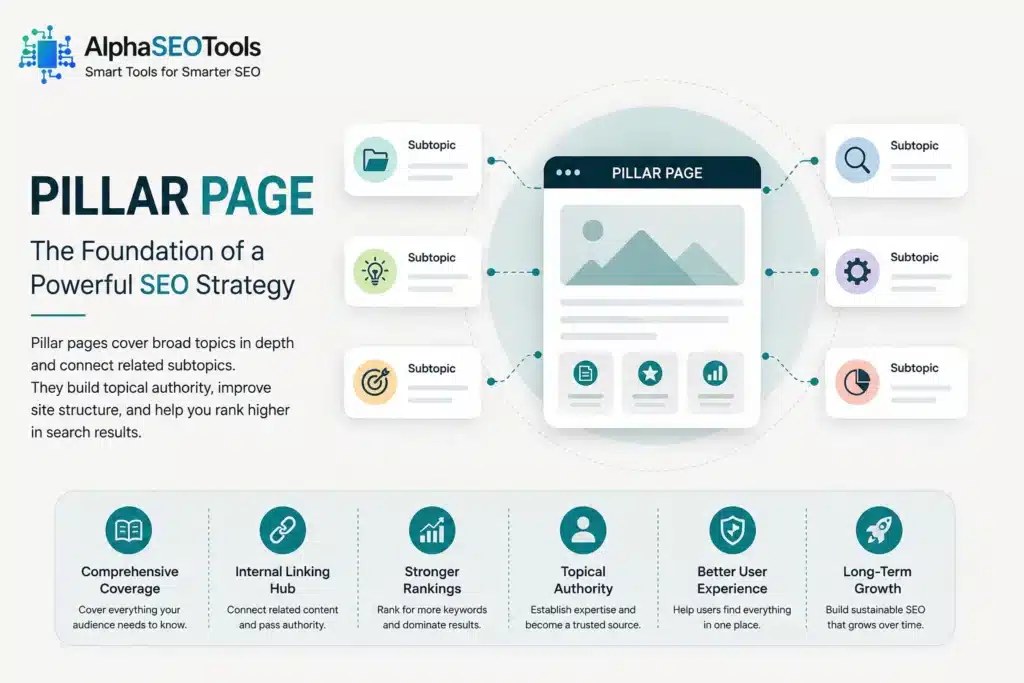
A pillar page is a comprehensive, authoritative web page that acts as the central hub for a broad topic. It provides an exhaustive yet high‑level overview of its subject, covering all essential concepts, and strategically links to multiple, more granular pages (often called cluster pages, supporting articles, or satellite pages) that explore specific subtopics in depth. This structure—the pillar page at the centre, surrounded by interlinked cluster pages—is what forms a topic cluster, a proven model for building topical authority and improving organic search performance.
The defining characteristic of a pillar page is its breadth combined with structural purpose. It does not attempt to cover every minute detail in one place; instead, it offers a complete, digestible overview that satisfies the core search intent of a broad query, while offering clear pathways (through contextual internal links) to deeper information. Think of it as the trunk of a tree: solid, foundational, and the point from which all branches (cluster pages) extend. Each branch, in turn, strengthens the trunk by linking back to it.
A pillar page is distinct from a regular blog post in several key ways. A blog post is typically narrowly focused, relatively short, and often time‑bound. A pillar page is evergreen content, designed to remain relevant for years with periodic updates. It is significantly longer and more comprehensive. It is also the primary page a site owner wants to rank for the most important, high‑volume focus keyword associated with a topic. For example, a digital marketing site might have a pillar page titled “The Ultimate Guide to SEO,” which covers on‑page SEO, off‑page SEO, technical SEO, and link building at a high level, and links out to detailed guides on each of those subtopics.
Synonyms for pillar page are abundant: cornerstone content, hub page, resource hub, knowledge hub, topic hub, comprehensive guide, ultimate guide, and 10X content. In the WordPress ecosystem, plugins like Rank Math and Yoast refer to this as cornerstone content. Regardless of the label, the function is identical: to be the single best, most linked‑to, most authoritative page on a website for a given subject. A properly built pillar page is not merely a long piece of writing; it is a carefully structured content asset designed to serve both human visitors seeking to learn and search engine crawlers evaluating expertise.
See The Alpha SEO Tools Overview & Guide To Semantic SEO: Click Here
Why Pillar Pages Are Non‑Negotiable for Modern SEO
Search engines have evolved dramatically. They now use sophisticated natural language processing and semantic understanding to evaluate content. A pillar page is perfectly aligned with this evolution, making it one of the most powerful tools in an SEO professional’s arsenal. Its importance stems from five core benefits.
- First, a pillar page directly establishes topical authority. When a website clusters interlinked content around a central hub, it signals to algorithms like Google’s that the site possesses comprehensive expertise on that subject. This is not about a single keyword; it is about covering an entire topic ecosystem. The pillar page and its supporting pages work together to answer virtually every question a user might have, which search engines interpret as a strong relevance signal and reward with higher search rankings.
- Second, a pillar page enables a superior internal linking structure. The hub‑and‑spoke model naturally creates a clean, logical hyperlink structure. The pillar links out to every relevant cluster page, and each cluster page links back to the pillar. This bidirectional linking distributes link equity (often informally called link juice) efficiently throughout the site. It also eliminates orphan pages—pages with no internal links pointing to them—which are often invisible to search engines. With a pillar page, every piece of cluster content is connected, improving crawl efficiency and ensuring that page authority flows to where it is most needed.
- Third, a pillar page is a magnet for backlinks. Other websites and industry publications are far more likely to reference a definitive, well‑structured comprehensive guide than a short, superficial post. These referring links boost the pillar’s domain authority and, through the internal linking web, strengthen the entire cluster. A pillar page thus becomes a compounding asset: more links lead to higher rankings, which lead to more traffic and even more natural links.
- Fourth, a pillar page perfectly satisfies search intent, especially informational intent. Users searching for broad terms like “what is content marketing” or “email marketing strategy” want a thorough overview, not a narrow article. A pillar page delivers that immediately, while offering clear navigation to deeper dives. When a page meets user intent so effectively, dwell time increases, bounce rates drop, and user engagement metrics improve—all of which are positive ranking signals.
- Finally, a pillar page is inherently ready for the future of search. With the rise of voice search, conversational search, and AI‑generated search, content that is structured, semantically rich, and authoritative is favoured. Large language models and AI search tools source their answers from content that defines entities clearly, uses proper heading hierarchy, and provides comprehensive answers. A pillar page built with answer engine optimization (AEO) and generative engine optimization (GEO) in mind is more likely to appear as a direct answer or in an AI‑powered overview, securing visibility in a zero‑click landscape.
The Anatomy of a High‑Performing Pillar Page
To understand what makes a pillar page effective, it helps to visualise its components. The following table breaks down the essential elements of a pillar page and explains their purpose in both user experience and SEO.
| Element | Description | SEO & UX Benefit |
| SEO Title & Meta Description | A compelling, keyword‑rich title (H1) and a concise summary that appears in SERPs. | Drives click‑through from search engine results pages; improves search visibility. |
| Table of Contents | A clickable list of all major sections, often with anchor links. | Enhances scannability, reduces bounce rate, and can appear as sitelinks in search. |
| Comprehensive Introduction | A section that defines the topic, sets expectations, and explains what the reader will learn. | Aligns with informational intent; reduces dwell time abandonment. |
| Logical Heading Hierarchy | H1 for the title, H2 for main sections, H3 for subsections, all following a nested order. | Improves crawlability, readability, and helps Google understand content hierarchy. |
| Strategic Internal Links | Contextual links to detailed cluster pages using optimized anchor text that describes the destination. | Passes link equity, strengthens topical relevance, improves content discovery, and eliminates orphan pages. |
| Rich Media | Relevant images, infographics, embedded videos, and interactive checklists. | Increases engagement, breaks up text, and provides additional ranking opportunities via image/video search. |
| FAQ Section with Structured Markup | A question‑and‑answer block using FAQ schema markup, addressing common queries concisely. | Eligible for people also ask and voice search results; enhances semantic understanding. |
| Authoritative External Links | Citations to trusted, relevant external sources. | Boosts trustworthiness and aligns with E‑E‑A‑T guidelines. |
| Clear Calls‑to‑Action | Relevant next steps, such as a newsletter sign‑up, a related guide pillar page, or a product demo. | Converts organic traffic into leads or deeper engagement. |
| Freshness Indicators | Visible publication and “last updated” dates. | Signals content freshness, a known ranking signal. |
Each of these elements must be present and optimised. A missing table of contents or a poorly structured heading hierarchy can undermine even the most well‑written content. The pillar page must be viewed as a holistic product, not just a text document.
Pillar Page Types: Choosing the Right Format for Your Topic
Not all pillar pages are identical. The format should be dictated by the core topic and the search intent it addresses. Understanding the available formats helps in planning a pillar page that resonates with the audience and performs well in organic search.
- The Guide Pillar Page (Ultimate Guide): This is the most common format. It takes a broad subject and organises it into a logical, chapter‑like flow. For example, a pillar page titled “The Ultimate Guide to Social Media Marketing” would cover strategy, platforms, content creation, analytics, and advertising. Each major section links to a detailed cluster page on that specific area. This format excels at capturing high‑volume informational intent queries.
- The Resource Pillar Page (Resource Hub): This type acts as a curated directory. It might list and describe the best tools, templates, articles, or external resources for a given topic. For instance, “50 Best Digital Marketing Tools for 2025” is a resource hub. It links heavily to internal tool reviews or external sites, making it highly link‑worthy and excellent for attracting backlinks.
- The “What Is” Pillar Page (Definition Guide): Designed to answer foundational questions like “What Is Account‑Based Marketing?” this pillar page exhaustively defines the concept, its history, benefits, and core components, then links to supporting articles on strategy, tactics, and examples. It is ideal for capturing question intent and voice search queries.
- The “How‑To” Pillar Page (Step‑by‑Step Framework): While many how‑to articles are cluster content, a very broad process can serve as a pillar page. For example, “How to Start an E‑commerce Business: A Complete Guide” covers every stage from ideation to first sale. It provides the overarching roadmap, with links to detailed guides on business plan writing, product sourcing, and store setup.
- The Product/Service Pillar Page: For e‑commerce or SaaS sites, this is a deeply informative page that explains a product category or service offering in full. It links to individual product pages, use‑case articles, and comparison guides. It bridges the gap between educational content and conversion, satisfying commercial investigation intent.
Choosing the right type ensures that the pillar page delivers on its promise. A mismatch—like using a resource list when the audience expects a step‑by‑step guide—leads to poor engagement and low search rankings.
Read The Guide To The Generative Engine Optimisation From Alpha SEO Tools: Read Here
A Step‑by‑Step Blueprint to Creating a Pillar Page That Ranks
Building a pillar page is a strategic process that blends content creation with technical SEO. The following steps form a repeatable, effective content framework that yields results.
1. Select a Broad, Evergreen Core Topic
The topic must be expansive enough to support at least 10–15 cluster pages but focused enough to remain coherent. It should be central to the brand’s expertise and align with long‑term content strategy. Avoid trends or news‑driven subjects; a pillar page must be evergreen content that lasts.
2. Perform Deep Keyword Research and Clustering
Use a keyword research tool to identify a seed keyword that represents the pillar topic. Then, expand outward to capture every relevant long‑tail keyword, related keyword, and semantic keyword. Group these into distinct keyword clusters—each cluster will become a separate supporting page. This keyword grouping forms the topical map that guides all writing. Tools like Semrush’s Topic Research or manual mind‑mapping are invaluable here.
3. Audit Existing Content
A thorough content audit reveals which existing pages already cover parts of the pillar topic. Some can be updated and repurposed as cluster pages; others may need to be consolidated or redirected. The audit prevents duplicate content, identifies orphan pages, and uncovers content gaps that the pillar page and its clusters will fill. The result is a clean slate and a clear content roadmap.
4. Design the Content Architecture and Outline
Map the information hierarchy visually. Place the pillar page at the top, then list every planned cluster page beneath it. This website taxonomy ensures logical flow. Next, outline the pillar itself using a strict heading hierarchy: H1 for the main title, H2s for major sections, H3s for detailed subsections. Each H2 should represent a core subtopic that will eventually link to a dedicated cluster page. This outline becomes the blueprint.
5. Write the Comprehensive Pillar Page
Now, write the page with a friendly, authoritative, third‑person voice. Every section must deliver genuine value. The introduction sets the stage. Each major section defines a concept, explains its importance, and then provides a clear link to a cluster page for deeper exploration. Integrate semantic keywords, contextual keywords, and entity‑based content naturally. Avoid fluff; every paragraph should inform. The tone should be that of a knowledgeable guide, never robotic.
6. Build the Internal Linking Web
As the content takes shape, insert contextual internal links to the designated cluster posts and pages using optimized anchor text that is descriptive and varied. For example, instead of “click here,” use “detailed guide to on‑page SEO.” These links establish the parent‑child relationships that define the topic cluster. Even if some cluster pages are not yet published, the links can be inserted and activated later. This step ensures the pillar functions as a true hub page.
7. Optimise On‑Page Technical SEO
Beyond the copy, every technical element must be precise. Craft an SEO title (H1) and meta description that are compelling and include the primary keyword. Use a short, SEO‑friendly URL (e.g., /guide/seo‑strategy). Add descriptive alt text to all images. Implement schema markup—Article schema for the page itself, plus FAQ schema for any question blocks, and BreadcrumbList to reinforce site structure. Verify mobile responsiveness and fast loading times; page experience directly influences SEO performance.
8. Enhance with Multimedia and Interactive Elements
A text‑heavy pillar page can be daunting. Incorporate relevant infographics to explain complex data, embed short videos that summarise sections, and offer downloadable checklists or templates. These elements increase user engagement, improve dwell time, and make the page more shareable and link‑worthy. They also signal to search engines that the content is rich and useful.
9. Publish, Promote, and Build Backlinks
Once published, the pillar page needs an initial boost. Share it across social channels, feature it in newsletters, and reach out to industry partners for backlinks. A well‑crafted pillar page is naturally linkable, but proactive outreach accelerates the process. The goal is to establish the page’s page authority early, so it can begin passing link equity to cluster pages.
10. Maintain and Refresh Regularly
A pillar page is never truly finished. Schedule a review every six months to update statistics, refresh examples, and add links to newly created cluster pages. This ongoing maintenance keeps the content evergreen and signals to search engines that the site actively manages its knowledge. An up‑to‑date pillar with a growing cluster is a compounding asset that strengthens over years.
Technical SEO for Pillar Pages: Crawlability, Indexing, and Beyond
A pillar page cannot succeed without solid technical underpinnings. Search engines must be able to crawl, understand, and index the page efficiently. The following technical SEO practices are essential.
- Crawl Depth and Navigation Structure: The pillar page should be no more than one or two clicks from the homepage. This flat website hierarchy ensures that search engine bots discover it quickly. A breadcrumb navigation trail on the pillar page reinforces its position within the site architecture and improves user navigation.
- URL Structure and Organisation: The URL should reflect the content hierarchy. For example, example.com/guide/seo is clearer than example.com/2024/03/12/seo‑post. A logical URL structure helps search engines understand page relationships and topic relevance.
- Structured Data and Schema Markup: Implementing the correct schema markup is a direct line to search engines. Use Article schema for the pillar page itself, marking up the headline, author, and publish date. If an FAQ section exists, FAQ schema makes the answers eligible for people also ask and direct answers. HowTo schema can be used if the pillar outlines a process. BreadcrumbList schema explicitly defines the page’s location in the site taxonomy.
- Internal Link Audit and Optimisation: Tools like Google Search Console, Ahrefs, or specialized internal link plugins can audit the internal links pointing to and from the pillar page. Identify orphan pages and add links. Ensure that the anchor text used across the site is varied and contextually relevant. A healthy internal linking profile prevents link juice dilution and ensures the pillar remains the most authoritative page in its cluster.
- Core Web Vitals and Page Experience: A slow‑loading pillar page will lose visitors and rankings. Optimise images, use a content delivery network (CDN), and minimise render‑blocking resources. Google’s emphasis on page experience means that a technically smooth pillar is a competitive advantage.
Get To Know All The Things You Need To Know About Content Pillar By Alpha SEO Tools
Pillar Pages in the Era of AI Search: AEO and GEO Optimisation
Search is no longer just about the ten blue links. Users now find answers through voice assistants, large language models like ChatGPT, and Google’s AI‑generated search overviews. A pillar page must be optimised for both answer engine optimization (AEO) and generative engine optimization (GEO) to remain visible.
For AEO, the focus is on providing clear, concise direct answers to common questions. The FAQ section of a pillar page should be written in a conversational tone, with short paragraphs that a voice assistant can read aloud. Using question‑based content as headings (e.g., “What Is a Pillar Page?”) increases the likelihood of being featured in people also ask boxes. Semantic markup, such as FAQ schema, directly enables these features.
For GEO, the goal is to be the source that AI models cite. This requires entity‑rich content that clearly defines key concepts, people, and relationships. The pillar page must be semantically grounded, using contextual relevance and related entities to provide a complete picture. A well‑structured heading hierarchy, clear definitions, and entity‑based content help AI models understand and trust the information. AI visibility depends on being the most comprehensive, authoritative, and well‑structured source available—exactly what a pillar page is designed to be.
To future‑proof a pillar page, site owners should view it as a knowledge graph optimization asset. Every entity mentioned on the page should be explained in context. Every relationship between concepts should be explicit. This machine‑readable clarity is what sets apart content that merely exists from content that is actively surfaced in AI search experiences.
Table: Pillar Page Types and Their Ideal Use Cases
| Pillar Page Type | Best For | Primary Search Intent | Example Title |
| Guide Pillar Page (Ultimate Guide) | Broad educational topics with many components | Informational | “The Ultimate Guide to Content Marketing” |
| Resource Hub / Directory | Curating tools, examples, or external references | Informational / Commercial Investigation | “50 Best SEO Tools for 2025” |
| “What Is” Definition Guide | Foundational concepts that need deep explanation | Informational / Question Intent | “What Is Account‑Based Marketing? A Complete Guide” |
| How‑To / Step‑by‑Step Framework | Broad processes requiring detailed walkthroughs | Informational / Transactional | “How to Start a Podcast: The Complete Step‑by‑Step Guide” |
| Product / Service Hub | E‑commerce or SaaS category overviews | Commercial Investigation / Transactional | “The Complete Guide to Project Management Software” |
This table serves as a quick reference when deciding which pillar page format to adopt. Matching the format to search intent is non‑negotiable; a mismatch results in poor engagement, regardless of content quality.
Common Pillar Page Mistakes That Sabotage Results
Even with the best intentions, critical errors can undermine a pillar page. Awareness of these pitfalls is the first step to avoiding them.
- Selecting a Topic That Is Too Narrow: A subject that can be exhausted in 1,500 words is not a pillar page; it is a cluster article at best. The pillar must be broad enough to sustain a network of related content. Without breadth, the topic cluster collapses.
- Neglecting the Table of Contents and Scannability: Users land on a pillar page expecting to navigate to a specific answer. If the page is a wall of text without a table of contents, descriptive headings, or visual breaks, visitors bounce. Scannability is not a luxury; it is a requirement for user experience.
- Weak or Missing Internal Links: A pillar page without a robust web of internal links is just a long, isolated blog post. It does not pass link equity, nor does it help search engines discover cluster content. Every subtopic mentioned must link to its dedicated page, and every cluster page must link back.
- Ignoring Search Intent Mismatch: If the primary keyword for the pillar implies a user wants a short list of tips, but the page delivers a 7,000‑word academic treatise, the intent is not met. Always analyse the current top‑ranking pages for the target query to understand the expected format and depth.
- Publishing and Abandoning the Page: A pillar page is not a static asset. Outdated statistics, broken links, and stale examples erode trust. An unmaintained pillar loses organic rankings over time. A commitment to regular updates is essential for evergreen success.
- Over‑Optimising Anchor Text: Using exactly the same keyword‑rich anchor text for every internal link pointing to the pillar looks unnatural and can trigger over‑optimisation penalties. Anchor text should be varied—some exact match, some partial match, some branded, some natural.
- Forgetting About Mobile and Page Speed: A pillar page that is beautifully designed on desktop but unusable on mobile loses a significant portion of its audience. Mobile‑first indexing means the mobile version is the primary one Google evaluates.
Avoiding these mistakes ensures the pillar page actually does its job: attracting, engaging, and converting visitors while dominating search rankings.
TRY Free Data Storage Converter Tool | Alpha SEO Tools
Frequently Asked Questions About Pillar Pages
What exactly is a pillar page?
A pillar page is a long‑form, authoritative web page that serves as the central hub for a broad topic. It provides a comprehensive overview and links out to detailed cluster pages on related subtopics, forming a topic cluster that builds topical authority.
How is a pillar page different from a regular blog post?
A regular blog post is usually short, focused on a narrow keyword, and may be time‑sensitive. A pillar page is evergreen content, significantly longer, and designed to be the definitive resource for an entire topic. It links strategically to supporting articles rather than covering everything in one place.
How many words should a pillar page have?
There is no strict minimum, but a pillar page typically ranges from 3,000 to over 10,000 words, depending on the topic’s breadth. The guiding principle is comprehensiveness: the page must cover all essential aspects at a high level and leave no major question unanswered.
What is the difference between a pillar page and a content pillar?
A content pillar is the thematic category or topic area. A pillar page is the actual, live URL that serves as the authoritative resource for that content pillar. The pillar is the strategy; the pillar page is the executed asset.
Do I need a separate pillar page for every topic on my site?
No. Focus on creating pillar pages for your most important, broad topics—the ones that define your brand’s expertise and have the highest search volume. Other topics can be covered as cluster pages or standard blog posts.
How do I choose the right keywords for my pillar page?
Start with a broad seed keyword that defines the topic. Then, use keyword research to identify a comprehensive list of long‑tail keywords and related keywords. Group these into clusters; the pillar targets the broad term, and each cluster article targets a specific long‑tail variation.
How often should I update a pillar page?
A pillar page should be reviewed and updated at least every six months. This keeps the content accurate, allows for the addition of links to new cluster pages, and signals content freshness to search engines.
Can a pillar page also be a landing page for paid ads?
It can be, but careful consideration is needed. A pillar page is primarily designed for informational intent. If used as a paid landing page, it must balance educational depth with clear, early conversion elements. Usually, a dedicated landing page is better for paid traffic, with the pillar serving as an organic authority builder.
How do I measure the success of my pillar page?
Track organic traffic to the pillar and its cluster pages, monitor keyword rankings for the pillar’s primary term and related long‑tail keywords, measure internal link click‑through rates, watch the growth of backlinks, and assess user engagement metrics such as dwell time and bounce rate.
Conclusion: The Pillar Page as Your Content Empire’s Foundation
A pillar page is not merely another item on an SEO checklist. It is the structural foundation upon which a powerful, authoritative web presence is built. It organises knowledge, satisfies user curiosity, and sends an unmistakable signal to search engines: this site is an expert on this topic.
The era of shallow, disconnected content is over. To compete in today’s search engine results pages—and to be visible in the AI‑powered search tools of tomorrow—websites must adopt a deliberate, clustered content approach. The pillar page is the linchpin of that approach. It requires an upfront investment of research, planning, and careful writing, but the returns compound. A single, well‑maintained pillar page can lift the performance of an entire content cluster, attract thousands of organic visits, and earn the kind of brand trust that no paid ad can replicate.
The framework is clear. The steps are actionable. The only remaining task is to choose that first core topic, map out the cluster, and start building the pillar page that will anchor everything else. The sooner the foundation is laid, the sooner the empire grows.
Get EVERYTHING Completely For Free On Alpha SEO Tools Forever | No Sign up – No Delays