

At a Glance: Content Pillar Fundamentals
- Definition: A comprehensive, evergreen resource page acting as the central hub for a specific, broad topic.
- Structure: Follows a hub-and-spoke model, linking to supporting “cluster pages” that dive into specific subtopics.
- Core Purpose: Establishes topical authority, improves search engine indexing, and centralizes link equity.
- Key SEO Benefits:
- Topical Authority: Signals expertise to search algorithms.
- Internal Linking: Enhances crawlability and user navigation.
- Performance: Consolidates ranking potential for broad and long-tail keywords.
- Synonyms: Pillar page, cornerstone content, content hub, knowledge hub.
- Strategic Workflow: Map personas → Audit existing content → Select broad topic → Create exhaustive guide → Build supporting cluster content.
Table of Contents
Introduction
Websites that publish content without a structured framework often end up with hundreds of disconnected pages. Articles compete for the same keywords, navigation becomes confusing, and search engines struggle to understand what the site is truly about. That is precisely where a content pillar changes everything. Instead of letting a blog turn into a chaotic archive, a content pillar introduces a deliberate hierarchy—one authoritative pillar page surrounded by tightly related cluster content. The result is a website that Google interprets as a genuine expert on a topic, not a random collection of keyword‑optimised posts.
A content pillar is far more than a long article. It is the ultimate guide on a subject, designed to be so comprehensive that a visitor rarely needs to leave the site to get a complete answer. It demonstrates topical authority, satisfies multiple layers of search intent, and functions as the sun in a solar system of supporting pages. The strongest content pillars attract natural backlinks because they are genuinely helpful, which in turn builds domain authority and improves ai search rankings. Whether someone calls it a pillar page, cornerstone content, a hub page, a content hub, or a knowledge hub, the purpose remains identical: to anchor a content strategy with a definitive, interlinked resource.
This guide explains everything a marketer, content strategist, or business owner needs to know about content pillars. It explores why they are crucial for SEO, how they differ from other content structures, the step‑by‑step process to build them, and how the world’s most successful brands use them. It also looks at the role AI now plays in accelerating content pillar development and how semantic SEO ensures these pages align with modern search algorithms. By the end, every reader will have a clear, actionable roadmap to building pillar content that captures organic traffic, dominates SERPs, and makes content planning far simpler.
What Is a Content Pillar?
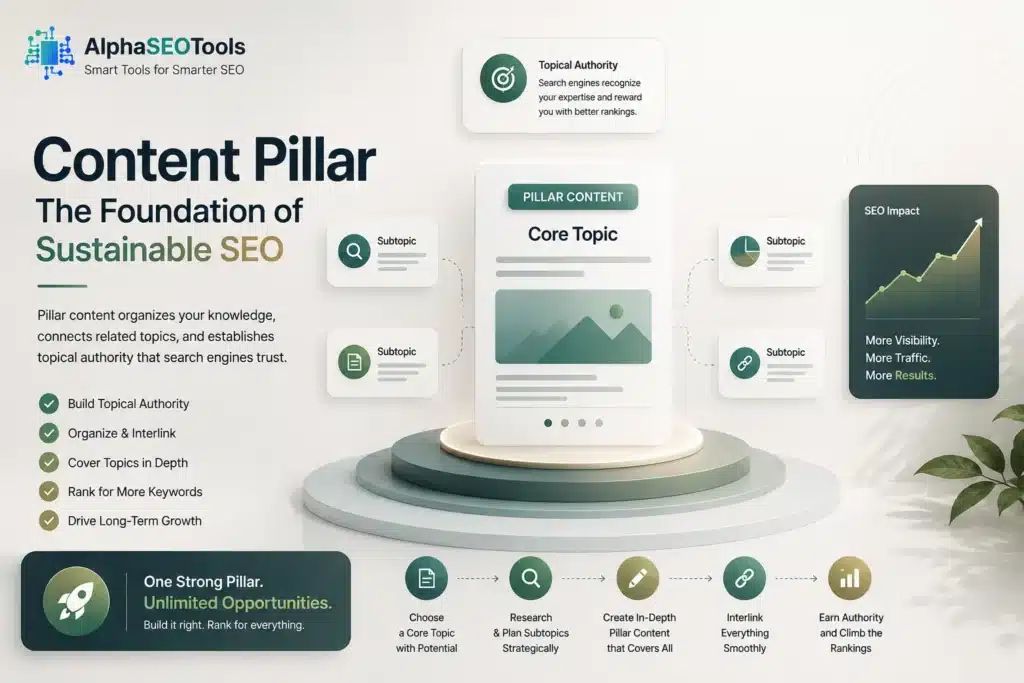
A content pillar is a comprehensive, evergreen piece of content that thoroughly covers a broad topic. It acts as the main hub for a topic cluster, linking out to multiple related, more detailed articles known as cluster pages or supporting content. This hub‑and‑spoke model forms the foundation of a modern SEO content strategy and is a central element of content marketing that values topical authority over isolated keywords.
Imagine a content pillar as the encyclopedia entry for a website. If a digital marketing site chooses “Digital Marketing” as its core subject, the pillar page might be titled “The Ultimate Guide to Digital Marketing.” That single page would then link to cluster articles on SEO, social media marketing, email marketing, PPC, content marketing, and analytics. Each cluster page links back to the main content pillar, creating a tight web of internal links that distributes link equity and sends powerful topical relevance signals to Google. This is the topic cluster model in action, and it is widely considered the most effective way to build search visibility for competitive terms.
There are many names for this concept. Cornerstone content, pillar page, hub page, evergreen guide, knowledge hub, and resource pillar all refer to the same idea. The label matters less than the execution: a content pillar must be the single best resource on a site for its given topic. It must be so thorough, well‑structured, and useful that search engines recognise it as an authority content piece worthy of top rankings.
A properly built content pillar is more than just long‑form writing. It features a clear content hierarchy with descriptive headings, a table of contents for easy navigation, and an internal linking structure that connects every subtopic seamlessly. It incorporates semantic SEO principles, using NLP keywords and related entities that Google’s algorithms expect to see for that subject. When maintained and updated regularly, a content pillar becomes an asset that consistently attracts organic traffic, earns backlinks, and educates the target audience for years.
Why Are Content Pillars Important?
Without a content pillar, a website’s content often lacks cohesion. Articles may rank for a short time and then disappear. With a well‑planned pillar page, the entire content ecosystem grows stronger with every new piece added. Here are the reasons content pillars are essential for any serious SEO and content marketing effort:
They Build Topical Authority
Search engines like Google have moved away from simple keyword matching. They now evaluate a site’s overall expertise on a subject. A content pillar surrounded by interlinked cluster pages demonstrates depth and breadth. This topical authority directly influences search rankings, helping not just the pillar but every connected page perform better in organic search. It signals to algorithms that the website is a comprehensive resource rather than a shallow page chasing a single phrase.
They Create a Superior Internal Linking Structure
The hub‑and‑spoke design of a content pillar naturally fosters a logical internal linking strategy. Every cluster page points back to the pillar, and the pillar links forward to each cluster. This improves crawlability, spreads link equity evenly, and eliminates orphan pages. Contextual links with descriptive anchor text help search engines understand the relationship between pages, boosting the topical relevance of the entire topic cluster.
They Enhance User Experience
Visitors do not want to jump between a dozen fragmented posts to understand a topic. A content pillar assembles everything in one place, with clear pathways to deeper dives. This reduces bounce rates, increases time on page, and builds trust. A well‑designed content hierarchy makes the site feel like a helpful knowledge base or resource center, not a cluttered blog.
They Improve Search Visibility Across Many Keywords
A pillar page that ranks for a broad term will often rank for hundreds of long‑tail variations. Because it covers multiple angles, it naturally includes semantic keywords and phrases that real people search for. When combined with supporting cluster pages, the site begins to own entire topic areas in the search results, capturing traffic at every stage of the customer journey.
They Simplify Content Planning
With a content pillar strategy, deciding what to write next becomes straightforward. The pillar topics act as the editorial north star, and cluster articles fill the identified gaps. This transforms a random editorial calendar into a focused content roadmap that systematically builds topical authority over time.
They Reinforce E‑E‑A‑T Signals
Google’s quality guidelines emphasise experience, expertise, authoritativeness, and trustworthiness. A thorough, well‑cited content pillar demonstrates all four. It proves the creator invested genuine effort to educate the audience, which builds brand authority and aligns with Google’s preference for helpful content. This is particularly crucial for sites affected by algorithm updates that prioritise user intent and content quality.
In summary, a content pillar is not just an SEO trick. It is a foundational element of a smart website architecture that serves both people and search engines. It turns a website into an information hub that grows more valuable with every new article.
Content Pillars vs. Topic Clusters vs. Cornerstone Content – What’s the Difference?
These terms are often used interchangeably, but each has a specific meaning within a content strategy. Understanding the distinctions ensures clear communication when discussing SEO architecture with a team.
- Content Pillar (or Pillar Page): This is the central, comprehensive guide itself—the main resource page. It covers a broad topic and links outward to related articles. The pillar page is the hub of the wheel.
- Topic Cluster: This is the entire group formed by the content pillar and all its linked cluster pages. The topic cluster is the strategy or model, not a single page. When a marketer says “we built a topic cluster,” they mean they created a pillar and several interlinked supporting pieces.
- Cornerstone Content: Often used synonymously with content pillar, but technically broader. Cornerstone content refers to any page that is fundamental to a website’s mission—pages that define the brand’s expertise. A pillar page is one type of cornerstone content. Other examples include a detailed “About Us” page or a core product hub.
- Hub Page (or Content Hub): Another name for a content pillar, especially when the page acts as an index or directory for a collection of resources. A knowledge hub or information hub serves the same purpose.
- Supporting Content / Cluster Content: These are the smaller, focused articles that link back to the pillar page. They target specific long‑tail keywords and answer narrow questions, contributing to the overall topical authority of the cluster.
- Content Silos: A similar concept where content is grouped into isolated categories with hierarchical linking. Topic clusters are often considered a more modern, flexible evolution of silos, emphasising contextual links over rigid directories.
The core idea is always the same: one powerful content pillar serves as the anchor, and everything else supports and links back to it. This website structure is the backbone of a successful SEO content framework.
How Do You Create Content Pillars? A Step‑by‑Step Framework

Building a content pillar is a structured process that blends content strategy, keyword research, and technical SEO. The following steps form a reliable content framework for creating pillar pages that drive real results.
Step 1: Define the Target Audience and Buyer Personas
A content pillar must answer the questions a specific audience is asking. The first step is to review buyer personas and understand the core problems, interests, and user intent behind the searches. What informational intent brings visitors to the site? What educational content would genuinely help them? This audience intent focus ensures the resulting pillar page resonates with readers and aligns with their search behavior.
Step 2: Perform a Content Audit and Identify Gaps
Before creating something new, it is essential to know what already exists. A thorough content audit catalogues all existing blog posts, guides, and resources. These are then grouped by theme. Often, natural clusters are already forming—just without a central hub. The audit reveals content gaps where deeper coverage is needed and where an overarching pillar page can unite scattered articles into a coherent content ecosystem.
Step 3: Conduct Keyword Research and Build a Topical Map
With the gaps identified, the next step is to choose a broad pillar topic and validate it with keyword research. The pillar should target a high‑volume term that encompasses the entire subject. But a single keyword is not enough. The strategist must also map out all related subtopics and long tail keywords. This is where keyword clustering and topic research come into play. Grouping related keywords into themes reveals the cluster articles that will support the pillar. The result is a topical map that guides both the pillar outline and the future editorial calendar.
Step 4: Design the Content Hierarchy and Outline
A strong content pillar requires a clear information architecture. The pillar outline must be exhaustive but logically structured. Typical sections include an introduction with a table of contents, deep dives into each major subtopic (each of which could become a standalone cluster article), real‑world examples and case studies, visual aids, and a conclusion with a call to action. Planning the heading hierarchy (H1, H2, H3) in advance ensures the page is scannable and pleasant to read.
Step 5: Write the Pillar Page as a Definitive Guide
Now the actual writing begins. The pillar page should be the best resource available on the web for that topic. While there is no universal word count, a useful content pillar often spans 3,000‑7,000 words depending on the subject. The writing must incorporate semantic keywords and related entities naturally—terms that Google’s NLP models expect to see. It must use internal links to cluster pages (even placeholders if those articles aren’t published yet) and include external links to authoritative sources to strengthen credibility. Each internal link should use relevant anchor text that describes the destination page, never generic phrases like “click here.” The tone remains friendly and educational, written in the third person to maintain an approachable but authoritative voice.
Step 6: Build the Topic Cluster
Once the pillar is live, the focus shifts to the supporting cluster content. Each cluster article dives deeply into one subtopic mentioned in the pillar, targeting a specific long tail keyword. These articles link back to the content pillar (and to other relevant cluster pages), reinforcing the internal linking structure. This interconnected web of contextual links passes link equity and solidifies the site’s topical authority. Even if some cluster pages are published months later, the pillar’s internal links can be updated to point to them retroactively.
Step 7: Optimise Technical SEO and User Experience
No content pillar is complete without attention to technical details. The page must load quickly, be fully responsive on mobile devices, and pass Core Web Vitals. Implementing breadcrumb navigation helps users and crawlers understand the page’s position within the overall website taxonomy. Adding a sticky table of contents improves navigation on long pages. Schema markup, such as Article schema, FAQ schema, and BreadcrumbList, provides search engines with explicit information architecture signals. These small technical improvements significantly enhance user experience and help Google index the content correctly.
Step 8: Promote, Monitor, and Update Regularly
A content pillar is a living asset. After publication, it should be shared across social channels, included in email newsletters, and pitched for backlinks from relevant industry sites. Its performance must be tracked using Google Search Console and SEO tools. Metrics such as organic traffic, keyword rankings, internal link click‑through rates, and time on page indicate whether the pillar is fulfilling its role. At least twice a year, the pillar should be refreshed with new data, updated examples, and additional links to new cluster content. An evergreen cornerstone page that is regularly maintained continues to earn search visibility and demonstrates freshness to search algorithms.
Following these eight steps transforms a scattered blog into a powerful content hub. The approach requires upfront effort, but the long‑term payoff in organic search and user engagement makes it one of the highest‑return investments in digital marketing.
Using AI to Develop Content Pillars
Artificial intelligence has become a valuable assistant in creating content pillars. It does not replace human expertise, but it dramatically speeds up research, ideation, and optimisation.
- Topic Research and Keyword Clustering: AI‑powered tools like Semrush’s Topic Research, Ahrefs, and MarketMuse analyse top‑ranking pages to suggest a complete topical map. They identify NLP keywords and semantic keywords that a human might overlook, ensuring the pillar covers every relevant angle required for topical authority.
- Content Ideation and Outlining: AI writers can generate a detailed, logically organised outline for a pillar page in seconds. A prompt such as “Create a content pillar outline for sustainable fashion” produces a structure that covers all necessary subtopics, which the strategist can then refine and expand.
- Drafting and Content Optimisation: While AI should not write the entire pillar unsupervised, it can assist with drafting introductions, summarising complex data, or suggesting phrasing that naturally includes related SEO terms. Tools like Jasper and Writer help keep the content both engaging and SEO content optimised.
- Internal Linking Suggestions: AI‑driven internal linking plugins scan a website and recommend where to add links from existing pages to the new content pillar. This saves hours of manual work and ensures link equity flows properly through the content ecosystem.
The key to using AI effectively is to treat it as a creative partner. The final pillar page must always carry the brand’s unique voice, original insights, and authentic expertise. AI simply removes the busywork, allowing strategists to focus on the content strategy and quality that search engines like Google reward.
5 Powerful Content Pillar Examples from Leading Brands
Seeing how successful brands use content pillars provides inspiration and practical lessons. The following examples demonstrate different approaches, each unified by a commitment to depth, organisation, and user value.
1. Patagonia – “Our Footprint”
Patagonia’s environmental responsibility hub is a content pillar that feels like a mission statement rather than traditional marketing. It exhaustively covers the company’s supply chain, material choices, and activism efforts. This cornerstone content builds immense brand authority and trust. The hub links to detailed reports, stories, and action initiatives, forming a perfect topic cluster around sustainability.
2. Dove – “The Dove Self‑Esteem Project”
Dove’s content hub is a pillar centred on body confidence and self‑esteem education. It houses research findings, downloadable educational resources, and powerful real‑life stories. By focusing relentlessly on a single mission, Dove creates deep topical authority and an emotional connection with its audience. The internal linking to partner organisations and in‑depth guides makes it a model of purpose‑driven pillar page design.
3. Canva – Design School
Canva’s Design School is a vast knowledge hub packed with tutorials, design courses, and inspiration. The “Design School” homepage acts as the ultimate content pillar, linking to smaller topic pillars like “Graphic Design Basics” and “Branding Fundamentals.” This layered content ecosystem drives millions of organic visits and establishes Canva as an educational authority in the design space.
4. Headspace – “Science of Meditation”
Headspace doesn’t simply ask users to meditate; it provides the scientific backing through a dedicated pillar page. This resource covers the benefits of meditation, links to peer‑reviewed studies, and offers expert‑backed articles. The result is a resource pillar that builds trustworthiness and topical authority, aligning directly with Google’s E‑E‑A‑T expectations.
5. HubSpot – “The Ultimate Guide to AI in Marketing”
HubSpot’s long‑form content pillars are legendary in the SEO world. Their AI marketing guide covers every angle, from tools to strategy, in a single, well‑structured page. It links to dozens of supporting articles, covering the topic with such depth that it ranks for thousands of keywords. This is content pillar mastery: exhaustive coverage, clear navigation, and sustained organic traffic.
These examples prove that a content pillar can take many forms—a report, a multimedia hub, or an educational guide. The consistent elements are exhaustive coverage, a logical content structure, and a focus on delivering genuine value.
Content Pillars for Social Media: A Brief Distinction
In social media strategy, the phrase “content pillars” often refers to the core content themes that guide daily posting. A fitness brand might use pillars like “Workout Tips,” “Nutrition,” and “Motivation.” While this concept shares the idea of a foundational framework, it is distinct from the SEO pillar page. Social media pillars keep a brand’s feed consistent, but they don’t involve internal linking or a central hub page. The principles of consistency and audience focus overlap, but the implementation is separate. For a website, a content pillar remains an in‑depth, interlinked page that builds topical authority over time.
How to Organise Content Pillars: A Practical Framework
Organising content pillars means designing the entire content hierarchy so that it is intuitive for users and clear to search engines. Here’s a numbered framework to bring order to any site’s information architecture:
- Select 3‑5 core pillar topics that define the brand’s expertise. These become the main hub pages.
- Map out the subtopic clusters for each pillar using a mind‑mapping tool or spreadsheet. List every question and keyword variation.
- Audit existing content to see which existing articles fit under each pillar. Identify what can be updated and what must be created anew.
- Plan the internal linking strategy before writing begins. Decide exactly how cluster pages will link to the pillar and to each other.
- Create a content calendar that prioritises publishing pillars first, then systematically rolls out cluster content.
- Review and refresh the pillars quarterly. A cornerstone page is never finished; it evolves alongside the industry and audience needs.
This content framework turns a disorganised blog into a knowledge hub that Google can crawl and understand with ease, while users enjoy a seamless browsing experience.
Common Content Pillar Mistakes and How to Avoid Them
Even experienced teams can stumble when building content pillars. These are the most frequent pitfalls:
- Choosing a pillar topic that is too narrow. A topic that can be fully explained in 1,500 words does not make a good pillar. The subject must be broad enough to support at least 10‑15 cluster articles. A pillar page that is really just a long blog post won’t function as a true content hub.
- Writing a pillar without a linking strategy. A pillar without internal links to and from cluster pages is just an isolated long article. Internal linking is the glue that holds the topic cluster together. Every cluster page must include a contextual link back to the pillar using appropriate anchor text.
- Ignoring search intent. The pillar page must align with the primary informational intent of the target keyword. If users searching the pillar topic expect a quick definition, a 7,000‑word guide may not satisfy their need. Understanding search behavior before writing ensures the content format matches user intent.
- Publishing and abandoning. An outdated pillar page loses rankings. A regular review schedule—at least twice a year—keeps statistics, examples, and internal links fresh. This demonstrates to Google that the site maintains its evergreen content responsibly.
- Neglecting design and readability. A dense wall of text hurts user experience. Short paragraphs, clear headings, lists, images, and a table of contents make the pillar inviting. A pillar page should be a pleasure to navigate, not an endurance test.
- Failing to promote the pillar. A content pillar needs an initial push through email, social media, and backlink outreach to gain traction. Early traffic and engagement signal quality to search engines.
By avoiding these errors, a content pillar strategy becomes a reliable engine for organic traffic growth and authority building.
Frequently Asked Questions About Content Pillars
What is the content pillar?
A content pillar is a comprehensive, evergreen resource that covers a broad topic in depth and links to multiple related articles. It serves as the central hub of a topic cluster, building topical authority and improving SEO.
What are the five pillars of content?
In a content strategy, the “five pillars” usually refer to the five core topic areas that define a brand’s expertise. For a digital marketing agency, these might be SEO, Content Marketing, Social Media, PPC, and Analytics. Each becomes a pillar page on the website.
Can you give me an example of a content pillar?
HubSpot’s “Ultimate Guide to Social Media Marketing” is a classic content pillar. It covers everything from strategy to platform tips and links to dozens of deeper guides on individual subtopics. It ranks for thousands of keywords as a single, definitive resource.
How do I find my content pillars?
Finding content pillars starts with understanding the audience’s core problems. Then, perform keyword research to identify broad topics with strong search volume. Audit existing content to spot natural groupings. The intersection of audience need, brand expertise, and search opportunity defines the pillars. A content mapping exercise can crystallise these.
What is another name for content pillars?
Other names include cornerstone content, pillar page, hub page, evergreen guide, knowledge hub, and resource pillar. All refer to a central, authoritative piece of content that anchors a topic cluster.
What is the difference between content pillars and content types?
Content pillars are the overarching topics (e.g., “SEO”). Content types are the formats used to cover those topics (e.g., blog posts, videos, infographics). A single pillar can be supported by multiple content types.
How to organize content pillars?
Start with a content audit, group related articles into clusters, and define a central pillar page for each group. Create a visual website taxonomy showing how everything connects, then build internal links systematically. This transforms a chaotic blog into a logical content architecture.
Measuring the Success of a Content Pillar Strategy
To know whether a content pillar is performing, track these metrics consistently:
- Organic traffic to the pillar page and its cluster pages. Steady growth indicates increasing search visibility.
- Keyword rankings for the pillar’s primary term and the long‑tail variations it captures.
- Number of indexed pages within the topic cluster, reflecting expanding topical coverage.
- Internal link click‑through rates from pillar to cluster pages, validating the content hierarchy.
- Bounce rate and average time on page, which signal whether the pillar content truly engages readers.
- Backlinks earned by the pillar, a measure of its perceived value as an authority content piece.
- Leads or conversions attributed to visits that started on the pillar page.
Monthly reviews of these metrics help refine the content roadmap and ensure the strategy continues to deliver compounding returns.
Conclusion: Your Content Pillar Is a Legacy Asset
A content pillar is far more than an SEO tactic. It is a long‑term investment in a website’s authority, structure, and user experience. In an era where AI‑generated content is widespread, the sites that stand out are the ones that offer genuine depth, clear organisation, and trustworthy expertise. That is precisely what a well‑crafted pillar page provides.
Every marketer now has the blueprint: understand the audience, audit existing content, map out a topic cluster, write the definitive guide, and connect everything with strategic internal links. When executed correctly, a content pillar transforms a random collection of blog posts into a powerful content ecosystem. It builds topical authority, captures organic traffic, and earns the kind of brand trust that no quick‑fix SEO trick can replicate.
The work starts with one pillar. Choose a broad topic that matters. Build the hub. Then, systematically expand the cluster. Over time, the website will become a knowledge hub that search engines reward and users return to. A content pillar does not just bring visitors—it builds a moat of authority around the brand.