
Table of Contents
The Glance On the Content Decay In SEO: AI Summary
Content decay in SEO is the silent, steady decline in organic traffic and rankings that afflicts once‑successful pages. It’s driven by outdated information, shifting search intent, and competitor gains—not penalties. This guide reveals how to spot decay early, execute surgical refreshes, prune what’s beyond saving, and build a living content library that resists decline in both traditional and AI‑driven search.
Introduction: The Vanishing Act No One Talks About
A blog post that once drew thousands of readers each month can slowly fade from the SERPs without a single warning. No manual action, no core update announcement—just a quiet, relentless decline in clicks. Marketers call this phenomenon content decay in SEO, and it’s one of the most pervasive yet under‑discussed threats to organic growth. While teams obsess over new content creation, existing assets bleed traffic in the background, draining authority and revenue.
Understanding content decay in SEO starts with a simple truth: a web page is not a museum piece. The information it contains ages, the expectations of searchers shift, and competitors are constantly raising the bar. A resource that was considered the gold standard two years ago may now look thin, outdated, or irrelevant. The good news is that content decay in SEO is predictable, detectable, and reversible—if you have the right systems in place.
This guide moves beyond generic advice to provide a complete diagnostic and recovery framework. From uncovering the hidden triggers of decay to executing transformative refreshes and building AI‑ready defenses, every section is packed with actionable insights. Whether you manage a small blog or a sprawling enterprise content operation, you’ll learn how to turn content decay in SEO from a silent killer into a manageable, strategic advantage.
The Anatomy of a Quiet Decline: What Content Decay in SEO Actually Means
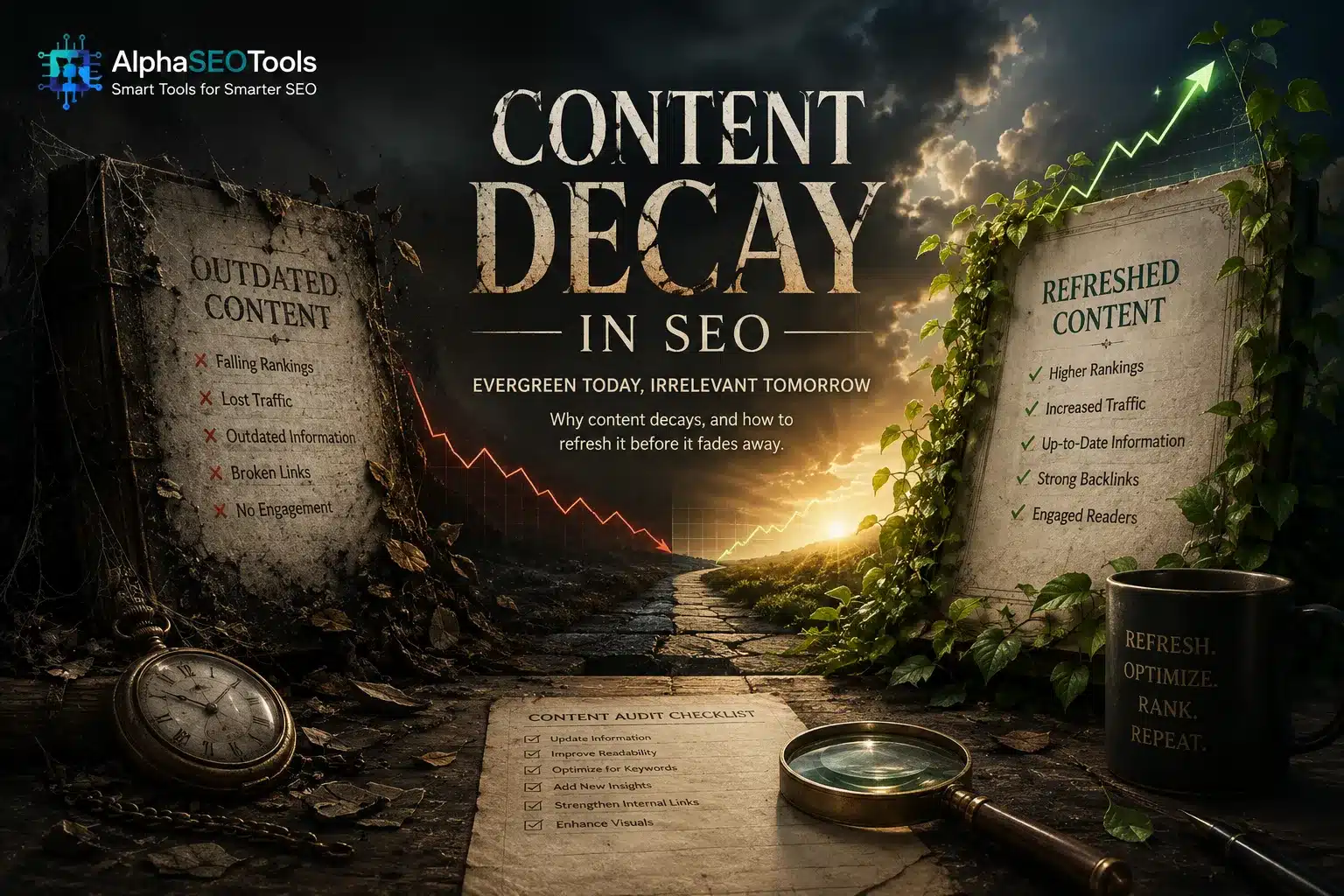
Content decay in SEO is the progressive erosion of a page’s ability to attract organic search traffic over time. Unlike the sudden jolt of an algorithm update, decay is a slow bleed—impressions and clicks trend downward across weeks and months, often unnoticed until a quarterly report reveals a significant loss. The page still exists, is still indexed, but its relevance has waned.
This decline is rooted in a widening gap between what the page delivers and what Google now deems the best response to a given query. The content may have been thoroughly researched at publication, but the world moved on. Statistics became stale, examples grew irrelevant, and competitors published richer alternatives. Content decay in SEO is not a punishment; it is a reflection of the search engine’s mandate to surface the most useful, accurate, and timely information.
Crucially, content decay in SEO operates at the page level while the rest of the site may remain healthy. This granularity is what makes it easy to overlook. A domain’s overall traffic can appear stable even as individual pages are hemorrhaging visits, because new content masks the losses. A disciplined monitoring approach is the only way to catch this hidden erosion early.
Why Your Best Pages Are Losing Ground: The Forces Behind Content Decay in SEO
Rarely does a single issue cause content decay in SEO. Instead, a web of interconnected factors conspires to push a page down the rankings. Pinpointing these forces is the first step toward reversing them.
| Decay Driver | What Happens Behind the Scenes | Real‑World Example |
| Information Obsolescence | Data, tools, and references age out. Google’s freshness systems demote pages that appear abandoned. | A 2021 guide citing “Clubhouse is the future of social audio” loses relevance as the platform fades. |
| Intent Drift | The meaning of a keyword shifts. Users now want video tutorials, not text guides, or their questions have evolved. | “Remote work tips” once meant setting up a home office; now it implies AI‑powered productivity hacks. |
| Competitive Overhaul | Rivals invest in deeper, more visually engaging content clusters that reset the quality threshold. | A page once ranking #3 for “email marketing strategy” falls to #12 after three competitors publish pillar‑and‑cluster ecosystems. |
| Technical Neglect | Orphan pages, broken internal links, or canonicalization errors starve the page of link equity and crawl attention. | A high‑value guide becomes orphaned after a site restructure, losing all internal link support. |
| Authority Dilution | Backlinks decay as referring pages die or lose their own authority, while no new links are earned. | A page with 15 old .edu links sees them dwindle to 5, cutting its domain‑level authority signal. |
These forces rarely operate in isolation. A page that is technically healthy but informationally stale will still suffer from content decay in SEO. Conversely, a well‑maintained article that becomes orphaned will lose visibility regardless of its quality. The solution requires a holistic approach that addresses content, links, and technical SEO simultaneously.
Detecting Decay Before It Becomes a Crisis: A Diagnostic Protocol for Content Decay in SEO
Waiting until a page has lost 70% of its traffic is a recipe for expensive, reactive fixes. A proactive diagnostic process surfaces decay early, when a light refresh can restore performance. Follow this numbered workflow to identify and assess content decay in SEO across any site:
- Map the Traffic Landscape: In Google Search Console or a trusted analytics platform, pull a 16‑month comparison for all indexed URLs. Flag pages with a consistent downward trend in clicks and impressions that cannot be explained by seasonality. Export the list of “declining URLs.”
- Isolate Keyword‑Level Losses: For each flagged page, drill into the query report. Identify which specific search terms lost the most clicks. This reveals whether the decay is due to a drop in rankings for the primary keyword, a collapse in long‑tail traffic, or both.
- Confirm Indexation Integrity: Use the URL Inspection tool to verify the page is live, indexed, and free of noindex tags, canonical chain issues, or crawl blocks. A sudden decay caused by technical issues will usually show a sharp cliff, not a gradual slope.
- Evaluate the Freshness Factor: Manually review the page. Are statistics older than two years? Are screenshots from a deprecated UI? Have the core assumptions of the article been invalidated by industry changes? Grade the page on a freshness scale.
- Benchmark Against the New Top Competitors: For the page’s primary target query, examine the top three ranking URLs today. Compare their depth, structure, multimedia usage, and publication dates. If they have clearly surpassed your page, the decay is competitive.
- Map the Link and Authority Profile: Audit internal links: how many contextual links point to the page, and from where? Check the backlink profile for lost referring domains. An orphan page with dwindling backlinks is doubly vulnerable.
- Uncover Cannibalization: Search for your own domain alongside the primary keyword. Are multiple URLs from your site competing for the same intent? If so, they are likely cannibalizing each other, and all are experiencing content decay in SEO as a group.
This diagnostic protocol turns content decay in SEO from an abstract worry into a measurable, actionable pipeline. The output is a prioritized list of pages with a clear diagnosis for each, enabling a targeted recovery plan.
The Revival Playbook: Breathing New Life Into Content That’s Losing Traction
Once decaying pages are identified and diagnosed, the most impactful response is a strategic content refresh. But not all refreshes are equal. A surface‑level date change fools no one; a meaningful overhaul that addresses the root causes of content decay in SEO is what moves the needle.
The following refresh actions are organized by impact, so you can prioritize based on the severity of the decay.
Structural and Depth Enhancements
- Expand the page to cover subtopics that competitors now address but your article misses. This closes the topical coverage gap.
- Add new sections like FAQs, expert commentary, or mini case studies that increase comprehensiveness and target question‑based queries.
- Reorganize the content flow to match the user’s journey, improving readability and dwell time.
Freshness and Accuracy Overhauls
- Replace every outdated statistic with current data, citing the source and year. This directly addresses Google’s “query deserves freshness” signals.
- Swap obsolete examples, tools, and screenshots for versions that reflect today’s reality.
- Update the title tag and meta description to better reflect the refreshed content and improve click‑through rate.
Media and Engagement Upgrades
- Incorporate custom graphics, infographics, or short explainer videos that make complex points digestible and increase time on page.
- Add a table of contents with jump links for long‑form pages, which can appear as sitelinks in search results.
- Embed interactive elements like free calculators, checklists, or quizzes where appropriate, signaling a rich user experience.
Authority and Linking Reinforcement
- Strengthen internal links by adding contextual links from relevant, high‑authority pages on your site to the refreshed piece.
- Earn new backlinks through outreach, highlighting the updated resource as a definitive guide that others should reference.
- Fix broken outbound links and ensure any external sources are credible and current.
After executing the refresh, monitor the page’s performance in Google Search Console. Look for a gradual upward trend in clicks and impressions over the next four to eight weeks. If the decline was primarily freshness‑driven, recovery can be relatively swift. If competitive factors dominate, sustained effort to build authority will be required.
The Art of Letting Go: Strategic Pruning to Halt Content Decay in SEO
Not every page deserves a refresh. Some content has decayed beyond recovery, either because the topic is no longer relevant to the audience or because the page was never strong enough to compete. In these cases, content pruning is the healthier choice for the overall site.
Content pruning for content decay in SEO involves removing, redirecting, or consolidating pages that are dragging down site quality. A bloated index filled with thin, outdated content confuses search engine crawlers and wastes crawl budget. By eliminating the weakest links, you concentrate authority on the pages that matter.
The pruning decision tree is straightforward:
- Zero or near‑zero organic traffic for 12+ months: Strong candidate for removal or redirection.
- No meaningful backlinks and few internal links: The page is not carrying authority; it’s safe to prune.
- Topic no longer aligns with your current content strategy: Redirect to a more relevant page if logical, otherwise remove.
- Overlap with other, better‑performing pages: Consolidate into a single comprehensive resource and redirect the weaker URLs.
When redirecting, always use a 301 (permanent) redirect to a topically relevant destination. This passes the bulk of link equity and provides a good user experience. For pages with no clear redirect target, a 410 (Gone) status code signals deliberate removal. After pruning, update your XML sitemap and remove internal links to the removed pages.
Pruning reverses content decay in SEO at the site level. It raises the average quality bar, improves crawl efficiency, and ensures your most valuable pages receive the internal link equity they deserve.
The Second Launch: Republishing and Repromoting for Maximum Impact
A page that has undergone a substantial refresh to combat content decay in SEO is essentially a new asset. It deserves a launch strategy similar to what you’d give a freshly published piece. Republishing and active promotion amplify the impact of your editorial work.
Republishing involves updating the publication date (only after significant, meaningful changes) and treating the page as “new” in your editorial calendar. This signals to both users and Google that the content has been meaningfully improved. However, it must be earned: a trivial change followed by a date update can backfire, as Google’s systems detect shallow updates.
Promotion tactics for a refreshed page include:
- Featuring it prominently in your email newsletter with a clear “just updated for [year]” angle.
- Sharing it across social channels, tagging relevant experts or brands mentioned in the update.
- Conduct outreach to sites that are linked to the old version, letting them know the resource has been improved.
- Adding the page to your site’s “featured resources” section or sidebar for an internal traffic boost.
This repromotion phase is where many teams drop the ball. After investing hours in a refresh, a lack of distribution leaves the page to climb back on its own. The initial surge of traffic and engagement from promotion acts as a powerful freshness and relevance signal, accelerating recovery from content decay in SEO.
The Technical Backbone: How Site Health Prevents Content Decay in SEO
Even the most brilliantly refreshed page will underperform if technical issues undermine it. Content decay in SEO often has a silent technical accomplice—a broken canonical tag, slow loading speed, or poor mobile experience that drags the page down despite high‑quality content.
A technical health checklist for combating content decay in SEO should cover:
- Indexation verification: Ensure the page is not inadvertently blocked by noindex tags, robots.txt disallow rules, or faulty canonicalization. Use URL Inspection for a live diagnosis.
- Structured data implementation: Apply Article schema, and add FAQ or HowTo schema where content warrants it. Rich results increase SERP real estate and can offset some traffic loss.
- Internal link health: Run an internal link audit to detect orphan status or weak link depth. Add contextual links from high‑performing related pages to funnel authority.
- Core Web Vitals optimization: Audit page speed, interactivity, and visual stability. Slow pages suffer in both rankings and user engagement, accelerating decay.
- Mobile usability: Confirm the page is fully responsive and easy to navigate on smartphones. Google’s mobile‑first indexing makes this non‑negotiable.
- Broken resource cleanup: Fix or replace broken images, broken outbound links, and missing assets that degrade user experience.
By treating technical SEO as part of the content maintenance cycle, you ensure that editorial improvements have a clean runway to perform. A technically sound page is the foundation upon which all other content decay in SEO defenses are built.
Preparing for the AI‑Search Era: Future‑Proofing Content Against New Waves of Decay
The definition of content decay in SEO is expanding. Traditional ranking declines are now joined by a new threat: invisibility in AI‑generated answers, voice search results, and large language model citations. A page that ranks well in the classic “ten blue links” may still lose substantial traffic if it fails to appear in the AI Overview or ChatGPT’s suggestions.
Future‑proofing your content involves optimizing for both answer engine optimization (AEO) and generative engine optimization (GEO). Key strategies include:
- Entity‑rich writing: Clearly define and connect entities (people, tools, concepts, brands) within your content. AI models reference pages that demonstrate clear entity understanding.
- FAQ‑driven structure: Anticipate and answer specific, conversational questions. Mark these up with FAQ schema to capture voice queries and People Also Ask features.
- Comprehensive, grounded depth: AI models favor content that covers topics exhaustively, provides original insights, and cites credible sources. Thin content is invisible to them.
- Monitoring AI visibility: Use emerging tools to track whether your content appears in AI‑generated responses. Adjust underperforming pages by adding more structured, entity‑focused information.
- Semantic expansion: Regularly update pages to include related concepts and semantic keywords that reflect the full breadth of a topic, as understood by modern NLP systems.
Content decay in SEO in the AI era is not just about losing your blue‑link spot. It’s about disappearing from the new surfaces where users are getting their answers. By building AI‑aware content from the start, you create resilience that transcends any single algorithm.

Building a Self‑Healing Content Library: Maintenance Rhythms That Prevent Decay
The ultimate defense against content decay in SEO is a proactive maintenance culture. Instead of scrambling to fix pages after traffic plummets, high‑performing teams embed ongoing content health checks into their operations. This turns content from a static library into a living portfolio that evolves with the market.
A sustainable maintenance rhythm can look like this:
- Monthly: Review Google Search Console for any pages showing early signs of declining clicks. Flag them for a quick audit.
- Quarterly: Conduct a more comprehensive content audit that evaluates freshness, keyword rankings, internal link status, and competitive positioning for all high‑priority pages.
- Annually: Perform a full‑scale refresh on every core content asset, updating statistics, examples, and structure. Treat this as an editorial renewal.
- Trigger‑based: When a major industry shift occurs, immediately audit related content for relevance. For example, a new AI tool launch warrants a review of any article mentioning “best AI tools.”
Documenting all changes in a content inventory ensures institutional knowledge isn’t lost. A simple spreadsheet tracking last‑updated dates, refresh notes, and performance trends makes future updates faster and more targeted.
This maintenance mindset not only prevents content decay in SEO but also improves the overall quality and authority of the site. Search engines reward living, breathing content ecosystems far more than stagnant archives.
Frequently Asked Questions About Content Decay in SEO
What is content decay in SEO?
Content decay in SEO is the gradual loss of organic search traffic and rankings for a page that previously performed well, caused by factors like outdated information, evolving search intent, and competitive pressure.
How is content decay different from an algorithm update impact?
An algorithm update usually causes a sudden drop at a known point in time, while content decay in SEO is a slow, progressive decline visible over months.
What are the earliest warning signs of content decay in SEO?
A steady decline in clicks and impressions for a specific page in Google Search Console, falling average position for target keywords, and a drop in click‑through rate are all early indicators.
Can every decaying page be saved?
No. Thin, obsolete pages with no backlinks or strategic value are often better pruned or consolidated. The decision should be data‑driven.
How often should content be refreshed to prevent decay?
A quarterly audit and an annual deep refresh for core pages are strong practices. High‑impact pages may need more frequent updates based on industry pace.
Does changing the publication date alone help?
Only if the page has undergone substantial, meaningful improvements. A superficial date change without real value addition is ineffective and can be seen as manipulative.
What role does internal linking play in fighting content decay in SEO?
Internal links distribute authority, prevent orphan status, and help search engines discover and value the page. Strengthening internal links is one of the fastest wins in a refresh.
How does AI search affect content decay?
Pages that are not optimized for AI citations—lacking entity clarity, FAQ structure, or comprehensive depth—risk losing visibility even if traditional rankings hold. AI optimization is now part of the decay‑prevention toolkit.
Conclusion: From Decay to Durability
Content decay in SEO is not a flaw in your content—it’s a sign that the web is alive and evolving. The challenge is not to eliminate decay entirely, but to build a system where it’s detected early, addressed strategically, and prevented where possible. That system is a blend of routine audits, courageous pruning, deep refreshes, and AI‑aware optimization.
The most successful content operations are those that treat their libraries as gardens, not monuments. They pull the weeds, nourish the strong plants, and aren’t afraid to replant when something has run its course. Content decay in SEO will always be a factor, but it doesn’t have to be a crisis. With the framework in this guide, you have everything you need to turn quiet decline into sustained growth.
Start the next audit today. Find the pages that are slipping. Refresh what matters, prune what doesn’t, and build a content engine that ages gracefully, ranks consistently, and stays visible across every search surface that matters.